Industrial Cabinet Latches: Handle Styles, Security Grades, and Enclosure Match
In 15 years of manufacturing industrial locks, ForndLock has reviewed thousands of cabinet latch specifications. Two errors recur most often: buyers pick a handle style because it looks right on the drawing, and buyers pay for keyed security where a tool-operated latch would serve better. A cabinet latch is a matching problem between three variables — the hand that opens it, the access grade behind it, and the enclosure it closes. When those align, the latch outlasts the cabinet.
Three Questions Before You Pick a Cabinet Latch
Answer three application questions first; they eliminate more than half of the catalog.
1. How often will the door be opened?
Cycle frequency decides the handle, not the lock body. A door opened a few times a week tolerates a small quarter-turn knob; a door opened dozens of times per shift needs a lever that multiplies torque and works with gloves. On high-cycle doors, ask for cycle-life data — a weakened return spring becomes a rattling door.
2. Who is allowed to open it — and with what?
Industrial access falls into three operational tiers:
● Tools (triangle, square, or double-bit keys): Fast, low-cost convenience access for maintenance crews.
● Keyed Cylinders: Restricted access for registered key holders.
● External Padlocks: Shared access compliance for Lockout/Tagout (LOTO) safety protocols.
A tool key is fast and cheap but a convenience, not a barrier; a cylinder restricts access to key holders; a padlock hands control to whoever manages it — hence its dominance in lockout/tagout programs.
3. Where does the enclosure live?
Environment filters both material and mechanism. Dry indoor rooms accept zinc alloy and chrome; outdoor cabinets need a sealed body, an IP65 minimum rating per IEC 60529, and often a compression stroke to hold gasket tension; washdown and coastal sites move you to 304 or 316 stainless; mobile equipment demands an anti-loosening detent so the latch cannot rotate itself open.
Cabinet Latch Types by Handle Style
The handle is the torque interface between operator and cam, and lever physics governs it: the same hand force on a 60 mm T-handle produces roughly three times the turning force of a 20 mm knob. Handle style also controls corridor protrusion, gloved grip and padlock acceptance.
Wing Knob Latches
A hand-turned quarter-turn latch with two small wings for grip; spring-returned versions fold back after release. Wing knobs suit frequent-access indoor cabinets where security is secondary. Their compact rotation turns the latch tongue 90° to capture the frame edge and maintain light gasket tension during closure.
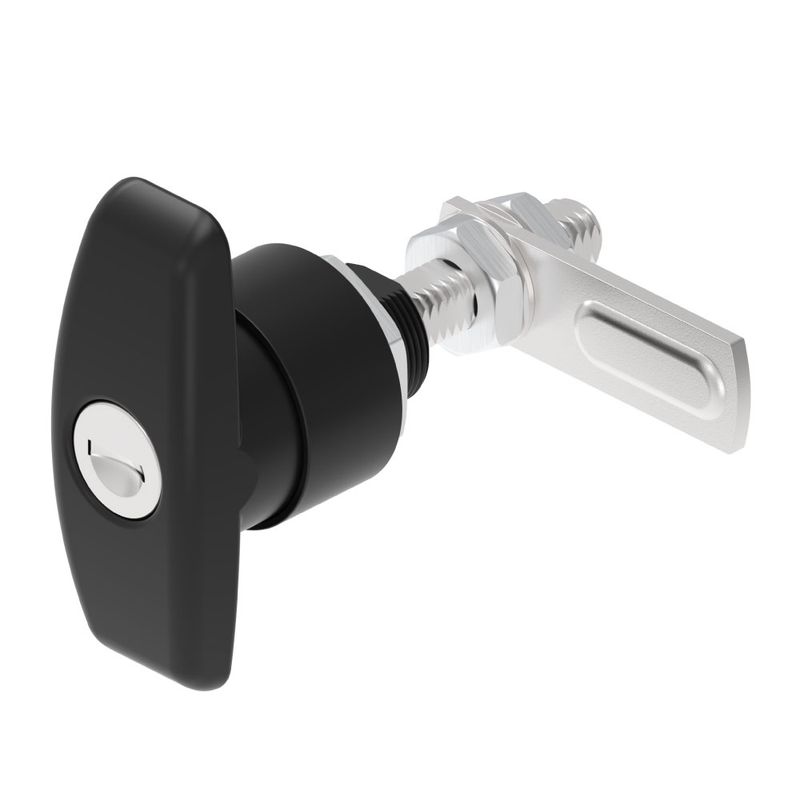
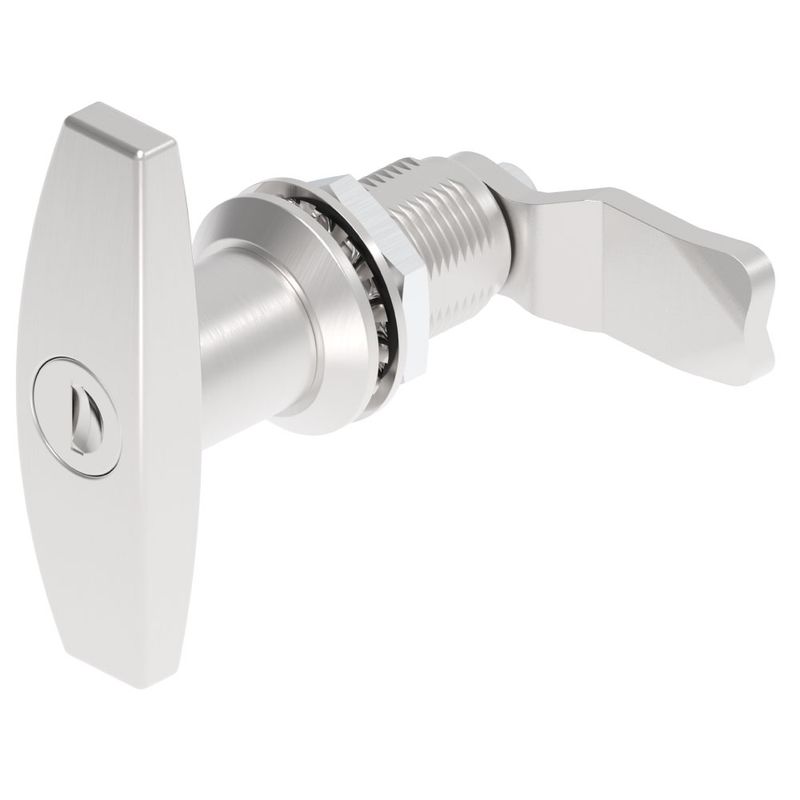
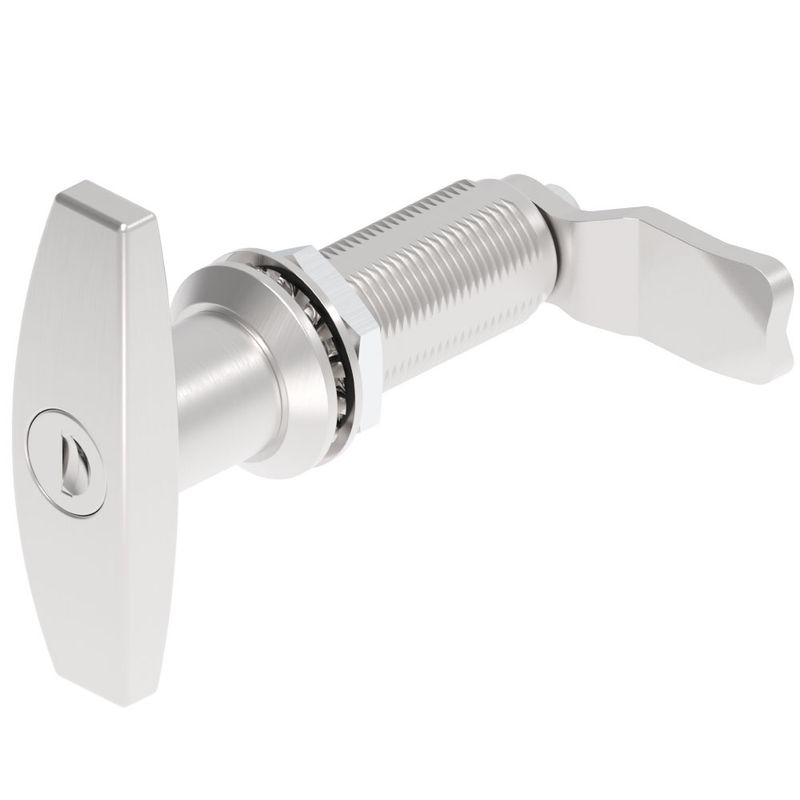
T-Handle Latches
A crossbar grip a gloved hand can catch in one motion, featuring a square shaft output at the rear that drives the lock tongue, locking rods, or multi-point linkages on taller doors. This high-torque structure is the standard specification for vehicle compartments, generator canopies, and heavy outdoor equipment covers.
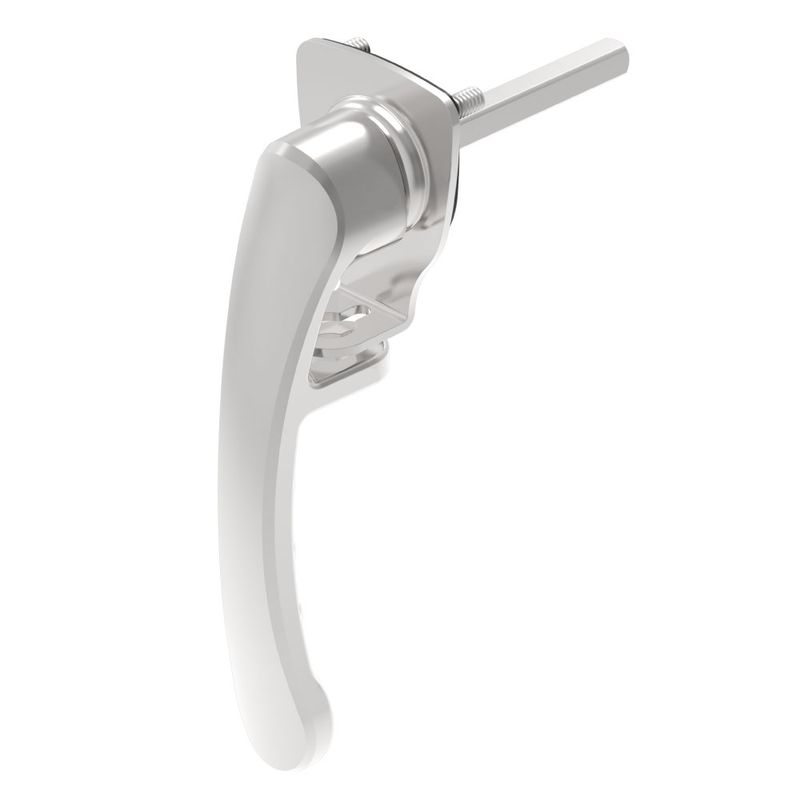
L-Handle Latches
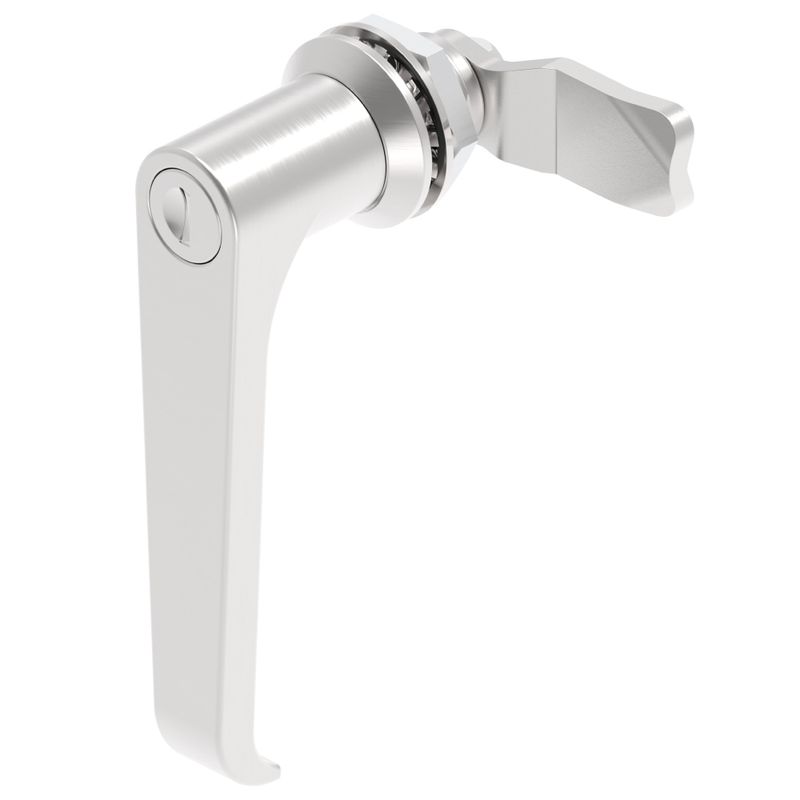
A single-lever grip that folds flatter than a T-handle while providing substantial leverage for smooth operation. Many designs incorporate a padlock hole in the handle base, allowing a single latch structure to cover daily routine access as well as controlled lockout protocols on electrical distribution panels and machinery doors.
Flush Push and Paddle Latches
A recessed paddle that releases the catch mechanism with a press or pull, sitting virtually flush with the panel face when closed. By eliminating exterior protrusions that could snag clothing or passing equipment, these latches are the default choice for narrow corridors, RV baggage doors, washdown areas, and machine guards.
Padlockable Latches
A knob- or key-operated latch configured with an integrated hasp for an external padlock, providing physical access control when multiple parties share cabinet responsibility or when safety lockout programs are required. Specifying optional protective hasp covers prevents dangling padlock hardware from damaging painted surfaces under wind and vibration.
ForndLock manufactures these core handle styles to match your door geometry, operator ergonomics, and mounting space. Below is a quick selection matrix.
Handle Style | ForndLock Reference | Image | How It Operates | Best For | Watch Out For |
Wing knob |
 | 90° hand turn; drives cam to rotate and compress gasket | Frequent-access indoor cabinets and control panels | Lowest security grade; wing knob can snag clothing | |
T-handle |
 | Crossbar grip; rear square shaft drives lock tongue or rods | Vehicle compartments, generator doors, gloved operation | Protrudes outside panel; requires swing clearance | |
L-handle |
 | 90° single-lever turn; optional base padlock hole | Electrical enclosures, distribution cabinets, shared access | Requires larger panel mounting area than wing knobs |
Security and Access Grades
An honest framing first: a cabinet latch is an access-control device, not a theft-proof barrier. Most quarter-turn cylinders resist casual tampering but not a determined attacker. The goal is controlling who opens the cabinet under normal conditions; door structure, hinges and strike handle forced entry. Match the grade to the scenario instead of buying the highest security available.
Access Grade | Who Can Open It | Security Level | Best For | Watch Out For |
Tool-operated (triangle / square / insert key) | Anyone carrying the standard tool | Deterrent | Telecom cabinets, utility panels, fleet maintenance | The tool is widely available; treat as convenience access |
Keyed cylinder (keyed alike or keyed to differ) | Registered key holders | Moderate | Restricted cabinets, tenant panels, kiosks | Key management at scale; record key codes at delivery |
Padlockable hasp | Whoever controls the padlock | Highest of the three | Shared equipment, hazardous-energy LOTO, remote sites | Weather and impact exposure; add hasp covers outdoors |

Tool-operated latches dominate fleet maintenance because one driver bit opens every cabinet on a site. Keyed alike versus keyed to differ should be decided at order time — master-keyed schemes are nearly impossible to retrofit. Padlockable latches add the only grade that supports LOTO, because the padlock itself becomes the lockout device.
Two mechanical behaviors sit underneath every grade. Anti-loosening: on vibrating equipment, specify a detent or spring-loaded return that physically resists rotation — ForndLock's 3000-10 Vertical Drive Rotary Lock, rated to 3,300 N, and the 3001-10 at 2,600 N are built for this duty on vehicle doors. Anti-accidental-opening: near walkways a protruding handle is a snag and accidental-release risk, so flush or folding styles are the safety choice.
Materials and Finishes at a Glance
Match latch body materials and surface finishes to environmental exposure rather than abstract strength. Component selection directly determines corrosion resistance, aesthetic life, and operational noise across industrial environments.
● Zinc Alloy: Economical baseline for indoor cabinets with moderate mechanical loads.
● 304 Stainless Steel: Standard choice for outdoor rain, humidity, and general weathering.
● 316 Stainless Steel: Molybdenum-alloyed grade essential for resisting coastal salt spray and washdown chemicals.
● Glass-Filled Nylon (PA66+30%GF): Lightweight, electrically insulated option for quiet, high-frequency operation.
Finish options range from black powder coating for electrical boxes to electropolished stainless for hygienic zones. Always request certified ASTM B117 salt-spray reports with verified test conditions.
Matching the Latch to Common Enclosure Types
Application boundaries teach faster than mechanism theory. The matrix below mirrors how ForndLock engineers map latch requirements in drawing reviews.
Enclosure Type | What the Latch Must Survive | Recommended Style & Grade | ForndLock Fit |
Electrical cabinets & control panels | Dust, occasional impact, frequent technician access | Wing knob or L-handle, keyed or tool-operated | |
Outdoor telecom & communication cabinets | Wind-driven rain, dust, UV, tool-carrying crews | Compression quarter-turn with gasket squeeze; tool or key access | |
Machine guards & access panels | Vibration, coolant mist, safety interlocks | Flush push/paddle or rotary slam latch, tool-operated | |
Food & pharma equipment | Washdown, disinfectants, hygiene audits | 304/316 stainless, polished finish, keyed access | |
Vehicle compartments & generator doors | Constant vibration, glove operation, road impact | T-handle or L-handle driving rods, keyed, anti-vibration detent | B-1201-118 T-Handle Lock; 3004-32 Shock-Absorbing Rotary Lock |
Three Installation Checks
Even a correctly selected latch fails against wrong geometry. Confirm three measurements first:
1. Cutout size and position. Match the cutout to the housing drawing, and cut before powder coating — a drilled hole through fresh coating is a corrosion seed.
2. Grip range and travel. Measure panel thickness plus compressed gasket plus frame distance; the tongue must cross the frame edge by at least 5 mm at full engagement.
3. Gasket compression. Sponge EPDM typically needs 20–30% compression for a watertight seal; if the latch cannot hold that squeeze, move to a compression style with a 2–4 mm extra stroke instead of over-tightening the mounting nut.
About ForndLock
ForndLock is an OEM/ODM manufacturer of industrial locks, latches, hinges, handles and enclosure hardware, operating a 50,000 m² facility with 120+ R&D patents and ISO 9001, RoHS, UL and IP69K certification. We supply wing knob, T-handle, L-handle, flush paddle, slam and rotary latches for electrical cabinets, telecom enclosures, machinery, food equipment and specialized vehicles, with customization across material, structure, surface treatment and batch delivery. Send your door drawing, cutout dimensions, grip range and target environment to us for a matched latch recommendation with sampling support.
Email: [email protected]