
Industrial Fasteners: Types, Materials and Specifications for Enclosure Panels
A control cabinet door that gets opened thirty times a day wears out its fasteners long before a sealed-once panel does. The first lives on its hardware: every cycle costs an operator a tool, a fastener dropped into the cabinet, or a screw cross-threaded in a hurry. Standard bolts suit permanent joints and fit poorly wherever panels are serviced weekly.
This is where industrial fasteners make the difference. In this manual, you will learn the definition of "industrial panel fasteners", their features, what different actions they provide, and how to choose the right material for the panel based on the environment.
What Defines an Industrial Panel Fastener—and When Does a Standard Bolt Still Win?
Industrial panel fasteners are fastening solutions commonly designed for repeated panel access, captive retention, quick release, or controlled reassembly. Three conditions point you toward this family:
● Frequent opening. A panel serviced weekly or daily accumulates tool time and thread wear that dwarf the fastener's price.
● Loss prevention. A fastener dropped into an electrical cabinet or machine interior is a failure event, not an inconvenience.
● Consistent reassembly. Quick-release mechanisms return the panel to the same clamped position every time, protecting gaskets and alignment.

But a standard hex-head bolt with a washer still wins where none of these conditions apply: structural joints, high-tension stacks, and joints opened once a year or less. It is cheaper and holds higher tensile loads for the money. For doors and covers that must also seal against weather, step up to a dedicated latch family — our quarter turn cam latches are the right starting point.
Quarter-Turn Panel Fasteners, Captive Screws, or Spring-Loaded Plungers: Which Action Matches Your Access Pattern?
Three mechanical actions cover most quick-access installations. The right one depends on access frequency, the tools operators carry, and the clamping force the joint needs.
Quarter turn panel fasteners: tool-free speed with detent feedback
A quarter-turn stud rotates 90° into a keyhole slot or cam profile, locking or unlocking in under two seconds. Built-in detents offer positive tactile feedback and vibration resistance. Ideal for guards, covers, and inspection panels, they trade maximum threaded clamping force for unmatched service speed and tool-free or tamper-resistant operation.
Captive panel screws and thumb screws: threaded clamping without the loose-hardware risk
Captive panel screws use retaining washers or springs to remain permanently attached during panel removal. Thumb screw variants enable fast, tool-free finger tightening. They can provide higher and more adjustable clamping force than many quarter-turn or spring-loaded options, depending on thread size and installation—making them essential for gasketed enclosures, heavy sub-panels, and high-vibration assemblies that demand full compression without loose-hardware risks.
Spring-loaded plungers: positioning and latching, not sealing
Spring plungers use spring-actuated ball or nose pins to engage detents instantly without tools or tight alignment tolerances. Designed purely for indexing, locating, hinge positioning, and latching non-sealed covers, they provide zero sealing compression or security. Always specify quarter-turns or captive screws instead whenever dust-tight or watertight panel protection is required. Spring plungers are included here as adjacent quick-access hardware rather than as direct substitutes for captive panel fasteners.
The table below compares the three actions on the dimensions that drive selection:
Action | Tool Needed | Open/Close Speed | Clamping Force | Loss Prevention | Best Fit |
Quarter turn | None to standard key | Fastest (~2 s) | Low–medium, fixed | Captive by design | Guards, inspection covers, daily-access panels |
Captive screw / thumb screw | Screwdriver or fingers | Moderate | High, adjustable | Captive washer or spring | Sealed covers, heavy panels needing gasket squeeze |
Spring plunger | None | Instant | Low, spring only | Captive, but can back out under load | Positioning, indexing, non-sealed covers |
The same logic governs ForndLock's quick-access hardware range:
Product | Image | Key Specs | Typical Scenarios |
 | 90° cam action; triangle, square, hex, coin-slot or wing inserts; stainless or zinc alloy; gasketed options for IP-rated cabinets | Electrical enclosures, telecom boxes, machinery guards, railway panels | |
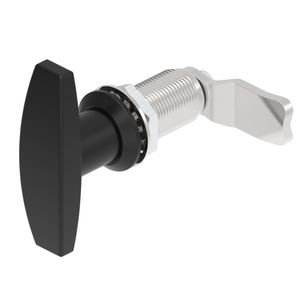 | Keyed; GH40 body for mid-thickness panels; SUS304 or die-cast zinc; 8 mm square shaft output | Vehicle compartments, generator doors, RV storage — gloved daily operation | |
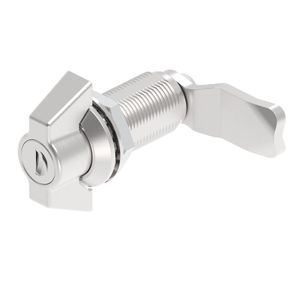 | GH40 body; SUS304 stainless steel or zinc alloy; tool-free hand operation; IP65 sealing option | Control cabinets, generator covers, electrical panel doors, RV compartments |
Captive Retention: What Keeps the Fastener Attached to the Panel?
Captive retention is what most clearly separates panel fasteners from standard bolts, and the four mechanisms below behave differently in service:
● Retaining washer (C-washer or flanged washer): the screw head passes through a slotted opening during assembly, then a spring washer snaps into a groove behind the head. The screw spins freely but cannot pass back out. Simple, cheap, field-retrofittable.
● Spring retention: a helical spring around the shank pushes against the panel, holding the screw in its extended ("ready") position while the panel is off — the screw stays parked, visible, and greatly reducing the risk of dropped hardware inside the cabinet.
● Press-in receptacle: the female thread is a self-clinching panel fastener pressed permanently into a punched hole; the mating screw threads into the panel itself, eliminating the nut, the access to the back side, and the dropped-nut risk in one move.
● Captive thread designs: on hygienic bolts, the sealing head and thread form a permanently joined unit with a captive O-ring or HNBR sealing face, helping minimize loose-part contamination risk in the product zone.
At an open electrical cabinet, a technician holds one tool instead of three loose parts; on medical and food equipment and overhead machine guards, the risk of loose hardware falling into a sterile zone or dropping from height is reduced. When reviewing a captive design, check the retention force rating — how hard you can pull the extended screw before it releases — against panel orientation and vibration.
Fastener Specifications Explained: Grip Range, Retention Load, Thread, and Panel Thickness
Panel fastener datasheets list several loads that are easy to conflate. Keep them separate:
● Retention load — the axial force needed to pull a captive screw out of its retained position; governs whether it stays parked during handling and transport.
● Clamping load — the force the joint applies to the panel stack-up; what compresses a gasket and resists panel flutter.
● Tensile and shear rating — the structural failure limits of the body; panel fasteners are rarely loaded near these values, and they matter only when the fastener doubles as a structural joint.
Three specification rules prevent most field failures:
1. Match grip range to the real stack-up. The grip range is the thickness band the fastener clamps correctly. Measure panel plus gasket in its compressed state; a fastener sized to uncompressed thickness bottoms out before the gasket squeezes. If the measured stack-up falls near the limit of a grip range, confirm the fit against the manufacturer’s specified engagement and clamping window rather than automatically selecting the next size.
2. Read retention load for orientation. Vertical and overhead panels need higher retention force because gravity plus vibration work on the extended screw continuously.
3. Follow the manufacturer's installation torque. Panel fasteners have small engagement areas and plated threads; a universal torque table written for structural bolts will strip them. Use the datasheet value for the specific thread and lubrication state, and re-check after the first thermal cycle.

Stainless Steel, Zinc-Plated Steel, or Nylon? Choosing the Right Enclosure Fastener Material
Material choice follows three inputs in order: environment, electrical requirements, and load.
Material | Corrosion Environment | Insulation | Strength | Cost | Typical Service |
Zinc-plated steel | Best suited to dry indoor or mild environments unless the coating system is specifically validated for outdoor exposure. | Conductive | High | Lowest | Indoor cabinets, machinery covers |
Stainless 304 | Outdoor, humidity, general industrial | Conductive | High | Medium | Telecom cabinets, generator panels |
Stainless 316/316L | Coastal, washdown, chemical exposure | Conductive | High | Highest | Marine, food and pharma washdown |
Nylon (PA6/PA66) | Corrosion-resistant, but moisture absorption and temperature effects must be considered. | Insulating | Low–medium | Low | Electrical insulation, light covers |
Selection Notes from Our Test Lab:
First, neutral salt-spray ratings depend on surface passivation and plating quality. Always request batch test reports for specific part numbers. Second, mating stainless fasteners with zinc die-cast bodies or aluminum panels can increase galvanic corrosion risk in wet or conductive environments; isolate dissimilar metals with non-conductive nylon washers. For a deeper grade comparison, see our 304 vs 316 stainless steel guide.
Where Do Industrial Panel Fasteners Get Used in the Field?
Five sectors account for most quick-access demand:
● Electrical control cabinets: tool-operated quarter turns and captive screws; controlled access, thousands of cycles, no loose hardware inside live cabinets.
● Outdoor telecom and power enclosures: stainless quarter-turn actions with gasket engagement; corrosion resistance plus vibration-tolerant locking.
● Automation guards: captive screws and quarter turns for guards removed during changeovers. On these guards, how fast a technician can remove and replace the panel matters more for line uptime than the clamping force rating.
● Vehicle service hatches: handle-driven quarter turns that survive road vibration and gloved operation; see our T-handle guide.
● Medical devices and test fixtures: hygienic sealed bolts that keep parts out of sterile zones and hold fixtures aligned through repeated setups.
About ForndLock
At ForndLock, we bridge precision engineering and volume production to manufacture application-specific panel fasteners, quarter-turn latches, and quick-access hardware. Backed by 120+ technical patents, ISO 9001 quality management, and rigorous environmental compliance, our Xuzhou production base delivers custom-tailored retention mechanisms—from vibration-resistant quarter-turn studs to high-purity SUS316L captive hardware. Provide your panel thickness, gasket compression targets, and environmental requirements, and our engineering team will calculate the exact grip range and supply verified samples for testing.
Email: [email protected]