
Which RV Door Lock Fits Your Door? Types, Applications and Fitment Specs
Which type of RV door lock is right for your application? The short answer is that no single lock suits every door. The choice of lock depends on its function – securing a living space, sealing a compartment, or locking a utility hatch – but it also depends on four technical specifications: cutout size, panel thickness, backset, and striker alignment. Correct matching of the door application and engineering parameters ensures reliable seal compression, structural security, and long-term cycle life.

At ForndLock, we manufacture industrial locks and access hardware for RV builders, trailer makers, and fleet operators. In this guide, we describe the six most frequent types of locks used in RV door design, provide examples of their usage, and list the parameters that our engineers check before starting to manufacture locks.
Why RV Doors Need Special Locks: Vibration, Weather and the Deadbolt Question
A residential lock is engineered for a thick, stationary door in a climate-controlled frame. An RV door differs on all three counts. Three structural factors drive the hardware design:
1. Thin, lightweight panels.
Most RV doors use a sandwich panel less than 50 mm thick, often about 32 to 38 mm. The backset distance and deadbolt length of a residential lock simply cannot be used: RV door locks clamp the two halves of the door together to seal the panel.
2. Constant vibration and frame flex.
A door moving at highway speed takes road shock and twist. A spring bolt — the angled latch that clicks shut when pushed — holds the door closed, but sustained road vibration can walk it out of the striker. A deadbolt — a solid rectangular bolt extended manually into the frame — cannot be pushed back without a key or thumb turn. A spring bolt maintains panel positioning during movement, whereas a deadbolt mechanically locks the door against forced entry.
3. Weather exposure and screen-door clearance.
RV hardware operates in rain, UV, and road spray, while the interior assembly shares space with a screen door. A lock housing that fits the panel cutout will still bind if its interior handle interferes with the screen frame.

To learn more about how 90° cam mechanisms achieve reliable sealing across various vehicle and equipment doors, explore our technical breakdown of quarter turn cam latches.
RV Door Lock Types at a Glance: Lockset, Paddle, Slam, Compression, Cam, and T-Handle
This classification reflects how locks are actually used and operated in RV applications, not a strict mechanical taxonomy. A slam latch and a compression latch may share internal parts; what separates them is behavior at the door.
Lock Type | Operating Principle | Sealing Behavior | Effort to Open | Typical Position |
Entry-door lockset | Handle operates latch; separate deadbolt | Gasketed housing | Key + thumb turn | Main habitation door |
Paddle latch | Flush paddle retracts the internal bolt | Light to moderate | Finger pressure | Baggage compartments |
Slam latch | Bolt catches automatically as door shuts | Light to moderate | Push-to-close, lever to open | High-frequency storage doors |
Compression latch | Rotating cam draws door against gasket | High (constant preload) | Quarter-turn or wing handle | Gasketed exterior compartments |
Cam lock | Key or knob rotates a cam behind the frame | Limited | Key or knob | Utility hatches, small panels |
T-handle lock | T-grip rotates cam or multi-point rods | High with gasket | Leverage grip | Large service doors, rod systems |
Three Operational Factors That Drive Selection
1. Closing effort. Slam latches engage automatically when the door is pushed shut. Paddle latches require a deliberate pull on the handle. Compression latches demand a full turn to engage, but they deliver consistent gasket squeeze across the entire door perimeter.
2. Sealing. On a gasketed door, a compression mechanism maintains preload as the gasket takes a set over time. Paddle and slam designs rely on fixed striker location, meaning seal tightness depends strictly on frame squareness and static striker adjustment.
3. Vibration retention. Under road vibration, a compression latch maintains working tension on the seal, while a spring bolt relies on the striker staying aligned. On rough-terrain vehicles, an uncompressed spring latch can loosen against the frame.
Matching Lock Types to RV Door Applications
The rule we apply at ForndLock is simple: identify the door's function first, then choose the family. The matrix below shows the combinations we most often approve for RV door lock replacement and OEM programs, including matched products from our range.
Door Application | Recommended Lock Type | ForndLock Product | Product Image | Key Specifications |
Main entry door | Entry lockset with deadbolt |
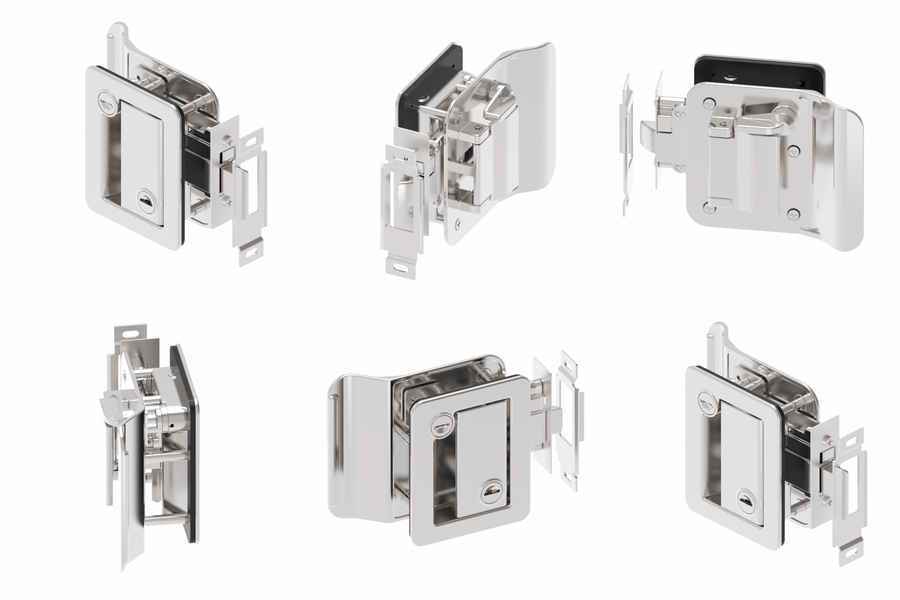 | Interior release, deadbolt, screen-door clearance | |
Baggage / storage compartment | Slam or paddle latch |
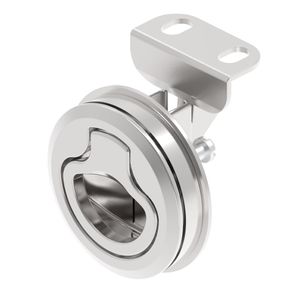 | Round flush pull, concealed handle, rear linkage release | |
Gasketed exterior compartment | Compression latch |
 | GH40 body, 90° rotary cam compresses gasket; IP65 option | |
Small utility hatch | Cam lock | B-1202-140 (Cylinder Version) |
 | Compact depth, anti-loosening cam, key-locking cylinder |
Large service door / rod system | T-handle lock |
 | 8 mm square shaft output for multi-point rods; zinc alloy | |
Vibrating equipment enclosure |
 | Slam-shut rotary pawl, M6×1 or Φ6.2 mounting, 3,300 N load |
Two placement rules we enforce:
● Entry hardware is not compartment hardware. A cam lock lacks the interior emergency release and secondary deadbolt required for a living space. Conversely, installing a full entry lockset on a baggage door adds unnecessary weight, cost, and cutout complexity.

● Match the latch to the gasket, not just panel size. If a baggage door uses a continuous perimeter gasket, a slam latch can allow water ingress if the door flexes under travel. A compression latch pulls the panel flat against the seal.
Critical RV Lock Fitment Specs: Cutout, Thickness, Backset, and Striker Alignment
Most fitment errors audited in the field trace back to seven basic measurements. Confirm all of them against the product drawing — never against an advertisement photo.
Fitment Parameter | What to Measure | Failure Mode If Incorrect |
Cutout size & radius | Height × width of opening, plus square vs. rounded corners | Lock body will not seat; filing openings weakens skin |
Panel thickness | Outer skin + core + inner skin + compressed gasket | Too thin: housing rattles; too thick: mounting screws strip |
Backset & latch throw | Door edge to spindle center; bolt extension distance | Latch fails to reach striker or binds during closure |
Handing | Hinge placement viewed from the exterior | Handle operates opposite to latch direction |
Striker alignment | Striker hole alignment when vehicle is level and loaded | Deadbolt drags, engagement is partial, door rattles |
Cam offset / grip range | Distance from housing base to rear clamping face | Cam misses frame lip or over-tightens onto edge |
Gasket compression | Uncompressed gasket height minus compressed height | Over-compression distorts frame; under-compression leaks |
Measure the opening cut into the door, not the outer trim of the old lock. Trim plates are larger than the cutout behind them. While a 95 × 70 mm cutout is common on towable RV entry doors, motorhomes, utility trailers, and custom builds use different dimensions.
Additionally, check striker engagement when the vehicle is loaded. A door that latches on a shop floor can misalign when cargo weight flexes the chassis.
RV Lock Keying and Security: Moving Beyond Common CH751 Compartment Locks
Replacing the CH751 Standard
CH751 is a common key code used across storage compartment locks from multiple manufacturers. Because so many builders install CH751 cylinders by default, a single key opens baggage hatches on hundreds of different vehicles. For fleet operators and RV owners storing tools or equipment, this creates an unnecessary security gap.
Replacing CH751 locks with a Keyed Alike (KA) or Keyed Different (KD) system resolves this issue:
● Keyed Alike (KA): Uses one key code for all compartment hatches on a single vehicle or fleet, reducing key clutter.
● Keyed Different (KD): Assigns separate keys to entry doors and baggage compartments, keeping storage access isolated from living quarters.
Replacing CH751 with customized key codes simplifies fleet management. Read our guide on locking and keying options to evaluate master key setups and lock cylinder choices.
Safety and Security Rules
A keyless lock must never be the only way in. Every electronic RV entry lock we support keeps a mechanical override cylinder. Batteries and keypads can fail in cold or wet conditions. A mechanical override is strongly recommended for electronic RV access systems to maintain entry when batteries, keypads, or electronics fail.
The deadbolt must never block emergency egress. Interior thumb-turn release has to work with zero dependency on power, codes, or apps. Any lock that can trap an occupant inside is rejected at the drawing-review stage, regardless of its other merits.
Troubleshooting Common RV Door Lock Assembly Problems
Field issues can usually be isolated to alignment, hardware sizing, or maintenance:
Symptom | Likely Cause | Corrective Action |
Door must be slammed to latch | Striker misaligned, frame sagging, or gasket over-compressed | Re-align striker; check door squareness under load |
Door rattles while driving | Incomplete latch engagement or loose mounting screws | Adjust striker depth; verify panel thickness matches grip range |
Key turns hard or sticks | Road grit in cylinder or binding latch bolt | Clean cylinder with lock-safe lubricant; check bolt clearance |
Lock body moves on panel | Mounting screws backed out or panel skin compressed | Re-torque fasteners with threadlocker; add a backing plate |
Door opens from outside, not inside | Interior release linkage disconnected or binding | Inspect interior linkage rod; adjust clearance to screen door |
A lock relies on the structural integrity of the surrounding frame. If a door panel sags or the frame twists, new hardware will experience the same binding issues as the old lock.
About ForndLock
ForndLock manufactures industrial locks, latches, hinges, and enclosure hardware from our 50,000 m² facility in Xuzhou, China. Supported by 120+ technical patents and certified to ISO 9001, RoHS, UL, and IP69K standards, we supply vehicle builders, trailer manufacturers, and OEM programs worldwide.
Our RV hardware range includes entry locksets, flush paddle latches, compression locks, T-handle multi-point systems, and heavy-duty rotary latches. We support custom modifications for grip ranges, drive shafts, key codes, and surface finishes.
Email: [email protected]