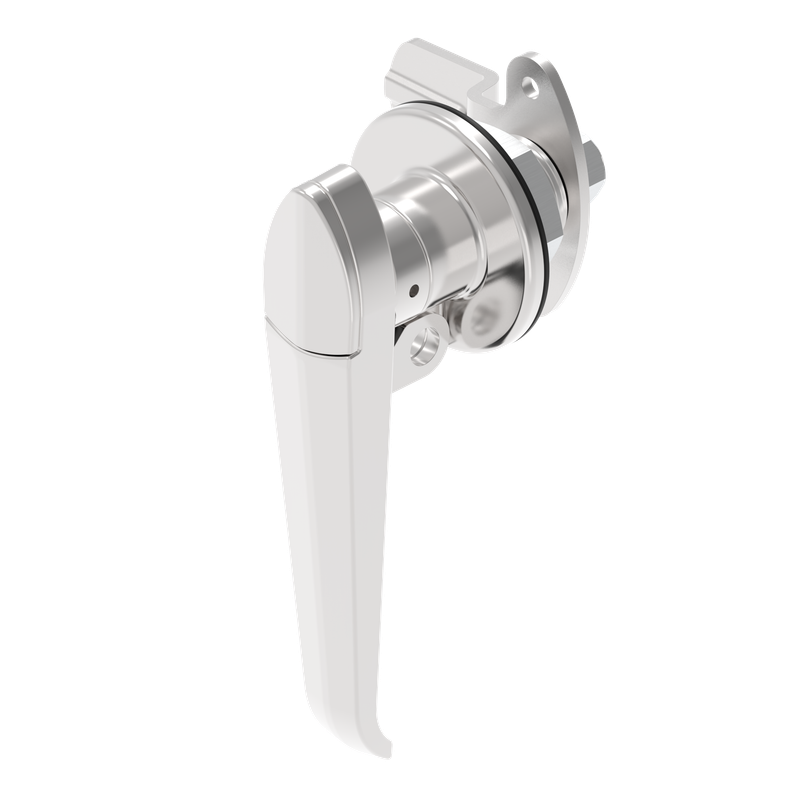
Quarter Turn Cam Latches: Keying, Panel Fit and Sealing for Electrical Enclosures
No access hardware appears on more electrical enclosures than the quarter turn cam latch. One 90° rotation of a key, wing knob or insert tool moves a cam behind the frame and the door is closed—fast to operate, compact in footprint, and workable with gloves—which is why it appears on so many enclosures.

At ForndLock, where we manufacture quarter turn systems from standard stainless bodies to IP65 sealed and high-security variants, we see the flip side: most field problems we are asked about come down to three things: the keying plan, the panel fit, and the seal. This article works through all three.
The 90° Motion: Engage vs Draw
Every quarter turn latch converts 90° of rotation into a lateral cam sweep behind the frame edge, but the motion completes in one of two ways — and the difference decides whether the door merely closes or actually seals.
Single-Step Engage
In the standard single-step design, the cam rotates directly from open to locked, capturing the frame edge while the door rests wherever hinges and gaskets set the line. Mechanical retention is immediate, though gasket compression remains incidental. Key operational characteristics include:
● Tactile 90° Detent: An internal hard stop halts plug rotation precisely at 90 degrees, providing positive tactile confirmation to the operator.
● Over-Travel Protection: The hard stop prevents over-rotation that could otherwise bend the cam profile or walk the threaded housing loose under torque.
● Best-Fit Applications: Ideal for indoor control cabinets, junction boxes, and access panels with light gasketing and modest vibration exposure.
Two-Step Engage and Draw
The compression variant introduces an axial draw-down phase: turning the handle 90 degrees first swings the cam behind the frame, after which the mechanism draws the cam—and the panel—4 to 6 mm inward toward the enclosure. This secondary axial stroke provides critical functional advantages:
● Controlled Gasket Squeeze: It actively pulls the door against its stops, compressing the seal to a defined thickness that a simple rotating cam angle cannot achieve alone.
● Vibration Resistance: Pre-loading the panel under continuous tension prevents joint rattle and door movement under dynamic shock.
● Best-Fit Applications: Essential for outdoor telecom shelters, generator canopies, and transport compartments where long-term IP sealing and rattle-free performance are required.
Keying Options: Keyed Alike, Keyed Different and Tool-Only
The cylinder or insert is where quarter turn projects most often go wrong, because keying gets decided by habit instead of access policy. Four schemes cover industrial reality, and each is an order-time commitment.
Keying Scheme | Who Opens What | Operational Trade-Off | Decide When |
Keyed alike (KA) | One key opens every lock in the group | A lost key compromises the whole group | Define the cabinet group and key holders at order time |
Keyed different (KD) | Each cabinet has a unique key | Isolates loss to one cabinet; heavier key management | Create a key-code map tied to cabinet identity |
Master key / grand master | Local keys plus supervisory tiers | Broadest convenience; most complex coding and replacement | Confirm the lock family supports the hierarchy before ordering |
Tool-only (triangle / square / hex / double bit) | Anyone carrying the standard insert | Deters casual operation only — not a security barrier | Treat as convenience access for internal panels |
Regardless of the selected keying scheme, two critical ordering specifications must be explicitly defined in the purchase order:
● Key Extraction Positions (Key Pulls): Specify whether the key can be withdrawn in the locked position, the unlocked position, or both. Trapping the key until re-locked forces security compliance but may annoy technicians; allowing double-key extraction adds field convenience but increases the risk of lost keys.
● Key-Code Documentation Schedule: Require full key-code records upon delivery. This documentation is the single reference point manufacturers need to supply precise, matching replacement keys years later.
To support these keying architectures and sealing requirements across standard and customized enclosure programs, ForndLock manufactures five core quarter turn product lines:
Product Line | Image | Structure & Spec | Actuation Options | Typical Scenario |
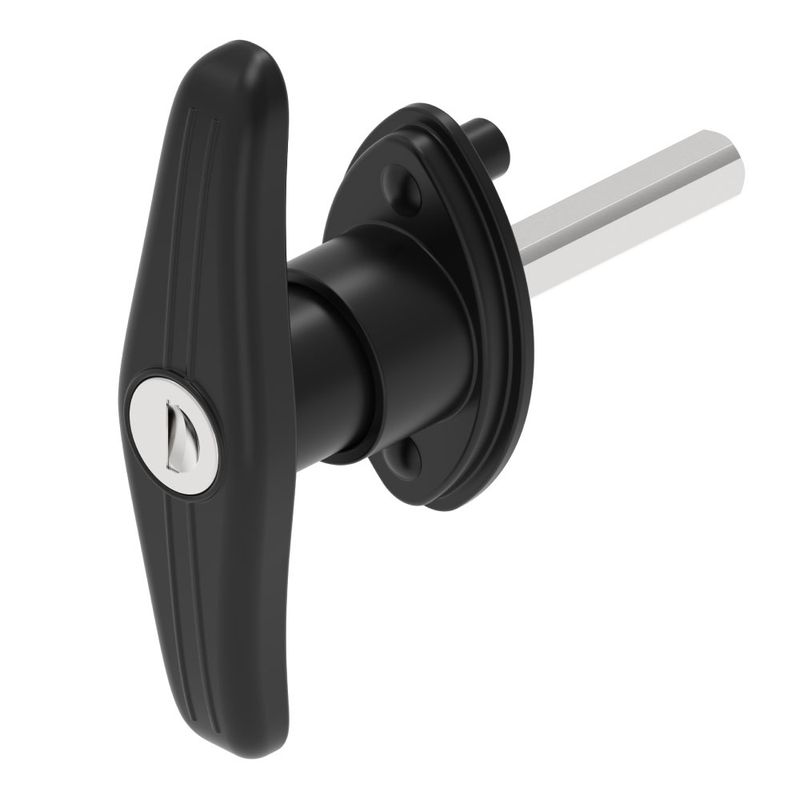
 | Adjustable cam lengths; panel thickness 1–8 mm; SS304/316 or zinc alloy; IP65/IP66 options | Key, wing knob, square/triangle insert, double bit, T-handle | Electrical cabinets, telecom racks, inverter and battery enclosures | |
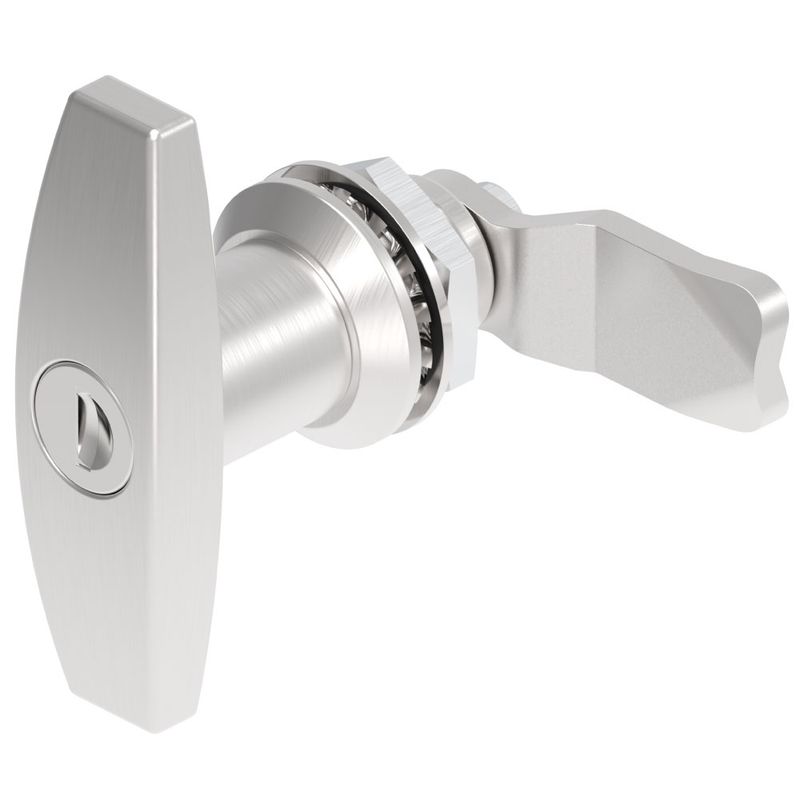
 | B-1202-130 wing handle cam lock: GH30 body, M22×20 hole, SS or zinc alloy, IP65 | Hand-operated wing knob, with or without cylinder | Control cabinets, generator doors, RV compartments | |
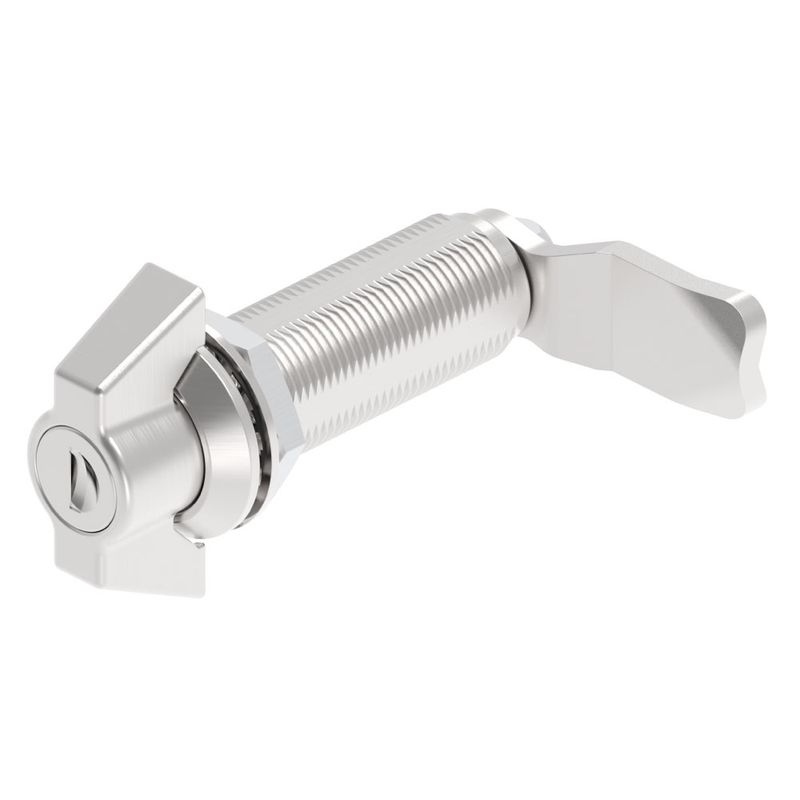
 | IP65-rated 1/4 turn cam latch bodies for insert tools | Triangle, square, hex or slotted insert | Internal service panels, infrastructure cabinets | |
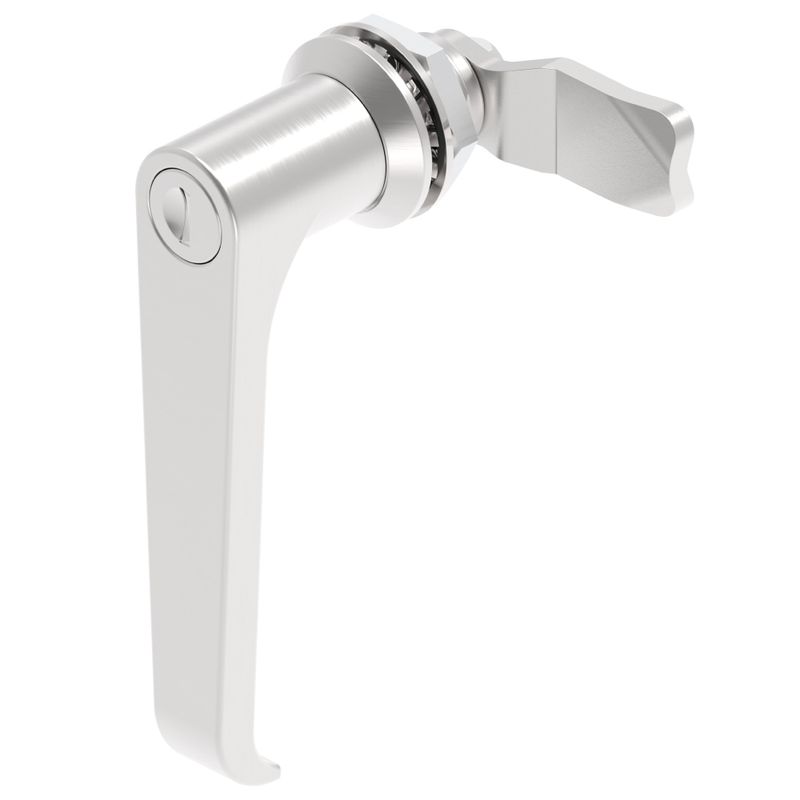
 | Cylinder-based, pick-resistant configurations, master-key capable | Key locking, double bit | Rail, telecom, utility — restricted access tiers |
Panel Fit: Cutout, Housing Length and Door Thickness
A quarter-turn latch depends on three dimensions. If they are correct, installation takes minutes; if not, expect a rattling door, a cam that misses the frame, or a housing that works loose.
Cutout Size and Tolerance
Industry-standard bodies use D-shaped cutouts—a round hole with a flat to prevent rotation—in standard diameters like 16.5 mm, 19 mm, 20.1 mm, and 22 mm. Keep hole tolerances within ±0.2 mm: oversized cutouts allow the body to rotate under torque, while undersized ones deform the flat and misalign the cam axis.
Laser-cut all mounting holes before applying powder coating, as drilling through fresh finish creates a primary corrosion seed. Always verify the D-flat orientation against the cam clocking drawing during CAD review to prevent reversed rotation or panel interference before sending drawings to the shop floor.
Housing Length vs Door Thickness
Proper housing length ensures full nut thread engagement while maintaining clear cam tailpiece clearance behind the panel. Standard latch bodies come in stepped lengths matching specific thickness ranges (commonly 1–8 mm). Using a short body on a thick panel forces the nut onto insufficient threads; using a long body on a thin door pushes the cam into internal components. Always select housing length using total measured door stack, including paint coatings and gasket landings.
Cam Profile, Hand and Interference
Behind the door, three geometric parameters complete the panel fit:
● Cam Profile: Choose straight cams for flush doors, offset cams for recessed panels, or cranked cams to bypass frame flanges. Specifying the wrong profile is the primary cause of a key turning without securing the panel.
● Rotation Hand: Most cams can be flipped 180° on the square drive shaft to switch between left- and right-hand orientation. Always confirm hand configuration before ordering mirrored cabinet pairs.
● Swing Interference: Verify the cam overlaps the frame edge by at least 5 mm at full engagement, while maintaining clear clearance from internal brackets, wiring ducts, and door stiffeners throughout its 90° swing arc.
Sealing and Vibration: When a Standard Cam Latch Falls Short
A bare quarter-turn cam latch is not a sealing device. While the housing itself may feature an IP65 front gasket to protect the keyway, perimeter sealing relies entirely on compressing the enclosure’s own gasket. Standard single-step cams contribute minimal compression. When doors face wind-driven rain, dust jets, or continuous vibration, standard cam latches routinely fall short.
When IP65/IP66 sealing or severe vibration resistance is required, specify the two-step compression variant. Its 4–6 mm draw stroke actively compresses the gasket against its stops, holding it secure. ForndLock validates sealing on complete latch assemblies and calculates required enclosure compression forces, ensuring the rating applies to the entire system rather than just the hardware.
Common Spec Mistakes to Avoid
Four errors account for the bulk of the quarter turn problems our service team reviews — all preventable at the order stage:

1. Mixing keying schemes by accident. A fleet ordered half keyed-alike and half keyed-different arrives with no way to tell which is which; the key-control schedule exists precisely to prevent this, so issue it before installation, not after the first lost key.
2. Panel thickness beyond the housing range. A door upgraded from 1.5 mm to 3 mm sheet mid-project invalidates every housing length on the original purchase order; recheck body length whenever the panel stack changes.
3. Cam interference discovered in assembly. Internal brackets routed after the latch was specced collide with the cam at 90°; the 5 mm engagement and full-swing clearance checks on the drawing eliminate this.
4. Specifying a standard cam latch where compression was required. The door closes, the gasket never loads, and six months of vibration open a whistle-path; match the motion type — engage or engage-and-draw — to the sealing requirement from the start.
About ForndLock
ForndLock engineers quarter-turn cam latches and enclosure access hardware for industrial electrical and telecom applications. From standard 90° cam models to IP65/IP66 sealed housings and two-step compression variants, we deliver application-matched solutions tailored to your exact door thickness, cutout tolerances, and environment.
We support project-level access control with customized Keyed Alike (KA), Keyed Different (KD), and Master Keying systems—complete with factory key-code documentation.
Email: [email protected]