T-Handle Lock: Locking, Pull and Industrial Handle Options for Heavy Enclosure Doors
Why do so many heavy enclosure doors rattle loose on corrugated roads or refuse to seal without a shoulder pushed against the gasket? In most cases, the failure lies in the handle mechanism rather than the door panel itself. When leverage, compression stroke, or shaft length are miscalculated, even a heavy-duty latch leaves gaps. This guide outlines the core engineering parameters—from gloved-hand leverage to axial pull-down travel—needed to specify a reliable T-handle lock.

T-Handle Lock
Why Does the T Shape Outperform Other Handle Profiles on Heavy Doors?
Leverage and Torque Multiplication
A T-handle is a double-ended lever wrapped around a spindle. Torque equals force times distance from the rotation axis, so every millimeter of grip span converts directly into cam torque at the shaft.
A T-handle with a longer effective lever arm can reduce the hand force needed to reach the target shaft torque compared with a smaller round knob.
Gloved Operation and Pull Redundancy
For vehicle-mounted enclosures on construction sites or cold-chain logistics, operators wearing insulated work gloves lose fine motor control. The wide crossbar gives the gloved hand something to push against, not just wrap around. That push-pull redundancy — grip to rotate, hook to pull the door — is why the T profile remains the default for truck toolboxes, generator enclosures, and telecom cabinets.
Recessed Cup, Flush-Folding, or Surface Mount?
The handle shape matters less than how it sits relative to the panel surface:
Profile | How It Sits | Panel Space Cost | Snag Risk |
Recessed Cup | Handle folds into a machined pocket; surface flat when closed | Requires pocket cutout ~15–20 mm deep | Lowest — nothing protrudes |
Flush-Folding | Handle pivots flat against panel face; no pocket needed | Minimal — handle thickness only (~8–12 mm) | Low |
Surface Mount | Handle and body project outward from panel | Highest — full body depth | Moderate — must clear cargo and walkways |
For corridors, truck beds, and areas where equipment passes the door face, a recessed cup profile is preferred; for sheds and static cabinets, surface mount is adequate. For a broader comparison of handle styles and enclosure types, refer to our industrial cabinet latches guide.
Can a T-Handle Pull Lock Actually Compress a Gasket — or Just Latch?
90° Cam Latch vs. Compression T-Handle Pull Lock
A standard quarter-turn cam rotates 90° and stops — the tongue slides behind the frame, and the door position at rest is whatever the hinge and gasket allow. A T-handle pull lock adds an axial phase: after the cam engages (first 45–60° of rotation), continued handle travel drives the shaft axially toward the frame, pulling the door inward through a tightening stroke that depends on latch design.
This distinction matters in three real-world situations:
1. Gasket aging: EPDM and silicone gaskets can take a permanent set under thermal cycling, depending on material and service conditions. A fixed-grip cam latch loses compression as the gasket shrinks. Adjustable compression designs can compensate for limited gasket set and installation variation within their specified adjustment range.
2. Panel tolerance stack-up: On welded steel enclosures, door-to-frame gap variation across units is application-specific. Compression locks can accommodate this variation within their specified adjustment range.
3. Installation error: If hinge alignment drifts in the field, a standard latch may leave one corner unsealed. Depending on latch design and door alignment, axial pull can help draw the door against the stop within the specified adjustment range.
Fixed Grip vs. Adjustable Grip
Grip range — the distance from panel face to strike — never stays constant in service. Gaskets take a permanent set after months of compression, sheet-metal panels vary within tolerance, and door alignment drifts as hinges wear. Two design answers dominate:
● Fixed grip bodies in stepped lengths (e.g., 18–60 mm body depths) — pick the length that matches your stack-up.
● Adjustable grip cams with several millimeters of travel — one SKU covers tolerance drift and lets the same lock fit multiple door thicknesses across a product family.
When specifying a T-handle pull lock, subtract the gasket's compressed thickness from your measured grip before selecting a cam; a lock sized to the uncompressed stack will never reach full squeeze.
The table below demonstrates representative T-handle options from ForndLock's quarter-turn and compression series:
Product | Image | Key Specifications | Application Scenarios |
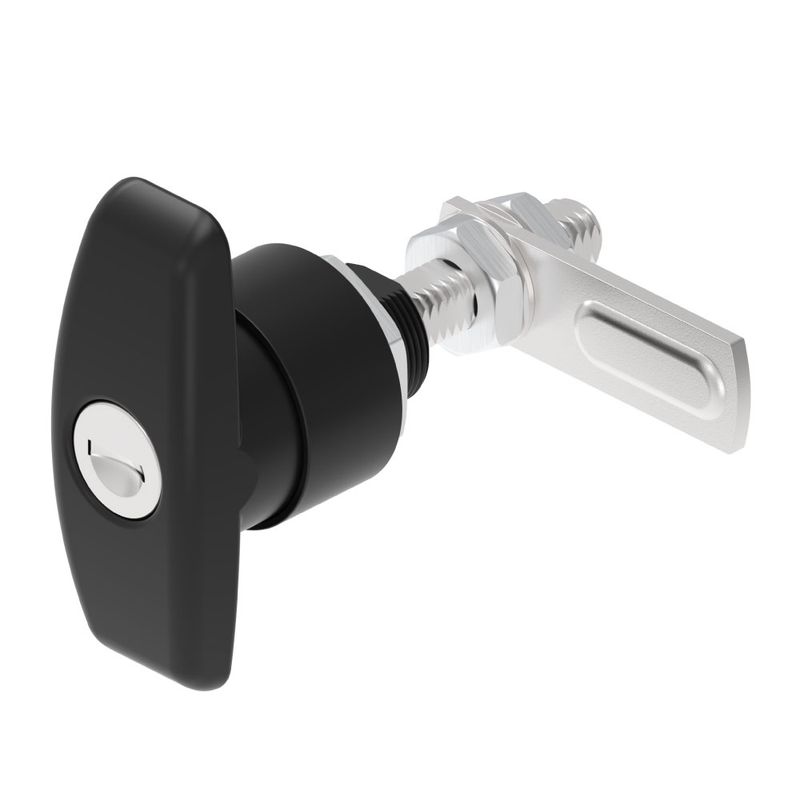
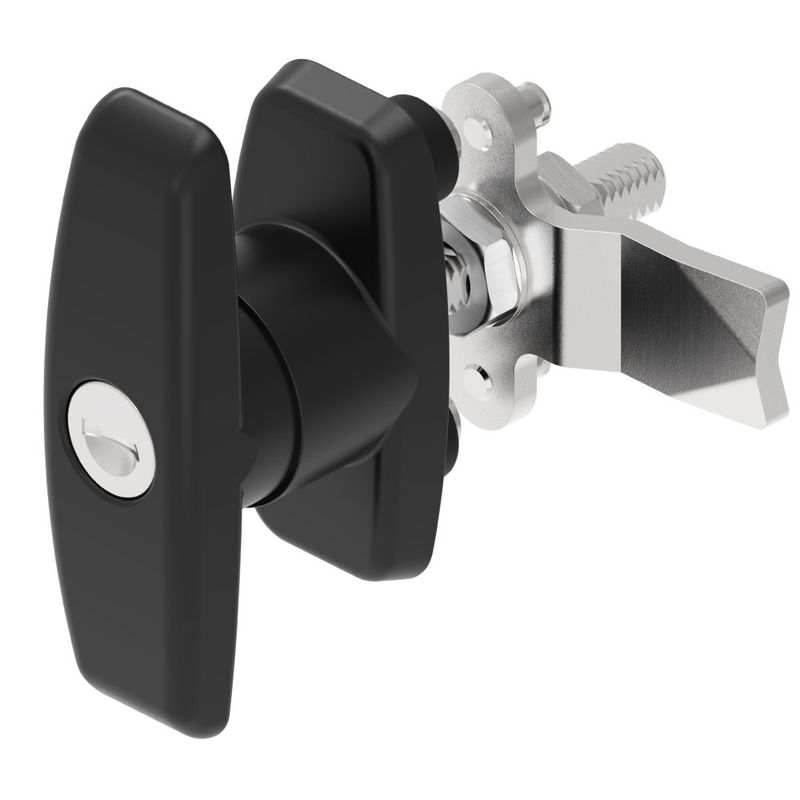
 | 19×16mm cutout; PA66+30GF+UV weatherable polymer; REACH compliant | Pickup truck bed covers, pickup toolboxes, trailer doors, RV storage compartments, and construction vehicle toolboxes | |
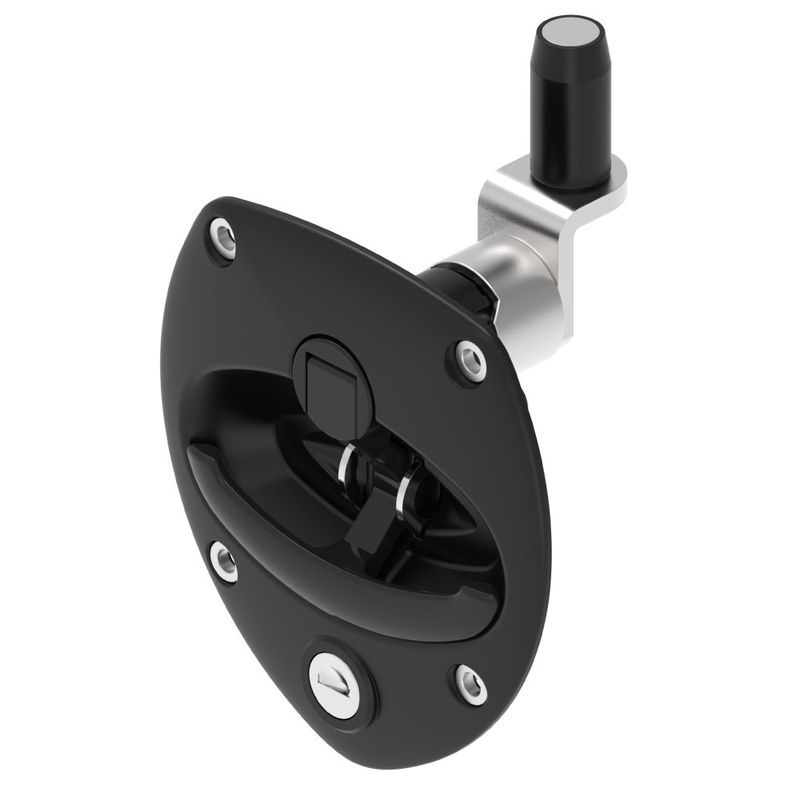
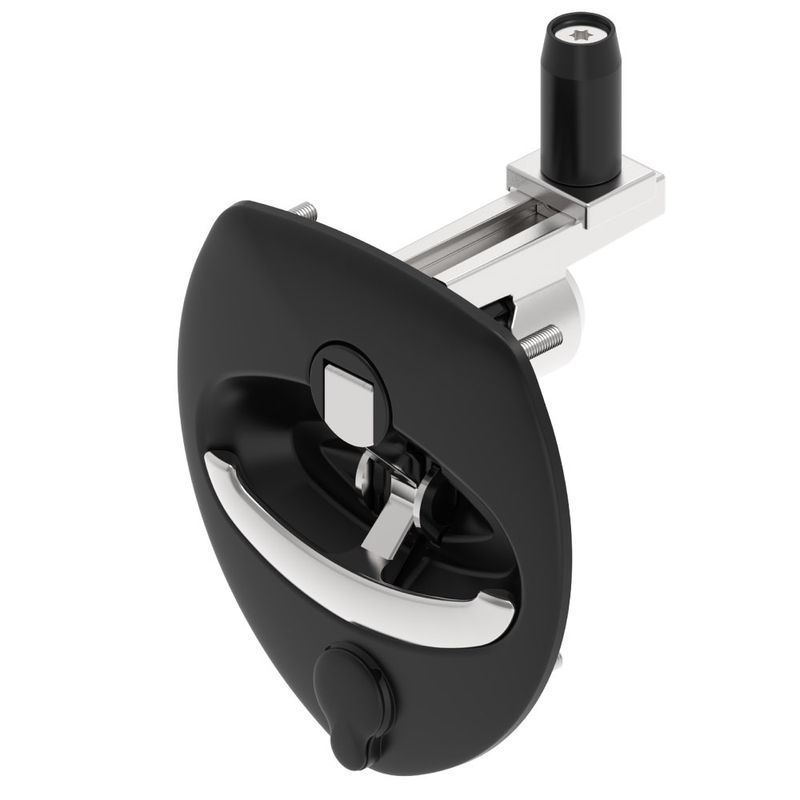
 | 3-hole flange mount; high-strength zinc alloy body; pop-out flush handle design; REACH compliant | RV / camper storage doors, pickup toolboxes, trailer compartments, and specialized vehicle maintenance doors | |
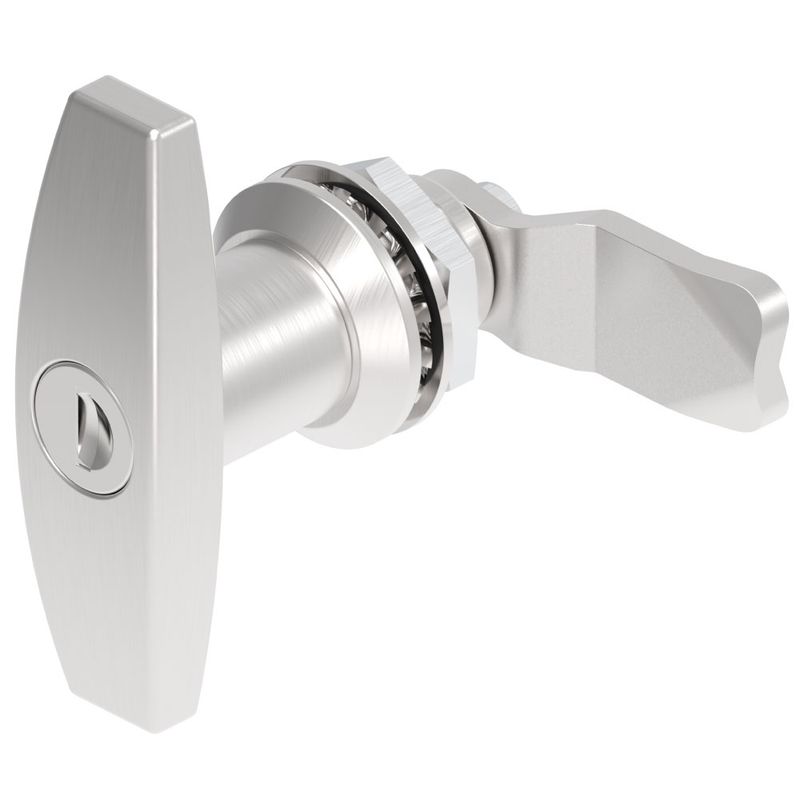
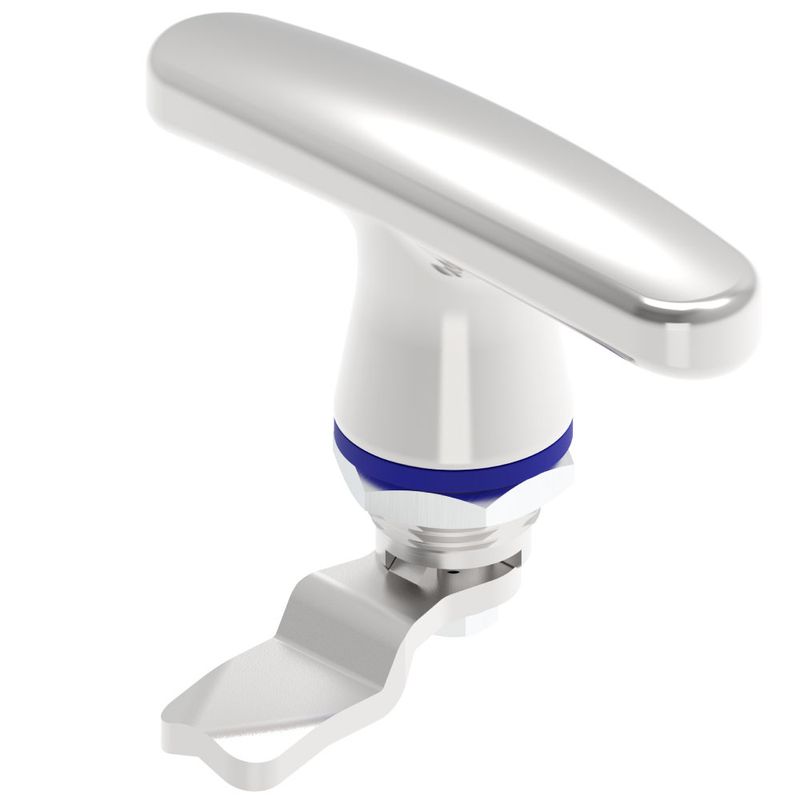
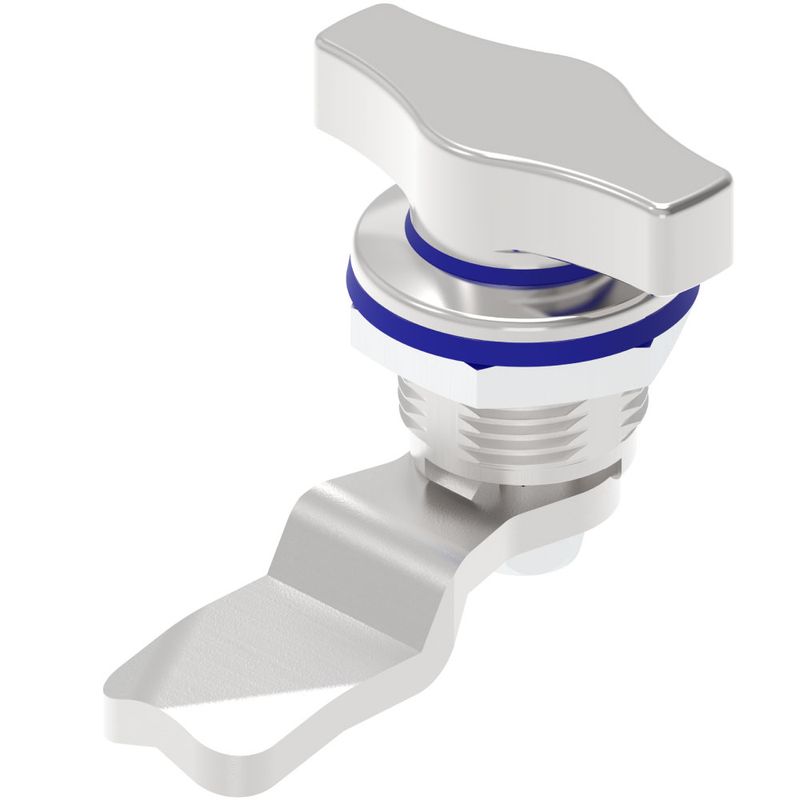
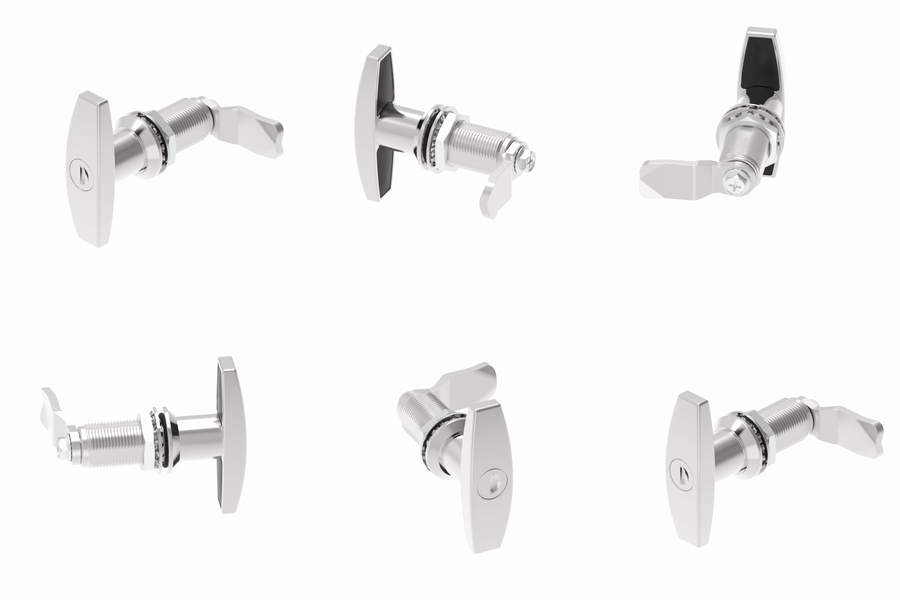 | M22×20 mounting barrel (GH40 body); SS304 / Zinc alloy options; IP65 sealed; 2-stage axial compression | Outdoor electrical enclosures, telecom cabinets, generator doors, RV storage, and heavy machinery access panels |
How Does a T-Handle Lock Body Mount — and Why Does Panel Thickness Matter?
3-Hole Bolt Pattern vs. M22×20 Single-Hole Mount
Industrial T-handle locks attach through one of two interfaces:
● 3-hole bolt pattern: Machine screws pass through the lock body flange into threaded inserts on the panel back. This distributes axial pull force across multiple points — often used for large doors, thick panels, and heavy gasket loads.
● M22×20 single-hole mount: The body passes through one drilled hole (22 mm × 20 mm) and is secured by a rear nut. Faster to mount, commonly suited to thin sheet-metal doors and high-volume production.
Shell Length and Panel Thickness
The lock body shell must span the full panel thickness plus any gasket, insulation, or inner liner. A lock for 1.5 mm sheet metal bottoms out on a 6 mm composite panel; a long shell on thin panel creates sloppy shaft travel before the cam engages.
Panel Build | Typical Thickness | Shell Requirement |
Single-skin steel | 1.0–2.0 mm | Short shell (GH18 / GH30) |
Double-skin with insulation | 6–15 mm | Medium shell (GH40 / GH50) |
Composite / sandwich panel | 15–30 mm | Extended shell (GH60 / spacer kit) |
Square Shaft and Multi-Point Rod Output
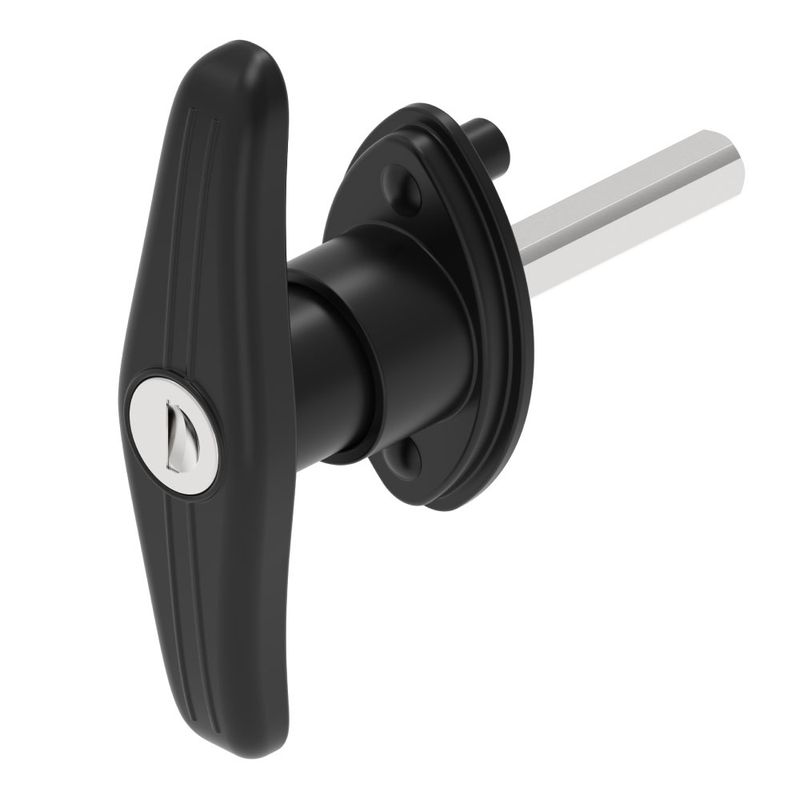
Some industrial T-handle locks use an 8 mm square shaft, which drives a single tongue, a pair of vertical locking rods, or a linkage into remote rotary latches. Tall, flexible, or gasketed doors may benefit from multi-point rod systems when a single central latch cannot maintain even perimeter engagement.
Keyed, Padlockable, or Non-Locking: Which Locking T-Handle Latch Fits Your Access Policy?
A T-handle lock integrates the cylinder into the grip center: in the locked position, the core blocks spindle rotation entirely.
Locking Option | Access Control | Best Fit | Watch Out For |
Keyed, Keyed-Alike (KA) | One key, many doors | Fleets, utility crews, multi-cabinet sites | Single lost key exposes all doors |
Keyed, Keyed-Different (KD) + Master | Per-door isolation with override | Mixed-tenant cabinets, graded security | Key control documentation required |
Padlockable Hasp | External shackle, shared control | Sites, lockout/tagout, seasonal storage | Shackle must be rated for the environment |
Non-Locking | None — latch only | Internal panels, machine guards | Pair with interlock if security needed |
On vibrating equipment — trailers, machinery, rail — consider a positive detent, secondary retention feature, or anti-rotation mechanism appropriate to the vibration level. This can help reduce the risk of vibration moving the cam off the strike plate and opening the door mid-transit.
From Catalog to Vehicle: How to Choose T-Handle Locks for Real Doors?
Catalog specs get you to a shortlist; the door makes the final decision. Before releasing a T-handle lock into production, test samples on the actual enclosure:
● Vibration and shock testing: run the locked door on a shaker or a real vehicle route — verify the detent holds and the gasket stays compressed.
● Gloved operation: operators in winter or cut-resistant gloves should open and close the door repeatedly; torque complaints here only appear in the field.
● Shaft and cam clearance: confirm cam and rod sweep clears the frame, hinge brackets, and interior wiring at every clocking position.
● Environmental validation: for outdoor duty, check low-temperature operation (as gasket stiffening raises breakout torque) and neutral salt-spray test results for the chosen material.
About ForndLock
ForndLock is an OEM/ODM manufacturer of industrial locks, latches, hinges, handles, and enclosure hardware, with 120+ R&D patents and ISO 9001, RoHS, UL, and IP69K certification.
Our T-handle series spans body lengths GH18–GH60 in SUS304 and die-cast zinc, keyed or non-locking, with square-shaft outputs for single- and multi-point drive — customizable in material, keying hierarchy, surface treatment, and batch delivery. Send us your door drawing, cutout dimensions, grip range, and target environment, and we will recommend a matched T-handle lock with sampling support.
Email: [email protected]