
Best Materials and Finishes for Industrial Cabinet Latches
There is no single best material for every industrial cabinet latch. Stainless steel is often preferred for corrosive or washdown environments, while coated steel and zinc alloy may provide a more economical solution for indoor equipment. Aluminum and engineering plastics solve specific weight, insulation, or chemical-resistance requirements. Selecting the right combination of industrial cabinet latch materials depends on mechanical load, corrosion exposure, contact wear, temperature, cleaning method, electrical requirements, and cost. This article covers stainless steel, carbon steel, zinc alloy, aluminum, and engineering plastics, along with zinc plating, powder coating, passivation, mechanical polishing, and electropolishing. Because a latch is an assembly rather than a single part, every component may need separate evaluation. At ForndLock, we work through this evaluation process daily as a manufacturer of industrial locks, latches, handles, and hinges for cabinets and enclosures.
What Performance Requirements Should Latch Materials and Finishes Meet?
Latch materials and finishes must satisfy mechanical load, corrosion exposure, contact wear, temperature range, cleaning method, and electrical requirements before cost is considered.
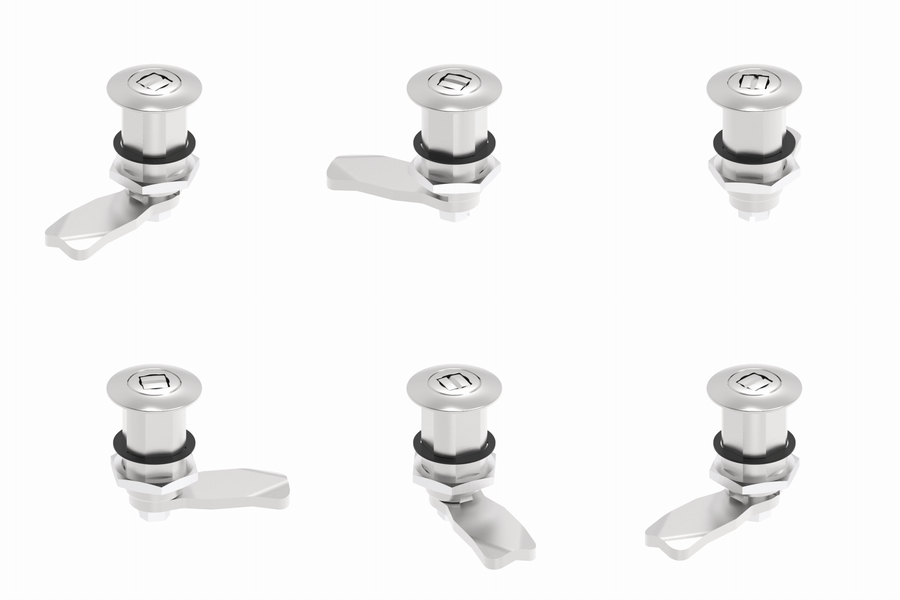
Before comparing materials, it helps to define what the latch actually has to withstand. Static load — the force needed to hold a door closed under vibration or pressure — is a different requirement from repeated operating wear, which accumulates every time an operator turns, pulls, or compresses the latch. Corrosion exposure also needs to be defined specifically: ambient humidity, occasional splashing, salt-laden air, and direct chemical contact each demand a different response. Finishes protect the base material, but they rarely protect it evenly. Edges, cut threads, drilled holes, and sliding or rotating contact points wear or chip first, exposing the substrate underneath. Exterior components facing weather may need different materials than internal components that stay dry and protected. Temperature extremes, UV exposure, electrical conductivity or insulation needs, magnetic sensitivity, and hygiene standards can all shift the decision. Finally, initial purchase price should be weighed against maintenance intervals and expected replacement cycles, since a cheaper latch that fails early is rarely the most economical choice.
Selection factor | What to evaluate | Risk if ignored |
Mechanical load | Pull force, shock and vibration | Bending or fracture |
Corrosion | Moisture, salt and chemicals | Seizure or material loss |
Wear | Cycles and contact surfaces | Excessive clearance |
Temperature | Minimum and maximum exposure | Embrittlement or deformation |
Cleaning | Washdown and chemicals | Coating damage |
Electrical requirements | Grounding or insulation | Unsafe or unreliable operation |
How Do Common Industrial Cabinet Latch Materials Compare?
Stainless steel, carbon steel, zinc alloy, aluminum, and engineering plastics each offer a different balance of corrosion resistance, mechanical strength, formability, and cost.
Material | Main strengths | Main limitations | Typical applications |
Stainless steel | Corrosion resistance and durability | Higher cost and grade-dependent performance | Outdoor, washdown and corrosive environments |
Carbon steel | Strength and cost efficiency | Requires corrosion protection | Dry indoor and general machinery |
Zinc alloy | Complex shapes and good finishing | Application-dependent structural capability | Lock housings and general enclosures |
Aluminum | Low weight | Wear and thread-strength limitations in some designs | Lightweight equipment |
Engineering plastic | Insulation and low weight | Temperature, creep and load limitations | Light-duty electrical applications |
When Should You Choose Stainless Steel?
Stainless steel is generally the starting point for outdoor, washdown, coastal, food, medical, and chemical environments because of its corrosion resistance.

Stainless steel resists rust in ways that plain carbon steel cannot, which is why it appears so often in wet, corrosive, or hygienic settings. Within stainless grades, 304 and 316 are the two most commonly discussed. Both contain chromium and nickel, but 316 also contains molybdenum, which typically improves resistance in environments containing chlorides, such as coastal air or de-icing salts. This does not mean 316 stainless steel is immune to corrosion. Under the right conditions — stagnant moisture, surface contamination, or tight crevices where cleaning agents or salts can concentrate — even 316 stainless steel can experience pitting, crevice corrosion, or surface staining. A complete latch assembly is only as durable as its weakest component, so a stainless steel housing paired with a lower-grade spring, pin, or fastener can still fail early. Because "stainless" is often used as a generic marketing term rather than a specific grade, buyers should always confirm the actual alloy designation used for each component rather than accepting an unqualified description.
When Are Carbon Steel and Zinc Alloy More Practical?
Carbon steel and zinc alloy are practical when cost efficiency, dimensional consistency, or complex shapes matter more than inherent corrosion resistance.
Carbon steel offers useful mechanical strength at a competitive cost, which makes it attractive for structural latch components that will stay indoors or under a protective coating. On its own, carbon steel corrodes readily, so it normally requires plating, painting, or another protective finish to remain serviceable. Zinc alloy, often die-cast, is a different material with different strengths: it supports complex housing shapes, tight dimensional tolerances, and attractive surface finishes at a reasonable cost. Many zinc alloy latch housings still rely on steel internally — cams, pins, springs, and fasteners are frequently made from steel rather than zinc, since zinc alloy's structural capability depends heavily on the specific application and loading conditions. If a coating on a steel component is damaged, the exposed substrate becomes vulnerable almost immediately. Zinc alloy should not be selected automatically for high-impact, high-load, or elevated-temperature applications without reviewing whether it actually meets those demands. Lifecycle cost, including maintenance and replacement, may tell a different story than the initial purchase price alone.
When Should You Consider Aluminum or Engineering Plastics?
Aluminum and engineering plastics are considered when weight, electrical insulation, or specific chemical resistance outweigh the need for maximum mechanical strength.
Aluminum's main advantage is low weight combined with reasonable formability, which is useful on lightweight equipment or where reducing overall enclosure mass matters. However, aluminum threads can wear or strip more easily than steel threads under repeated use, and aluminum is more vulnerable to impact damage. It also requires attention to galvanic-corrosion risk when placed in contact with dissimilar metals in a wet environment. Engineering plastics bring electrical insulation, low weight, and resistance to specific chemicals that would attack many metals. Their limitations relate to temperature range, creep under sustained load, and behavior under UV exposure, which can cause discoloration or embrittlement over time. Fiber reinforcement — such as glass-filled nylon — can improve stiffness and impact resistance, but it can also introduce directional strength differences depending on how the material was molded. Because raw-material datasheets describe the polymer alone, not the finished part, complete-product testing on the actual latch geometry is necessary rather than relying only on generic material specifications.
Which Finishes Provide the Right Level of Protection?
A finish is a surface treatment applied to a base material, and it can improve protection but cannot fully compensate for an unsuitable substrate.
It is worth separating two concepts that are often confused in casual descriptions. The material is the substrate the component is made from — carbon steel, zinc alloy, stainless steel, and so on. The finish is what is applied on top of that substrate to improve appearance, corrosion resistance, or cleanability. A high-quality finish on the wrong base material will not deliver long-term performance; the substrate still has to be appropriate for the environment.
When Is Zinc Plating Suitable for Steel Latches?
Zinc plating is generally suitable for general indoor and controlled industrial applications on steel latches.
Zinc plating provides a sacrificial barrier that protects steel from moisture and mild atmospheric exposure, and its effectiveness depends on coating thickness, whether it has been passivated, whether it has received a sealing treatment, and the actual exposure conditions in service. The greatest risk areas are edges, cut threads, drilled holes, riveted joints, and sliding contact surfaces, since these areas often receive thinner or less consistent coverage during plating. Repeated cam or pawl contact against a keeper or frame can gradually wear through the plating at that specific point, even while the rest of the part looks intact. Laboratory salt-spray test hours are useful for comparing coatings under controlled conditions, but they cannot be directly converted into outdoor service years, since real-world exposure involves variable humidity, temperature cycling, and contamination that a salt-spray chamber does not fully replicate. For high-strength steel fasteners or components, hydrogen embrittlement is another factor that may need attention during the plating process, since certain plating methods can introduce hydrogen into the steel.
When Should You Use Powder Coating?
Powder coating is generally suitable for exposed housings, handles, and larger structural surfaces rather than moving contact points.
Powder coating performs well on visible surfaces such as latch housings and handles, offering consistent color, a clean appearance, and a reasonably durable barrier against moisture and minor abrasion. Because the coating adds measurable thickness, it can affect how closely mating parts fit together, which matters on precision components. As with plating, coverage risk is highest at edges, thread starts, recesses, and areas that were masked during the coating process. Moving contact surfaces — where a cam, latch bolt, or pawl slides or rotates against another part — should not depend on powder coating alone for wear resistance, since the coating is not designed to survive sustained friction. If the coating is chipped or scratched, moisture can reach the substrate underneath and corrosion can spread beneath the intact coating nearby, sometimes without obvious surface signs until the damage is advanced.
When Are Passivation, Polishing or Electropolishing Appropriate?
Passivation, mechanical polishing, and electropolishing are appropriate when surface contamination, roughness, or cleanability must be controlled beyond the base grade's inherent resistance.
Passivation is a chemical treatment used to remove free iron and other surface contamination from stainless steel, supporting the natural passive oxide layer that gives the alloy its corrosion resistance. Mechanical polishing changes surface smoothness and appearance through abrasive processes, improving how the part looks and, to some extent, how easily it can be wiped clean. Electropolishing goes further by using an electrochemical process to reduce microscopic surface irregularities, which can improve cleanability and reduce places where contamination could collect. Food processing, medical, pharmaceutical, and washdown equipment often require closer attention to surface roughness for exactly this reason. None of these treatments change the underlying corrosion limits of the stainless steel grade being treated — polishing an unsuitable grade will not make it perform like a higher grade in an aggressive environment.
How Should Materials and Finishes Be Matched to the Operating Environment?
Materials and finishes should be matched to environment by starting from a baseline option and verifying it against the specific moisture, salt, chemical, and cleaning conditions on site.
Environment | Preferred starting point | Key verification |
Dry indoor cabinet | Coated steel or zinc alloy | Wear, appearance and cost |
General outdoor enclosure | Stainless steel or protected metal | Water, UV and coating damage |
Coastal environment | Suitable stainless grade | Chlorides, crevices and drainage |
Washdown equipment | Stainless steel with suitable surface treatment | Chemicals and cleanability |
Chemical processing | Material confirmed against actual chemicals | Concentration, temperature and exposure |
Electrical equipment | Metal or insulating material according to design | Grounding, insulation and fire performance |
What Should Be Selected for Outdoor and Coastal Cabinets?
Outdoor and coastal cabinets require verification beyond a generic "outdoor" label, since rain, salt, UV, and temperature cycling create different demands.
"Outdoor" covers a wide range of conditions, from a sheltered rooftop enclosure to a coastal installation with constant salt spray. Rain, condensation, airborne salt, industrial pollution, daily temperature cycling, and UV exposure all act on a latch differently and often simultaneously. Chloride exposure raises the risk of crevice corrosion in tight gaps, seams, and fastener joints, which is why grade selection matters more in coastal projects. Internal components — springs, rivets, cams, and fasteners — deserve the same scrutiny as the visible housing, since moisture that reaches these hidden parts can cause failure long before the exterior shows damage. Drainage geometry matters too: a design that traps water against a metal surface accelerates corrosion compared with one that lets water run off. Finally, dissimilar-metal contact between the latch, its fasteners, and the cabinet door itself needs review, since combining incompatible metals in a wet environment can introduce galvanic corrosion risk independent of how good each material is individually.
What Should Be Selected for Washdown or Chemical Environments?
Washdown or chemical environments require the actual chemical type, concentration, temperature, and cleaning frequency to be confirmed before material selection.
A generic claim of "chemical-resistant" is not sufficient for procurement purposes, because resistance varies enormously depending on the specific chemical, its concentration, the operating temperature, how long the surface is exposed, and how often cleaning occurs. Smooth surfaces with good drainage and minimal contamination traps reduce residue buildup and make cleaning more effective, which matters for both hygiene and corrosion control. Chemical compatibility also extends beyond the base metal to seals, plastic grips, and any lubricants used on moving parts, since these components can degrade even when the main structural material holds up well. Frequent cleaning cycles, particularly with strong detergents or high-pressure washdown, can strip away lubrication from moving contact points, which increases wear even if corrosion itself is well controlled.
Why Must Each Latch Component Be Evaluated Separately?
Each latch component must be evaluated separately because the housing, cam, shaft, spring, fasteners, and seal often face different load, wear, and corrosion conditions.
A latch assembly is rarely made from a single material throughout. The housing might be selected mainly for appearance and general corrosion resistance, while the cam or pawl experiences direct mechanical contact and wear every time the latch operates. The shaft or pin carries rotational or sliding loads, the spring must maintain consistent tension over thousands of cycles, and fasteners hold the entire assembly together under vibration. Handles or grip inserts are often chosen for ergonomics and may use a different material entirely, while seals depend on chemical compatibility and flexibility rather than mechanical strength. The visible housing material alone does not define the durability of the complete latch — a stainless steel housing paired with an unsuitable internal spring or fastener can still fail well before its expected service life.
How Do Wear and Contact Surfaces Change Material Selection?
Wear and contact surfaces change material selection because coating wear at cam-and-keeper contact points can expose the substrate long before the housing shows damage.
Every time a cam or pawl engages a frame or keeper, that contact point experiences localized friction that eventually wears through any surface coating in that specific spot. The relative hardness of the two mating surfaces influences how quickly this wear occurs — a harder component will generally wear a softer mating surface faster. Depending on the materials and loading, this wear can appear as abrasive material loss, plastic deformation, or surface scoring. When two loaded stainless steel surfaces slide or rotate against each other under pressure, galling can occur, where the surfaces bind and transfer material between them, sometimes seizing the mechanism. Geometry, surface hardness, lubrication, and deliberate material pairing — choosing two materials that do not gall or wear each other excessively — all factor into a reliable design.
How Can Dissimilar Metals Cause Galvanic Corrosion?
Dissimilar metals can cause galvanic corrosion when direct electrical contact and an electrolyte are both present between different materials.
Galvanic corrosion requires two specific conditions: direct electrical contact between two dissimilar metals, and an electrolyte such as moisture or salt water bridging them. The severity depends on how far apart the two materials are in their electrochemical behavior, the relative surface area of each metal, and how often and how long the assembly stays wet. A common risk scenario is mounting stainless steel latch hardware directly onto an aluminum panel or a zinc-coated steel door, where the less noble metal can corrode preferentially around the contact point. Isolation washers or bushings, protective coatings, compatible fastener materials, and drainage that limits standing water are common ways to reduce this risk. Because the door, mounting bracket, and fasteners all participate in this electrical circuit, they need to be assessed together with the latch rather than in isolation.
How Should Latch Materials and Finishes Be Validated?
Latch materials and finishes should be validated through application-specific testing that defines exposure conditions, duration, and acceptance criteria before approval.
Which Tests Should Be Specified?
Tests to specify depend on the application and may include corrosion testing, coating-thickness measurement, adhesion testing, chemical compatibility, load testing, and cycle testing.
Depending on the operating environment, relevant tests can include salt-fog or cyclic corrosion testing, coating-thickness measurement, coating adhesion testing, chemical compatibility exposure, UV exposure, temperature cycling, static load testing, operating-cycle testing, vibration testing, and post-test functional inspection to confirm the latch still operates correctly. Each test should clearly define the sample construction, the exact material and finish being tested, how the sample was installed or mounted, the exposure conditions applied, the test duration, the acceptance criteria for pass or fail, and what functional operation is required after the test concludes. It is worth repeating that accelerated corrosion testing is valuable for comparing options and maintaining quality control between production batches, but it does not directly predict how many years a latch will last in actual field service, since real environments involve variables that accelerated tests cannot fully reproduce.
What Should Be Confirmed with the Manufacturer?
Buyers should confirm the material grade of each major component, the surface-treatment process, and batch consistency directly with the manufacturer before approval.
ForndLock Industrial Lock Series
Before finalizing a specification, it is worth confirming: the material grade for each major component, not just the housing; the surface-treatment process used; coating requirements and expected thickness; how stainless steel surfaces are finished; the materials used for springs and fasteners; color and appearance standards; how coating thickness might affect fit and dimensions; test conditions and available reports; batch-to-batch quality control practices; how material or process changes are managed and communicated; and how closely production parts match the originally approved samples. Buyers should be cautious about accepting unspecified descriptions such as "stainless," "weatherproof," or "corrosion-resistant" without a documented grade, process, or test basis behind them, since these terms alone do not guarantee performance in a specific application.
How Can You Choose the Best Material and Finish for Your Cabinet Latch?
Choosing the best material and finish requires defining loads and environmental exposure first, then selecting and validating the base material and surface treatment together as one system.
A practical decision process generally follows these steps: define the mechanical loads and operating cycles the latch will see; identify moisture, salt, chemical, temperature, and UV exposure; confirm grounding, insulation, magnetic, or hygiene requirements tied to the application; select the base material accordingly; select the finish based on that substrate and the environment; review every component in the assembly, not only the visible housing; check for contact wear and dissimilar-metal risks; define test conditions and acceptance criteria; test samples mounted on the actual cabinet door rather than in isolation; and approve a controlled material and finish specification before production begins.
Coated steel or zinc alloy can be reasonable starting points for dry indoor applications where cost efficiency matters and corrosion exposure is limited. Outdoor, washdown, coastal, and chemical environments generally call for more rigorous material verification, since the consequences of an unsuitable choice are more severe. The best solution is not necessarily the most expensive material available — it is the material-and-finish combination that has actually been validated for the real load, environment, and expected service life of the application.
In one outdoor telecommunication cabinet application we reviewed, the original latch showed surface staining and stiffening after repeated exposure to coastal humidity and periodic washdown cleaning. Our review considered chloride exposure, temperature cycling, and cleaning frequency, and compared stainless steel grade options along with surface-finishing approaches for the housing and internal cam components. Sample latches were mounted on the actual cabinet door for functional testing rather than evaluated as standalone parts, allowing fit, operation, and finish performance to be assessed under conditions closer to the real installation.
Need Help Selecting a Material and Finish for Your Cabinet Latch?
At ForndLock, we can review your cabinet application, mechanical load, operating environment, material compatibility, surface-treatment requirements, and validation needs.
Contact us for:
· Material and finish recommendations
· Outdoor and corrosive-environment review
· Custom latch development
· Drawing evaluation
· Sample testing
· Production-project support
Email: [email protected]
Recommended Products
Obtain Solutions
Get product guidance, samples, and custom solutions.