
Industrial Locks: Types, Selection, Security Standards and Best Practices
Industrial equipment relies on more than just mechanical performance — every access point, cabinet door, and enclosure requires a reliable locking system to protect critical components and maintain safe operation. Unlike standard locks used in general applications, industrial locks are designed to withstand demanding conditions such as vibration, dust, moisture, corrosion, and frequent access cycles.
At ForndLock, we understand that selecting the right industrial lock is not simply about choosing a locking mechanism that fits a door. Factors including application environment, security requirements, door structure, protection rating, material selection, and long-term maintenance all influence locking performance and service life.
From quarter turn locks and compression latches to rotary latches and multi-point locking systems, different industrial applications require different locking solutions. In this guide, we will explain the main types of industrial locks, key selection factors, security standards, installation practices, and maintenance methods to help engineers and equipment manufacturers choose the right locking solution for their projects.
What Are Industrial Locks and Why Do They Matter?
Industrial locks are engineered fastening and access-control devices built to secure cabinets, machinery, and enclosures under mechanical stress and environmental exposure that standard hardware cannot withstand. They are found on electrical cabinets, control panels, industrial machinery housings, telecom enclosures, transportation equipment, and outdoor cabinets exposed to weather and airborne contaminants.
Unlike a residential deadbolt or an office cabinet lock, an industrial lock has to satisfy four performance dimensions simultaneously. It needs durability under repeated mechanical load, reliable access control for authorized personnel only, environmental protection against moisture and particulate ingress, and operational reliability across a service life that often spans a decade or more without replacement. A residential lock is specified for convenience and modest wear. An industrial lock is specified for a duty cycle, a sealing requirement, and a corrosion exposure profile — three variables that rarely appear on a consumer product spec sheet at all.
What Types of Industrial Locks Are Used in Manufacturing?
Industrial facilities rely on quarter turn locks, compression latches, rotary latches, swing handles, cam locks, push button locks, and multi-point systems, each suited to a different door structure and sealing requirement. Type selection follows the physical demands of the door and the environment around it — not personal preference or what happens to be in stock.
Lock Type | Mechanism | Sealing Performance | Typical Application | Common Weak Point |
Quarter turn lock | 90-degree rotational cam | Moderate, gasket-dependent | Electrical cabinets, control panels | Loses grip if gasket compresses unevenly |
Compression latch | Cam draws door inward against gasket | High, positive compression | Outdoor enclosures, industrial cabinets | Cam wear reduces compression over time |
Hook engagement under spring tension | Moderate to high | Vehicle doors, heavy equipment panels | Requires precise striker alignment | |
Swing handle | Multi-point actuation from one handle | High on large doors | Large cabinet doors | Handle linkage wear on frequent-use doors |
Cam lock | Simple rotating cam, small footprint | Low to moderate | Small panels, junction boxes | Limited load capacity |
Push button lock | Spring-loaded tool-free release | Low | Frequently accessed service panels | Lower security tier |
Multi-point system | Distributed locking points, single actuator | High, uniform gasket contact | Large-format outdoor cabinets | More components to maintain |
How Do Quarter Turn Locks Work?
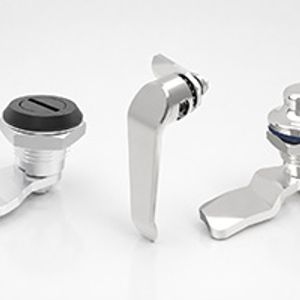
A quarter turn lock engages or releases with a 90-degree rotation of a cam, allowing fast access with a tool or key while keeping a low mounting profile. This makes it a common choice for electrical cabinets and control panels where technicians need repeated, quick access without a bulky handle assembly. Sealing performance is moderate on its own; when paired with a compressed gasket, it holds up reasonably well, but on high-exposure outdoor sites it is usually not the first choice unless combined with additional sealing hardware.
Why Are Compression Latches Used Outdoors?
Compression latches draw the door inward against a gasket using cam action, creating a positive sealing force rather than simple surface contact.
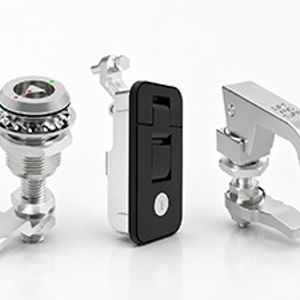
That distinction matters more than it sounds. A latch that only holds a door "closed" leaves gaps for moisture and dust to find their way in through vibration-induced flex. A compression latch actively squeezes the gasket, which is precisely why most IP-rated outdoor enclosures depend on this mechanism to achieve their rating in practice, not just on paper. This is the latch family we specify most often for outdoor telecom cabinets, coastal substations, and enclosures exposed to rain and airborne dust.
When Should You Use Rotary Latches?
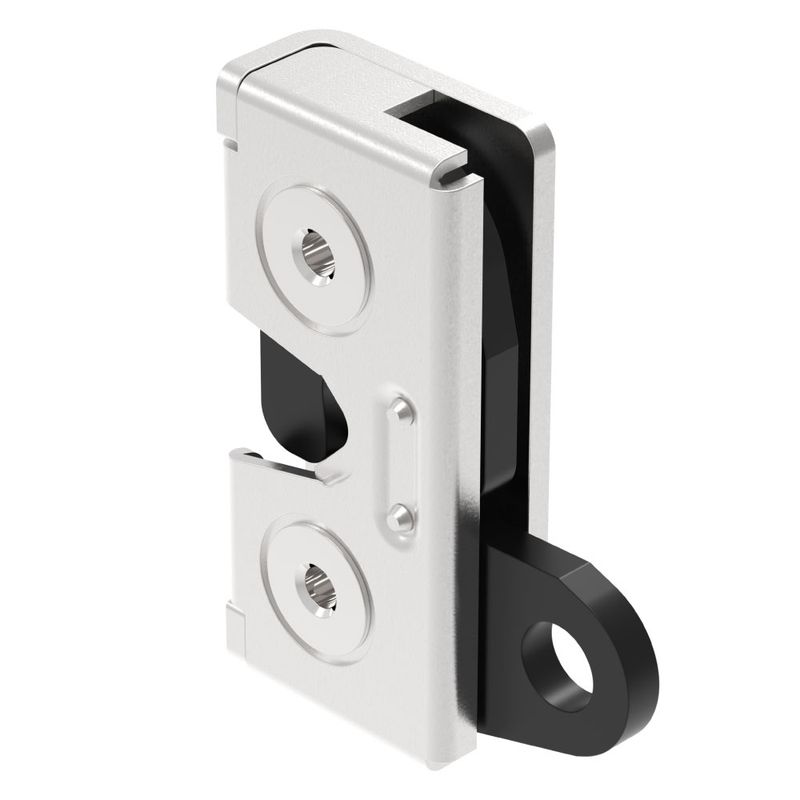
Rotary latches use a hook-style rotational engagement that resists pull-out force far better than simple hook latches, making them suited to shock-load applications.
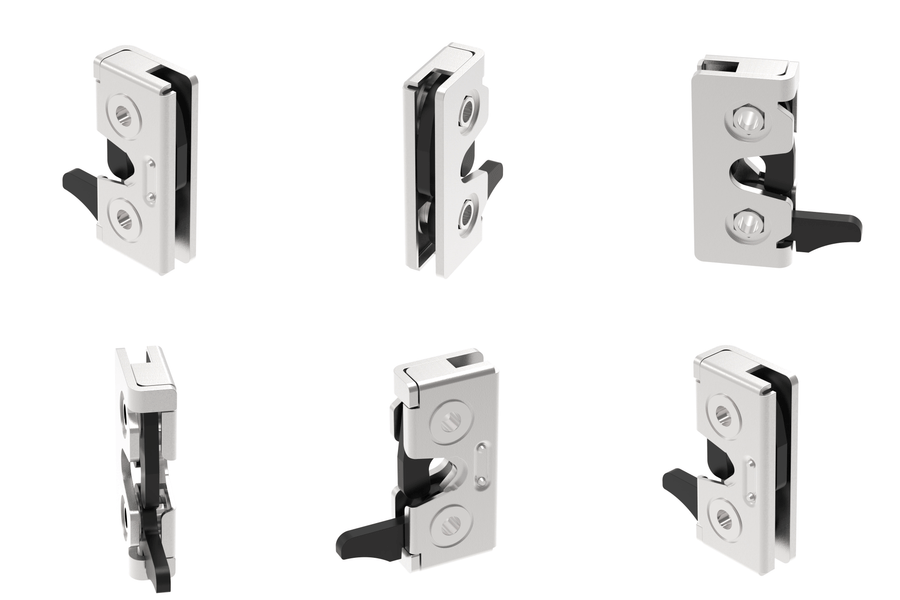
They show up frequently on vehicle doors and heavy equipment access panels where the door experiences repeated impact and vibration rather than steady load. Their strength lies in holding position under sudden shock, not in sealing performance, so they are often paired with separate gasket systems when weather resistance is also required.
What Makes Swing Handles Different from Standard Latches?
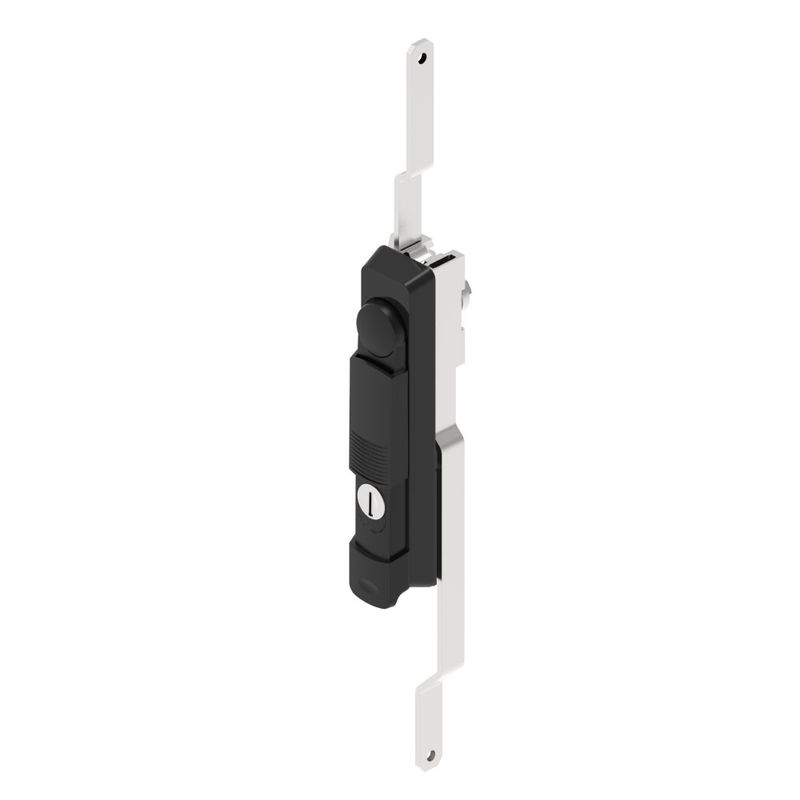
A swing handle actuates multiple locking points from a single handle turn, distributing locking force evenly across a large door rather than concentrating it at one point.
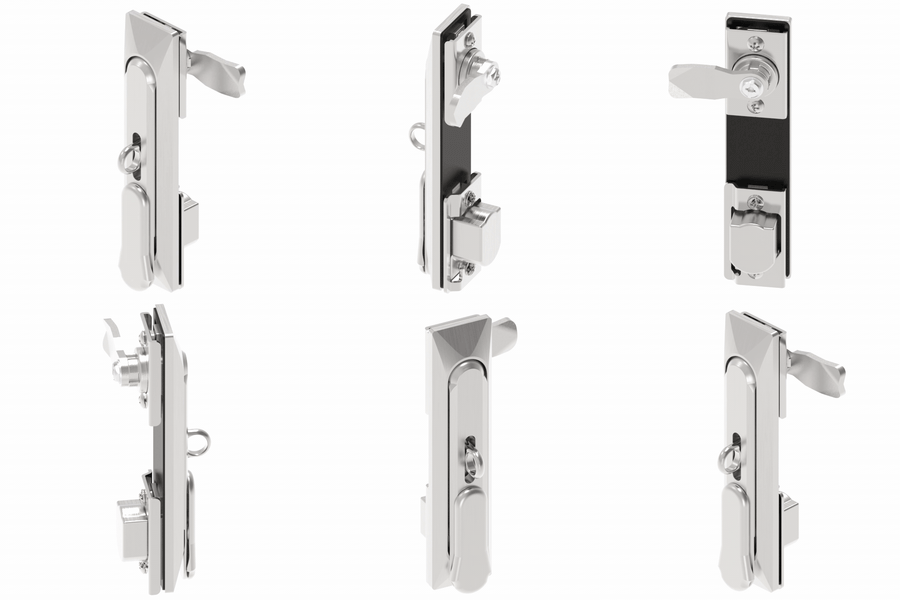
On large cabinet doors, uneven locking force causes warping over time, which in turn breaks the gasket seal at the edges furthest from the latch. Swing handles solve that by tying several rods to one actuation point, which is why they dominate large-format industrial cabinet applications.
Where Are Cam Locks Still the Right Choice?
Cam locks remain the right choice for small panels and junction boxes where load is light and footprint constraints rule out larger mechanisms. They are cost-efficient and simple, but their load capacity is limited — they are not a substitute for compression latches or multi-point systems on larger or heavier enclosure doors. We see cam locks misapplied fairly often on doors that have simply outgrown them, which leads to premature latch wear.
How Do Push Button Locks Improve Access Speed?
Push button locks allow tool-free, single-hand operation, which speeds up access on panels that technicians open frequently during routine service. The trade-off is a lower security tier compared with keyed or multi-point systems, so they are best reserved for low-risk internal access rather than perimeter or high-value equipment enclosures.
Why Do Large Cabinets Need Multi-Point Locking Systems?
Multi-point locking systems distribute locking force across several points on a single door, which improves gasket compression uniformity and reduces door flex. On large-format outdoor cabinets, a single-point latch simply cannot hold the whole door flat against the frame under wind load or thermal expansion. Multi-point systems keep the seal consistent along the entire door edge, which is often the deciding factor in whether an enclosure actually achieves its rated IP performance in the field.
Which Materials Perform Best in Humid and Corrosive Environments?
Stainless steel resists corrosion best in humid and chemical-exposure environments, zinc alloy suits cost-sensitive indoor applications, and engineering plastics serve lightweight, electrically insulated installations. Material selection is arguably the single most decisive factor in whether an industrial lock survives a coastal or chemical-plant deployment, more so than the mechanism type itself.
When Should You Specify Stainless Steel Locks?
Stainless steel should be specified whenever the installation involves chloride exposure — coastal air, marine-adjacent sites, or chemical vapor — because it resists the pitting corrosion that destroys plated components. The grade distinction matters: 304 stainless performs adequately in general outdoor use, but 316 stainless, with its added molybdenum content, holds up significantly longer under sustained salt spray exposure and chloride contact. In salt spray testing, 316 grade components commonly reach several hundred additional hours before red rust onset compared with 304 under identical test conditions, which translates directly into extended service life at coastal or chemical-exposure sites. Stainless steel is the default specification for food processing equipment, medical equipment, outdoor telecom enclosures, and any installation near marine air or chemical vapor.
Neutral Salt Spray Test for ForndLock Rotary Locks & Swing Hinges
Why Choose Zinc Alloy for Indoor Applications?
Zinc alloy offers a strong strength-to-cost ratio and casts well into complex geometries, making it a practical choice for indoor cabinets where corrosion exposure is limited. Its protection depends entirely on plating — chrome, nickel, or similar coatings — and once that coating is scratched or worn through, the base metal corrodes quickly underneath. Typical plated zinc components hold up reasonably well indoors for years, but we do not recommend zinc alloy for direct outdoor exposure or washdown environments unless an additional protective coating is applied, and even then, it should not be treated as a substitute for stainless steel on genuinely corrosive sites.
What Role Do Engineering Plastic Components Play?
Engineering plastics contribute lightweight construction and electrical insulation value, particularly on live-panel applications where metal components would introduce shock risk. They reduce overall assembly weight on panels where every gram matters, and they eliminate the conductivity concerns metal locks introduce near electrical components. Their limitation is environmental: extended ultraviolet exposure and wide temperature swings cause embrittlement over time, so plastic components are generally better suited to indoor or shaded outdoor use rather than direct sun and weather exposure over many years.
What Security Standards and Ratings Apply to Industrial Locks?
Industrial lock security is measured through IP sealing ratings, mechanical strength and cycle-life testing, and salt spray corrosion resistance, with requirements varying by industry. These three testing categories, taken together, tell you far more about real-world lock performance than a generic "industrial grade" label ever will.

What Do IP54, IP65, IP66, and IP67 Actually Mean?
IP ratings describe a two-digit measure of protection against solid particle ingress and liquid ingress, and they apply to the enclosure system as a whole, not to the lock in isolation.
Rating | Dust Protection | Water Protection | Typical Application |
IP54 | Limited dust ingress protected | Splashing water from any direction | Indoor equipment near light moisture exposure |
IP65 | Dust-tight | Low-pressure water jets from any direction | Outdoor cabinets, telecom enclosures |
IP66 | Dust-tight | High-pressure water jets | Coastal and washdown-adjacent installations |
IP67 | Dust-tight | Temporary immersion up to one meter | Enclosures exposed to flooding risk or heavy rain pooling |
A common mistake in the field is assuming that a lock's stated IP rating holds regardless of how it is mounted. It does not. The rating depends on the gasket condition, the compression force the latch mechanism actually delivers, and the precision of the installation itself. A compression latch rated for IP66 performance will not deliver that protection if it is mounted on a warped door or torqued unevenly — the lock is only one part of a sealing system that includes the gasket, the door structure, and the installation quality.
How Is Mechanical Security Performance Measured?
Mechanical security is evaluated through locking strength and holding force under pull and shear load, tamper resistance testing, and cycle life testing that counts operations before failure. Holding force testing determines how much force a latch can resist before disengaging under load, which matters directly for doors exposed to vibration or impact. Tamper resistance evaluation checks how easily a lock can be defeated without the correct key or actuator. Cycle life testing runs a lock through repeated open-close operations to establish a realistic service interval before component fatigue sets in — a figure that matters far more for frequently accessed service panels than for rarely opened enclosures.
How Is Corrosion Resistance Actually Tested?
Corrosion resistance is tested primarily through salt spray (fog) testing, which exposes components to a continuous saline mist and measures the hours until visible red rust appears on the base metal. Material grade and surface treatment change the outcome significantly: passivated stainless steel, properly plated zinc alloy, and untreated mild steel will show dramatically different rust onset times under the same test chamber conditions. In our own testing process, we run salt spray evaluation on new material and coating combinations before recommending them for coastal or chemical-exposure projects, because a coating that performs well in a lab chamber under controlled conditions does not always behave identically in a field environment with variable temperature, wind-driven salt deposition, or intermittent chemical splash. Lab test duration gives a comparative benchmark between materials, but we treat it as a starting point for field validation, not a final guarantee — which is why we encourage customers on genuinely severe sites to run a pilot installation before committing to volume deployment.
Do Different Industries Require Different Lock Standards?
Different industries do require different lock standards, because the dominant failure mode changes from one application to another. Electrical equipment applications prioritize insulation properties and fire-safety compliance, since a lock near live components must not introduce conductivity or combustion risk. Transportation equipment prioritizes shock and vibration endurance, since doors on vehicles and heavy equipment experience constant mechanical stress that stationary cabinets never see. Food processing applications require washdown-rated, hygienic materials that tolerate repeated caustic cleaning cycles. Outdoor industrial systems — including the coastal and chemically exposed sites this guide is centered on — demand a combined IP and corrosion resistance profile, because neither sealing performance nor material resistance alone is sufficient; both have to hold up together over years of exposure. This combined requirement is also where explosion proof industrial locks for hazardous chemical plants become relevant: enclosures in classified hazardous areas need locking hardware that satisfies ignition-prevention requirements in addition to standard IP and corrosion criteria, which narrows the acceptable lock and material combination considerably.
How Do You Select the Right Industrial Lock for Your Application?
Choosing the right industrial lock requires matching the operating environment, security demand, door structure, and material grade to the application, not selecting by appearance or price alone.
Environment | Recommended Lock Type | Recommended Material | Minimum IP Guidance |
Indoor, dry, controlled | Cam lock or quarter turn | Zinc alloy | IP54 |
Indoor, high traffic | Push button or swing handle | Zinc alloy or plastic | IP54–IP65 |
Outdoor, general weather | Compression latch | Stainless steel 304 | IP65 |
Coastal, marine-adjacent | Compression latch or multi-point | Stainless steel 316 | IP66 |
Chemical plant, corrosive vapor | Multi-point or explosion proof lock | Stainless steel 316 | IP66–IP67 |
Vehicle or heavy equipment | Rotary latch | Stainless steel or hardened alloy | IP65 |
How Does the Application Environment Affect Lock Choice?
The operating environment sets the baseline requirement before any other factor is considered, because a lock that meets every mechanical need will still fail if it cannot survive its surroundings. Indoor installations can generally use standard zinc alloy hardware with modest sealing. Outdoor sites, and particularly industrial locks for high humidity and corrosive outdoor environments, shift the priority toward stainless steel construction and compression-based sealing from the outset. High-vibration settings, separately, push the priority toward mechanical retention — rotary latches and swing handles that resist disengagement under repeated shock, regardless of how dry or clean the site is.
What Security Requirements Should Drive Your Decision?
Security requirements should be based on access frequency, the level of unauthorized access risk at the site, and whether single-point or multi-point locking matches that risk profile. A panel opened dozens of times a day by rotating staff has different wear and access-control needs than a rarely opened enclosure holding sensitive control equipment. Higher-risk sites generally justify multi-point locking not just for sealing reasons but because distributed locking points are harder to defeat than a single latch.
How Do Door Structure and Load Affect Lock Selection?
Door weight, size, and the operating frequency of the panel determine which latch or handle mechanism can physically support reliable long-term engagement. A large, heavy outdoor cabinet door under wind load needs a multi-point or swing handle system to avoid warping; a small junction box door under no meaningful load can use a simple cam lock without any performance compromise. Vibration load from nearby machinery or vehicle transport adds another variable, favoring rotary latches or reinforced compression latches over lighter mechanisms.
How Should Material and Protection Level Be Matched?
Material and IP rating should be matched to environmental severity, with stainless steel and higher IP ratings reserved for humid, corrosive, or chemically exposed sites, and zinc alloy reserved for controlled indoor conditions. Overspecifying is rarely a problem beyond cost; underspecifying is what leads to the field failures described at the start of this guide.
How Should Industrial Locks Be Installed for Reliable Performance?
Reliable industrial lock performance depends on correct mounting position, proper torque, door alignment, and post-installation testing — steps that are frequently skipped in field installation.
Why Does Mounting Position Affect Lock Life?
Mounting position affects lock life because misaligned cutouts or brackets introduce uneven stress that accelerates wear on the latch and strike. Poor engagement between the latch mechanism and its striker means the lock is fighting misalignment every time it operates, which shortens component life well before the rated cycle count is reached.
Why Does Installation Torque Matter?
Installation torque matters because overtightening deforms the gasket or housing, while undertightening leaves mounting hardware loose and creates gaps in the seal. Both mistakes are common and both defeat the purpose of specifying a sealed, corrosion-resistant lock in the first place — a properly rated component installed with the wrong torque will not deliver its rated protection.
How Do You Check Door Alignment Before Final Fit?
Door alignment should be checked by verifying smooth latch engagement across the full swing of the door and confirming consistent gasket contact along the entire seal line. Any binding, uneven contact, or resistance during a manual open-close test before final fastening indicates an alignment issue that should be corrected before the installation is considered complete.
What Should You Test After Installation?
After installation, the lock should go through an opening and closing cycle test along with a sealing verification check, particularly on enclosures that carry an IP rating. This confirms not just that the lock functions, but that the gasket compression and door fit actually deliver the protection level the enclosure was specified to achieve.
How Do You Maintain Industrial Locks for Long-Term Performance?
Long-term industrial lock performance depends on scheduled inspection, cleaning and lubrication, and timely replacement of worn components before corrosion or wear compromises security.
What Should Regular Inspection Cover?
Regular inspection should cover visible wear on latch and cam surfaces, early corrosion signs on plated components, and loose fasteners or mounting hardware. Catching corrosion at the surface stage — before it reaches the base metal — is far cheaper than replacing a seized latch assembly later.
How Often Should Locks Be Cleaned and Lubricated?
Cleaning and lubrication intervals should scale with environmental severity, with corrosive or outdoor sites requiring more frequent attention than controlled indoor settings. Lubricant selection matters as much as frequency: general-purpose lubricants break down faster under salt exposure or chemical vapor, so corrosive-environment applications call for lubricants formulated for that exposure rather than standard indoor products.
When Should You Replace Damaged Lock Components?
Damaged lock components should be replaced as soon as cylinder wear, latching mechanism fatigue, or seal degradation is identified, rather than waiting for complete failure. Gasket and seal materials on outdoor enclosures typically hold their sealing performance for roughly three to five years before compression set and material aging reduce their effectiveness, and outdoor lock hardware in coastal or chemical-exposure settings often warrants a full replacement cycle earlier than its indoor equivalent given the accelerated corrosion environment. Waiting until a component visibly fails usually means the enclosure has already been compromised for some time before anyone notices.
How Do You Sustain Security Performance Over Years of Use?
Sustaining security performance over years of use means documenting inspection history for audit and compliance purposes and replacing components proactively rather than reactively. A documented maintenance record also gives procurement and engineering teams the data needed to adjust lock specifications on the next project rather than repeating the same premature-failure cycle.
What Selection Mistakes Reduce Industrial Lock Reliability?
The most common industrial lock selection mistakes are choosing by appearance, ignoring environmental exposure, underestimating vibration, misjudging IP rating needs, and overlooking maintenance requirements.
Selecting by appearance or price without environmental analysis is the mistake behind most of the early failures we get called in to diagnose — a lock that looks identical to a properly rated one on a shelf can have a completely different base material underneath its plating. Ignoring corrosive or humid site conditions until failure occurs is closely related: teams often specify hardware based on a general "outdoor rated" label without checking whether that rating was tested for the specific chloride or chemical exposure their site actually presents. We reviewed one project where a client had specified painted mild steel latches for a chemical storage yard based on a general outdoor rating; within a year, the paint had blistered from chemical vapor contact and the latches had rusted solid, requiring an unplanned mid-project retrofit to stainless steel hardware.
Underestimating vibration load leads to latch fatigue that shows up as intermittent sticking long before complete failure. Choosing an incorrect IP rating for the actual exposure level — specifying IP54 on a site that experiences direct rain or pressure washing — guarantees moisture ingress regardless of how well the lock itself is built. And overlooking maintenance access when specifying lock location creates a situation where the correct hardware is chosen, but nobody can reach it easily enough to inspect or service it on schedule, which defeats the maintenance plan before it even starts.
Where Are Industrial Locks Used Across Different Industries?
Industrial locks secure electrical cabinets, telecom equipment, industrial machinery, railway systems, commercial vehicles, and food processing equipment, each with distinct environmental and load demands.
Electrical cabinets require insulation properties alongside tamper resistance, since unauthorized access near live components carries safety implications beyond simple theft prevention. Telecom equipment, frequently mounted outdoors on poles, towers, or roadside cabinets, needs outdoor IP rating combined with corrosion resistance as a baseline, not an upgrade. Industrial machinery enclosures need to withstand continuous vibration and high cycle life given how often service panels are opened during routine maintenance. Railway equipment combines shock load resistance with sustained weather exposure across years of outdoor service. Commercial vehicles favor vibration-tolerant hardware, with rotary latches showing up frequently on cargo and equipment access doors. Food processing equipment requires hygienic, washdown-resistant materials that tolerate repeated caustic cleaning without degrading — a requirement that overlaps closely with the corrosion resistance demands of coastal and chemical sites, even though the exposure source is different.
ForndLock: Heavy-Duty Compression Locks for Railways
How Can ForndLock Support Your Custom Industrial Lock Project?
We support custom industrial lock projects from drawing evaluation through prototype testing to volume production, adapting dimensions, materials, and coatings to each application's environment.
We work directly from customer drawings to develop dimensionally accurate custom locks rather than modifying off-the-shelf parts to fit an application they were never designed for. When a project involves humid, coastal, or chemically exposed installations, we review the environmental data — chloride exposure level, temperature range, chemical vapor type — and recommend a material and coating combination suited to that specific profile, rather than defaulting to a generic "outdoor" specification. Surface treatment options including passivation, plating, and coating are matched against salt spray requirements and the target IP rating for the enclosure.
ForndLock Unveiled: Inside Our State-of-the-Art Factory
On one recent custom development, a customer supplied cabinet drawings for an outdoor telecom application along with site data indicating sustained coastal salt exposure. We evaluated the drawing, recommended a 316 stainless compression latch configuration in place of the originally specified zinc alloy quarter turn lock, produced a small prototype batch for the customer's own field and salt spray testing, and moved into volume production only after that sample round confirmed the sealing and corrosion performance held up under their actual site conditions. That sequence — drawing review, material recommendation, sample validation, then production — is how we approach most custom projects, including specialized categories such as explosion proof industrial locks for hazardous chemical plants, where material grade, sealing method, and ignition-prevention design all have to be engineered together rather than treated as separate specifications.
How Should You Start Your Next Industrial Lock Project?
Industrial lock selection is a technical decision shaped by environment, load, and applicable standards — not a generic hardware pick made from a catalog page. Outdoor, humid, and corrosive sites in particular demand upfront material and sealing analysis, because the cost of correcting a poor specification after installation is always higher than the cost of getting it right at the drawing stage.
If your project involves coastal, offshore, or chemically exposed installations, we can review your environmental data and recommend a lock construction suited to long-term corrosion resistance rather than short-term cost savings that show up as a maintenance problem within a year or two. Send us your cabinet drawings and operating environment details, and our engineering team will identify the locking configuration that fits your load, sealing, and access-control requirements.
If you are specifying industrial locks for a new project — particularly for high humidity, corrosive, or hazardous chemical environments — contact ForndLock with your drawings and application requirements. Our team can evaluate material selection, IP rating, and locking mechanism together, then support you from prototype sample through mass production.
Recommended Products
Obtain Solutions
Get product guidance, samples, and custom solutions.