When One Push Closes the Panel: Concealed Rotary Draw Latches for Remote-Access Enclosures
Flush medical cabinets, cleanroom panels, telecom doors and vehicle compartments share one design brief: no protruding hardware on the panel face, and a latch deep inside the door doing the holding. At ForndLock, we build that concealed side — rotary draw latches, drive mechanisms and cable systems — and this article explains how the architecture works, where it beats exposed toggles and compression latches, and what to check before releasing drawings.
Push-to-Close: Why the Draw Motion Fits Concealed Panels
A conventional exposed toggle latch requires a visible handle, an external keeper, and a deliberate two-handed closing sequence. A concealed rotary draw latch inverts this arrangement: the latch body mounts inside the door frame edge, a small striker mounts to the cabinet, and closing requires only a single push.
Three mechanical advantages make this concealed draw motion effective:
● Low Closing Force: The rotor and pawl geometry present low, near-constant resistance as the striker enters. The mechanism's leverage ratio—rather than operator manual force—generates the final clamping force, allowing large doors to shut smoothly.
● Misalignment Tolerance: The angled entry mouth accepts the striker across a defined capture window. Hinge wear, frame flex, and mounting tolerances do not impede engagement, eliminating the need to precisely align a latch tongue against a frame edge.
● Flush Face, No Snag Points: Once the pawl drops behind the rotor, the striker remains locked inside the jaw. Only a clean panel seam remains visible externally—eliminating exposed handles that could catch clothing, suffer vandalism, or trap washdown fluids.
Compared to an exposed draw toggle, the concealed rotary latch provides equivalent retention load with a flush outer profile. Compared to a standard cam latch, it adds slam-closing convenience and a secondary safety catch.
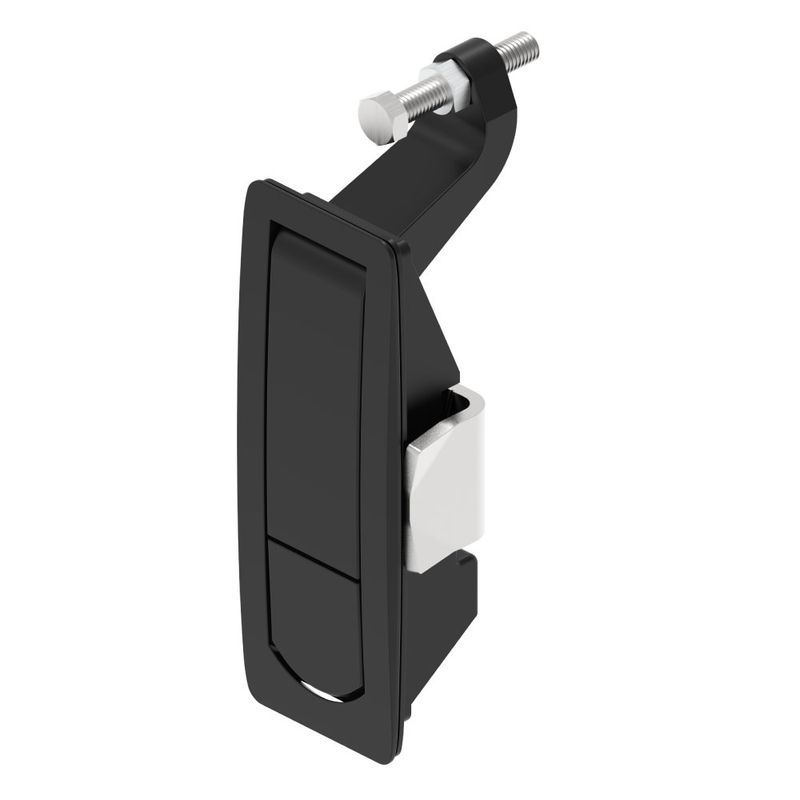
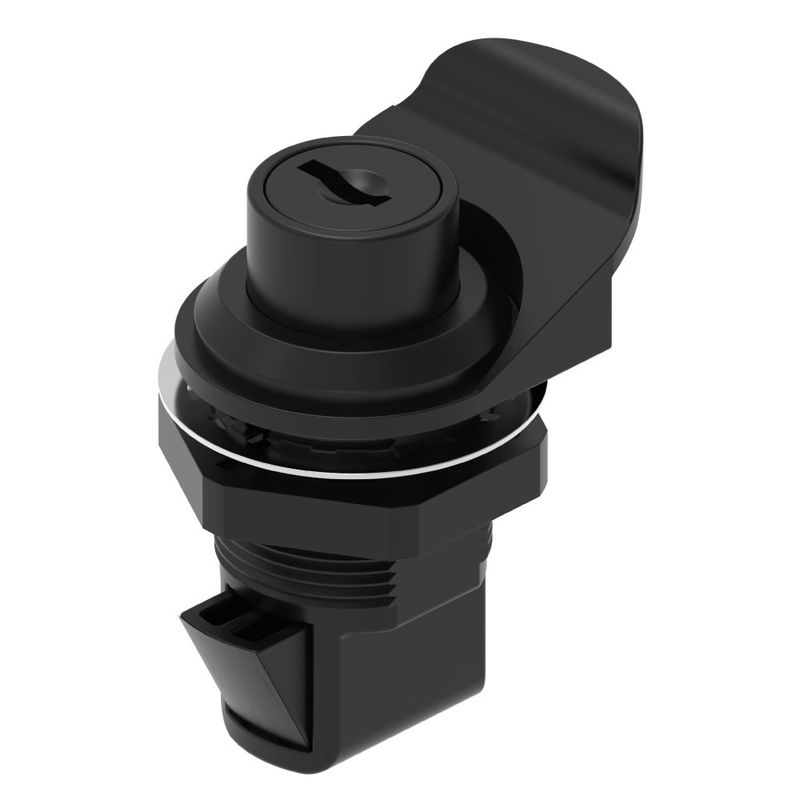
The table below covers the push-to-close rotary family; models with an integral release lever suit semi-concealed installations where the lever sits behind a secondary cover or inside the door edge.
Product | Image | Structure & Spec | Release / Drive Interface | Typical Scenario |
 | Compact single-rotor, slam shut, metal release lever | Bottom drive; links to handles or button mechanisms | RV storage doors, trailer toolboxes, equipment access covers | |
 | Compact direct drive; 6.4 mm striker stroke; 2,600 N ultimate load | Direct handle connection, minimal linkage | Light-medium panels, vehicle enclosures, sealed covers | |
 | Slam-shut rotor with integrated cable bracket | Bottom interface connects steel cable or external button | Remote-release panels, multi-point systems, engine compartments | |
 | Matched Bowden-type cables for OEM volume programs | Connects latch, release lever and handle | Complete cable-controlled installations |
One Handle, Multiple Points: Cable Actuation Explained
Because the latch sits deep in the door and the handle must sit where the operator is, the release has to travel. The answer is cable actuation — a steel or Bowden-type cable connecting the latch's release lever to a handle, T-bar or button at the panel edge. One handle can drive one latch on a small hatch or, through a junction block, two or more latches along a tall door, scaling single-point access panels into full-height enclosures without multi-handle clutter.
Successful cable routing requires evaluating three critical engineering parameters:
● Minimum Bend Radius: Exceeding cable bend limits sharply increases internal friction, resulting in stiff handle operation and incomplete release. Route generous curves instead of sharp corners.
● Working Stroke Margin: The cable's pull travel must exceed the latch lever's release throw with built-in tolerance. Insufficient stroke leaves the pawl partially engaged, causing mechanism binding.
● Multi-Point Timing Alignment: Varied cable lengths and friction paths cause distant latches to release later. Adjust cable lengths or lever geometry so all strikers clear simultaneously before the door swings open.
Drive orientation is a key early architectural choice. Vertical drive suits handles mounted above the latch line, bottom drive accommodates sill-level or T-bar releases, and direct drive eliminates the cable entirely when the handle sits inline with the latch. For integrated cable setups, bracket-equipped rotary latches provide dedicated housing termination. For shorter handle-to-latch runs, ForndLock T-handle quarter-turn latches with shaft outputs can drive release linkages directly, combining key-locking access with the release input.
Drive Layout | Cable / Linkage Path | Best For | Watch Out For |
Vertical drive | Lever above the latch line | Handles mounted over the latch point | Linkage binding caused by structural panel flex |
Bottom drive | Lever below with downward cable exit | Sill-level handles, T-bars, low cable routing | Water tracking along cables (seal entry ports) |
Direct drive | No cable; handle mounts directly to latch | Small panels requiring minimal parts count | Handle position fixed directly at latch location |
Cable actuated | Bowden cable with remote bracket termination | Concealed multi-point doors, engine bays | Cable bend radius, travel margin, and timing synchronization |
Draw Tension and Panel Alignment: Closing Even Gaps Without Compression Latches
A concealed rotary draw latch closes the door with the same draw action as its exposed toggle cousins: the rotor pulls the striker the last few millimeters and clamps the panel against its stops. This sets the final gap uniformity along the door edge, because the jaw pulls to a fixed, repeatable closed position rather than resting wherever friction left it.
Gap alignment and gasket compression are separate requirements, and they drive different latch choices:
● Rotary Draw Latches: Ideal for flush appearance, slam closing, uniform gap control, and vibration-safe retention on lightly sealed or dust-proof panels. The mechanism pulls the door against hard stops for precise structural alignment.
● Compression Latches: Required when enclosures demand verified IP-rated fluid sealing using 2 mm to 4 mm of continuous gasket squeeze.
Many OEM designs combine both mechanisms: utilizing rotary draw latches on flush access panels where dust resistance and quick slam closure are required, and compression latches on dedicated washdown compartments.

Light, Medium or Heavy: Sizing by Panel Weight
Size the latch class from panel weight and door dynamics rather than door area. Size the system from the working load the door imposes in its worst attitude (an upward-opening compartment door at full extension imposes very different loads than a vertical hatch), then verify the striker and hinge set share the safety margin.
Load Class | Panel Weight Band | Typical Configuration |
Light | Up to ~20 kg doors and covers | Single rotary latch, direct or short-cable drive |
Medium | 20–60 kg equipment doors | One or two latches, T-bar or cable release |
Heavy | 60 kg+ or high-racking doors | Two to three latches on one handle, junction timing |
Setup Checks for a Cable-Controlled System
Before sign-off on a concealed cable system, run four checks in this order — they catch nearly every field complaint we see returned to our service desk:
1. Cycle the release from the handle with the door both open and closed; release force must stay consistent across temperature range, because cable housing expands and contracts.
2. Verify full pawl travel at each latch point; a latch that releases at 90% of stroke in the workshop will hang at 95% after gasket aging.
3. Confirm multi-point sequencing by operating the handle slowly and watching each striker clear before the door begins to swing.
4. Inspect cable entries for sealing — an unsealed bottom-drive exit is a direct water path into the door cavity on outdoor enclosures.
About ForndLock
ForndLock engineers heavy-duty rotary latches, compression systems, and cable-actuated hardware for industrial enclosures and transport equipment. From single-rotor mechanisms to multi-point cable drives, we provide end-to-end OEM/ODM design, load validation, and custom manufacturing. Contact ForndLock for cable routing review, prototype samples, and engineering support.
Email: [email protected]