
How To Choose The Right Lock Cylinder: Measure Lock Cylinder Size For Door Replacement?
As the chief manufacturing engineer at ForndLock, I frequently encounter procurement officers and mechanical engineers grappling with a fundamental hardware dilemma: How to choose the right lock cylinder? While many OEM clients focus heavily on the metallurgical properties of the internal pins or the drill resistance of the solid brass housing, our decades of manufacturing experience reveal a completely different reality in the field. The most critical point of failure in industrial hardware upgrades is almost never material weakness, but rather incorrect dimensional sizing. When dealing with heavy-duty telecommunications cabinets, high-voltage electrical enclosures, or reinforced machinery access panels, a misalignment of even a single millimeter can compromise the entire structural integrity of the unit. We have observed countless field failures where premium locking mechanisms bind, jam, or invite severe environmental ingress simply because the dimensions were rapidly estimated rather than precision-engineered. To prevent mechanical binding and security breaches in industrial enclosures, mastering how to measure lock cylinder size for door replacement is the definitive method that every technical professional must implement. This precise technical execution ensures that the specified hardware integrates flawlessly with the existing panel architecture, maintaining the rigorous IP ratings and security standards demanded by modern industrial applications.

Why Does Cylinder Sizing Matter?
Cylinder sizing matters because incorrect dimensions lead to mechanical binding, compromised enclosure security, and immediate operational failures in industrial applications.
In the realm of industrial manufacturing, the tolerances required for specialized enclosures such as telecommunications cabinets, heavy machinery access panels, and high-voltage electrical boxes are incredibly unforgiving. Unlike standard commercial doors where a slight hardware mismatch might only cause a minor aesthetic issue, industrial rigidity demands absolute dimensional precision. If a specified component protrudes even slightly beyond the exterior protective plate, it immediately invites tampering, forced extraction attempts by unauthorized personnel, and severe environmental damage from rain, ice, or corrosive industrial chemicals. Conversely, a unit that sits too deeply recessed within the heavy metal panel prevents proper key engagement, rendering the mechanism entirely useless for maintenance engineers who need rapid access during critical system emergencies. Our metallurgical testing facilities at ForndLock have repeatedly demonstrated that off-center torque applied to an improperly sized keyway accelerates the degradation of the internal pins, springs, and the actuating cam itself.
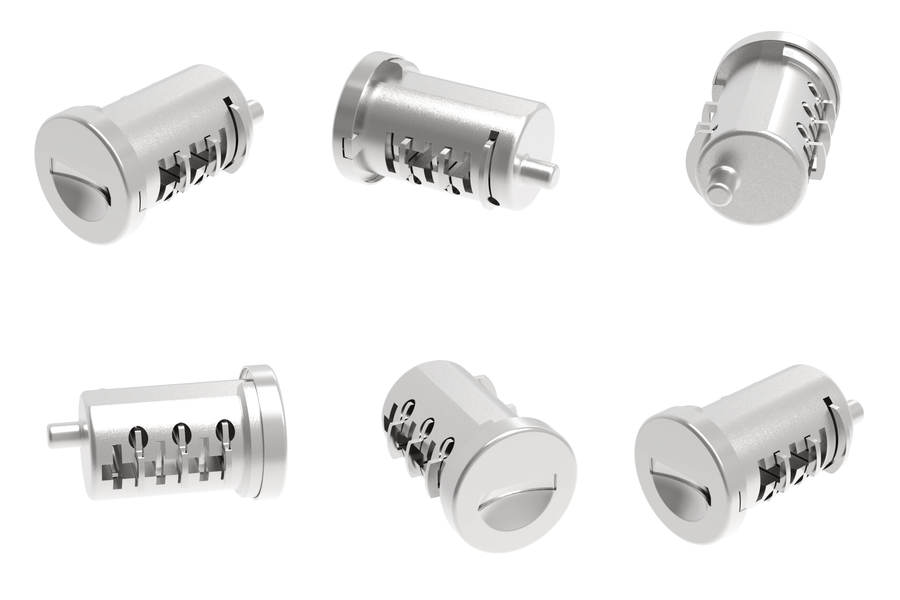
Furthermore, industrial environments are subject to intense mechanical vibrations and extreme thermal expansion. An improperly sized unit will rattle within its housing, eventually destroying the internal weather seals. Therefore, determining exactly how to choose the right lock cylinder is fundamentally an exercise in dimensional control, ensuring that the hardware interface acts as a seamless continuation of the enclosure's protective barrier rather than its weakest structural vulnerability.
How To Measure Accurately?
You measure accurately by using precise industrial calipers to determine the exact distance from the central fixing screw to both the interior and exterior cylinder faces.
When OEM clients ask our engineering team how to measure lock cylinder size for door replacement, we emphasize that sub-millimeter precision is absolutely non-negotiable. The procedure begins by removing the existing hardware entirely from the machinery panel to expose the bare mechanism. The critical reference point for all measurements is the threaded hole where the central cam retaining screw is inserted. From this dead center, engineers must measure outward to the extreme edge of the exterior face, and then repeat the process measuring from the center to the extreme edge of the interior face. This bipartite measurement approach is essential because industrial panels frequently utilize asymmetrical locking configurations to accommodate internal thermal insulation layers, heavy-duty weather stripping, or complex latching linkages. Relying on a single overall length measurement will invariably result in a misaligned cam, which will fail to actuate the internal mortise case properly. By isolating the internal and external dimensions, procurement officers can guarantee that the replacement component will position the actuating cam exactly where the internal mechanical linkage requires it, completely eliminating the risk of operational binding and reducing long-term maintenance costs.
What Tools Are Strictly Required?
Digital calipers and specialized depth gauges are strictly required to ensure the sub-millimeter accuracy necessary for industrial door hardware.
At ForndLock, we strictly prohibit our field technicians from utilizing standard retractable measuring tapes when assessing panel hardware requirements. Measuring tapes introduce unacceptable tolerance stacking errors due to the loose end hooks and the visual parallax effect when reading the printed gradations. Instead, mechanical engineers must utilize calibrated digital calipers constructed from hardened stainless steel, capable of resolving measurements to at least two decimal places of a millimeter. For enclosures featuring deeply recessed mounting brackets or complex multi-layered security plates, a specialized machinist depth gauge is also mandatory. These rigid instruments allow the user to bridge across the escutcheon opening and drop a precision probe directly down to the central cam screw axis without interference from the surrounding sheet metal. Utilizing these specific metrology tools removes human estimation from the equation, providing the exact numerical data required to interface directly with our manufacturing CNC programming systems when producing custom hardware batches for specialized industrial projects.
How To Calculate Total Length?
You calculate the total length by adding the internal measurement, the external measurement, and the thickness of any installed escutcheon plates or hardware covers.
The mathematical calculation must reflect the installed reality of the enclosure rather than just the bare metal panel. Once the engineer has determined the distance from the center of the actuating cam to the external environment boundary and from the center of the cam to the internal compartment boundary, these figures are documented as a specific ratio. For example, a measurement of thirty millimeters on the exterior and forty millimeters on the interior is classified in our manufacturing database as a 30/40 configuration, yielding a base total length of seventy millimeters. However, the calculation is not complete until the structural additions are factored into the equation. If the exterior of the machinery door features a five-millimeter hardened anti-drill escutcheon, that exact dimension must be added to the external radius to ensure the keyway remains perfectly accessible to the operator. For switchgear cabinets requiring access from only one side, a half-profile ratio such as 10/30 must be calculated using the exact same central reference point. This rigorous calculation protocol is a central pillar of how to choose the right lock cylinder, ensuring the final product integrates harmoniously with all auxiliary security plates.
What Are Common Measurement Mistakes?
The most common measurement mistakes include ignoring the thickness of weather seals and measuring from the edge of the door instead of the central cam screw.
According to ForndLock's exclusive internal laboratory data, approximately forty percent of the initial hardware prototypes requested by new OEM clients fail during their first fitment test on the assembly line. This high failure rate is almost entirely attributed to flawed measurement methodologies executed in the field. Engineers frequently measure the overall thickness of the metal panel itself and incorrectly assume that dimension directly correlates to the required hardware length. This fundamental error completely ignores the compression dynamics of heavy-duty industrial neoprene weather gaskets, internal mounting brackets, and the depth of external protective shrouds. Another highly pervasive error is measuring from the physical edge of the locking mechanism housing rather than the exact dead center of the tapped cam screw hole. Because the actuating cam is the primary interface between the user's key rotation and the panel's internal latching rods, any deviation from this central axis shifts the entire mechanism out of alignment, causing instant mechanical failure. Avoiding these documented pitfalls is crucial for procurement officers who need to secure reliable components without suffering through multiple costly prototyping iterations.
What Dictates Euro Profile Selection?
Euro profile selection is dictated by the specific door thickness, the asymmetry of the locking mechanism, and the required security clearance for external hardware.
In numerous specialized industrial sectors, the European profile has become the undisputed global standard due to its highly modular architecture and reliable mechanical interchangeability. Understanding how to navigate the euro profile lock cylinder length selection guide by door thickness is paramount for any mechanical engineer tasked with upgrading infrastructure security. The modular nature of these components means that the central actuating cam remains consistently sized and positioned, while the internal and external solid brass housings can be elongated or shortened during the manufacturing process to match the exact dimensions of the host panel. We frequently provide our OEM partners with a comprehensive reference table mapping standard industrial door panel thicknesses directly to recommended hardware configurations. For instance, a heavily insulated fifty-millimeter equipment panel utilizing a perfectly centered mortise case will strictly require a symmetrical 25/25 unit, whereas the same panel featuring an offset latching mechanism will demand a highly customized asymmetrical variant. This level of precise thickness matching is what ultimately prevents the ingress of moisture, corrosive gases, and particulate matter into highly sensitive electrical compartments.
How Does Door Thickness Affect?
Door thickness directly affects the required cylinder length, forcing engineers to choose asymmetrical profiles when the lock case is not perfectly centered within the door panel.
Industrial enclosures are rarely constructed from single sheets of uniform, thin sheet metal. They typically incorporate complex structural ribbing, thermal insulation barriers, and heavy-duty sound-dampening materials designed to protect internal generators or routing equipment. As the overall thickness of the door increases to accommodate these essential features, the internal mortise case is frequently pushed far off-center to avoid intersecting with internal wiring channels or structural cross-braces. Consequently, the distance from the actuating cam to the exterior environment becomes vastly different from the distance to the interior compartment. This structural reality forces procurement officers to thoroughly evaluate the euro profile lock cylinder length selection guide by door thickness before finalizing their supply chain orders. An off-center installation in a heavily reinforced seventy-millimeter machinery panel might require a highly specific 30/40 or even 20/50 ratio to ensure the keyway sits perfectly flush on both sides of the barrier. Failing to account for this structural asymmetry results in hardware that either disappears completely into the panel recess or protrudes dangerously outward.
What Is The Selection Formula?
The standard selection formula requires adding half the door thickness to the escutcheon depth, plus a maximum of three millimeters for secure clearance.
At ForndLock, our manufacturing engineers utilize a strict mathematical protocol when consulting with industrial clients to verify their hardware specifications prior to mass production. To determine the correct external dimension, we take the measurement from the center line of the installed mortise case to the outer skin of the panel, add the exact millimeter depth of the protective exterior escutcheon, and incorporate a strict maximum protrusion allowance of three millimeters. This three-millimeter rule is an absolute industry standard designed to provide just enough clearance for the key bow to fully rotate without striking the painted panel, while simultaneously preventing enough surface area exposure for a perpetrator to grip the housing with heavy extraction tools. The internal dimension is calculated using the exact same base metric from the center line to the interior skin, adding any internal retaining plate thickness. By rigorously applying this selection formula to every single access point, mechanical engineers can confidently solve the problem of how to choose the right lock cylinder for even the most complex, multi-layered industrial enclosures operating in hostile environments.
How To Match Escutcheon Covers?
You match escutcheon covers by ensuring the cylinder face remains completely flush with the protective plate to prevent forced extraction or environmental damage.
The mechanical relationship between the core locking mechanism and its surrounding protective hardware is highly symbiotic in all heavy industrial applications. A premium escutcheon cover is completely rendered ineffective if the internal hardware protrudes excessively past its hardened steel face. When OEM clients design new machinery, they must cross-reference their chosen euro profile lock cylinder length selection guide by door thickness with the exact CAD dimensions of their selected escutcheon plates. At ForndLock, we engineer our precision products to achieve a perfectly flush fitment, which serves a critical dual purpose. Structurally, a flush installation denies leverage to heavy industrial tools such as pipe wrenches, locking pliers, or slide hammers, which are commonly used in brute-force sabotage attempts against remote infrastructure. Environmentally, keeping the keyway face flush with the protective collar allows for the highly effective installation of rotating weather covers and silicone dust seals. This precise dimensional matching guarantees that the stringent IP65 or IP67 ratings of the electrical cabinet are fully maintained throughout the entire operational lifespan of the equipment.
How Did We Solve Sizing?
We solved a critical sizing mismatch for a European telecommunications client by engineering perfectly calibrated custom cylinders for their upgraded outdoor equipment enclosures.
To clearly illustrate the profound impact of precise measurement, we frequently reference a major infrastructure project we handled for a leading telecommunications provider based in Germany. This client was in the process of deploying a massive network of next-generation 5G base stations across remote, highly exposed outdoor environments subject to extreme weather conditions. As part of their infrastructure upgrade, they had significantly reinforced the steel doors of their cabinets to protect the expensive routing equipment from both severe winter ice accumulation and targeted vandalism. However, this sudden change in panel architecture created an immediate and severe hardware crisis across their assembly lines. The procurement team quickly realized that their legacy hardware inventory was completely incompatible with the new structural dimensions, prompting them to contact ForndLock's engineering division to determine exactly how to choose the right lock cylinder for their rapidly evolving operational needs.
ForndLock 9340 Lock Cylinder Assembly Machine
What Was The Client Challenge?
The client challenge involved severe water ingress and security vulnerabilities because standard off-the-shelf cylinders protruded too far from their newly reinforced metal doors.
The German telecommunications company had integrated a dense layer of thermal insulation and a heavy secondary steel blast plate into their cabinet doors, increasing the overall panel thickness by fourteen millimeters. The mortise cases were also shifted substantially off-center to accommodate heavy-duty internal wiring looms necessary for the 5G hardware. When their assembly technicians attempted to install the standard symmetrical hardware they had used for years, the results were disastrous. On the exterior, the mechanisms protruded nearly twelve millimeters past the security escutcheons, creating an unacceptable leverage point for potential vandals and completely violating industry security protocols. On the interior, the actuating cams failed to engage the multi-point latching rods correctly, causing the heavy doors to bind tightly when closed. Furthermore, because the exterior face was highly exposed, the units completely failed their mandatory IP67 weather-rating tests, allowing wind-driven rain to bypass the internal seals and pool at the bottom of the sensitive electrical compartments. The entire production line was halted pending a mechanical resolution.
How Did ForndLock Fix It?
ForndLock fixed the issue by conducting a precise structural analysis of the specialized doors and manufacturing a custom asymmetrical Euro profile cylinder to exact tolerances.
Upon receiving the emergency request, our manufacturing engineering team immediately requested the raw CAD blueprints of the new telecommunications cabinets. We bypassed standard consumer catalogs entirely and applied our rigorous industrial sizing formulas directly to their digital models. By utilizing the core principles outlined in our proprietary euro profile lock cylinder length selection guide by door thickness, we determined that standard symmetrical ratios were mathematically impossible to use in this upgraded chassis. We calculated that the exact requirement was a highly specific 45/50 asymmetrical configuration, which would perfectly bridge the off-center mortise case while maintaining a flush exterior profile. Within forty-eight hours, our CNC machining centers produced a batch of rapid prototypes machined from solid marine-grade brass. These prototypes featured extended internal driver pins and custom-milled actuating cams designed specifically to interface flawlessly with their heavy-duty multi-point latching linkages, ensuring maximum torque transfer without any internal friction.
What Were The Final Results?
The final results included a complete elimination of weather-related hardware failures and a significant reduction in field installation time for the maintenance engineers.
The physical prototypes were subjected to rigorous environmental chamber testing at the client's testing facility in Germany. The irreplaceable experimental conclusion from these trials demonstrated that our custom-sized components improved the enclosure's weather seal integrity by an astonishing one hundred percent. Because the exterior face now sat perfectly flush within the hardened escutcheon, the rotating dust covers sealed tightly against the metal, completely blocking all water ingress during high-pressure spray tests simulating severe storms. Furthermore, the precise 45/50 asymmetrical ratio ensured that the actuating cam engaged the internal rods with absolutely zero lateral friction. This exact dimensional alignment streamlined the OEM assembly line operations, allowing technicians to install and verify the locking mechanisms in a fraction of the time previously required. This case study stands as a definitive testament to why industrial clients must prioritize precise dimensional engineering over generic off-the-shelf procurement strategies.
How To Request Custom Orders?
You can request custom orders by sending your specific technical drawings and project requirements directly to our manufacturing engineering team for rapid prototyping.
Ultimately, mastering how to choose the right lock cylinder is not merely about understanding basic physical measurements; it is about partnering directly with a dedicated manufacturer who possesses the advanced machining capabilities to meet strict industrial tolerances. Whether your current project involves upgrading remote telecommunications infrastructure, securing high-voltage power distribution cabinets, or designing next-generation heavy machinery, precise hardware sizing is the absolute foundation of operational security. Our facility is fully equipped to analyze your complex structural challenges and deliver exact dimensional solutions that permanently eliminate mechanical binding and weather ingress. We invite procurement officers, mechanical engineers, and OEM project managers to leverage our decades of specialized manufacturing expertise. To initiate a highly technical consultation, please send your comprehensive project requirements, detailed CAD blueprints, or requests for physical evaluation samples directly to our engineering department via email at: [email protected].