
Flush-Mount vs. Surface-Mount Torque Hinges: Which One Do You Need?
Flush-mount and surface-mount torque hinges can both hold a door, lid or panel at a selected position, but they solve different packaging and installation problems. The real decision is not about which style looks better on a data sheet — it is about required holding torque, door weight, center of gravity, hinge spacing, panel thickness, available mounting depth, external projection, installation method and long-term serviceability. Each of these variables pulls the decision in a slightly different direction, and in many designs they conflict with one another. Skipping any of them tends to surface later as a fit problem, a weak mounting point, or a door that will not hold its angle. The correct choice starts with the door structure and torque requirement, not appearance alone.
ForndLock Friction & Torque Hinges
Flush-Mount vs. Surface-Mount Torque Hinges: The Practical Difference
Flush-mount and surface-mount torque hinges differ mainly in how the hinge body sits relative to the panel surface, and that difference drives every downstream decision about machining, clearance and appearance.

This section is not a definition exercise — it is a structural comparison, because the mounting relationship between hinge and panel determines what the rest of the design has to accommodate. For background on how friction mechanisms themselves are classified before mounting style even enters the conversation, our earlier guide covers how friction torque hinges are classified and applied.
Flush-Mount Torque Hinges
A flush-mount torque hinge is recessed into or integrated with the panel structure so its outer surface stays close to the panel plane.
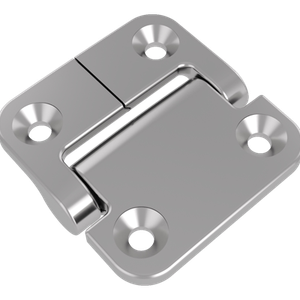
The barrel, mounting geometry, or both are set into a cutout or recess rather than sitting on top of the surface. This produces a cleaner external face, a lower projection profile, and a more integrated appearance on the finished equipment. The trade-off is immediate: the panel structure now has to be designed, or modified, to accept that recess, which shifts design responsibility from the hinge to the panel itself.
Surface-Mount Torque Hinges
A surface-mount torque hinge fixes its leaves or mounting body directly onto the panel or frame surface without recessing. There is no cutout to plan and no internal geometry to coordinate — the hinge is positioned, fastened, and functional. That directness makes surface mounting attractive for retrofit work and for structures where the panel was never designed around a recessed hinge. It comes at the cost of visible hardware and a projection that has to be accounted for in the equipment's overall envelope.

Flush-Mount vs. Surface-Mount Torque Hinges at a Glance
Factor | Flush-Mount Torque Hinge | Surface-Mount Torque Hinge |
External projection | Minimal, close to panel plane | Visible, adds to panel depth |
Panel machining | Recess or cutout required | Typically drilling only |
Rear clearance | Must be confirmed before selection | Less critical, but still relevant |
Installation complexity | Higher, needs precise alignment | Lower, more direct process |
Retrofit suitability | Limited unless designed in early | Generally strong |
Visual integration | High | Lower, hardware remains visible |
Adjustment | Constrained by recessed structure | Easier to observe and adjust |
Service replacement | More disassembly involved | Faster access in most cases |
Flush mounting reduces external projection but demands more from the panel structure. Surface mounting simplifies integration but leaves more hardware exposed.
Torque Comes First—Mounting Style Comes Second
Mounting style should never be the first decision — the required hinge torque, driven by door weight and center of gravity, has to be confirmed before flush or surface mounting is even discussed. A design team that starts from "we want a flush look" without first calculating torque is solving the wrong problem in the wrong order. Torque requirement is a function of several interacting variables: door or lid weight, the location of the center of gravity relative to the hinge axis, the number of hinges installed, hinge spacing across the panel, the opening angle, and any handles, displays or accessories added after the original weight estimate.

A heavier door does not automatically require only a "larger hinge." The moment created by the center of gravity relative to the hinge axis is equally important — a lighter panel with its mass concentrated far from the hinge line can demand more holding torque than a heavier panel with a center of gravity close to the axis. This is why door weight alone is an incomplete input. Our engineering team checks door weight together with center of gravity before recommending a mounting style, because the two numbers together — not either one in isolation — determine what the hinge configuration actually needs to resist. For the calculation logic behind matching a torque value to a given panel, see how to determine the correct torque value for a friction hinge.
What Changes the Required Hinge Torque?
Variable | Effect on Hinge Selection | Why It Matters |
Higher door weight | Increases total torque demand, but only when combined with CG distance | Weight alone does not fix the moment arm |
CG farther from hinge axis | Can raise torque demand even on a lighter panel | Moment arm often outweighs mass in the calculation |
More hinges | Distributes torque per unit, easing individual hinge load | Reduces stress concentration, but adds alignment sensitivity |
Wider hinge spacing | Changes load sharing and alignment tolerance | Uneven spacing can shift more moment onto one hinge |
Added components | Shifts mass distribution after the original estimate | A display or handle added late can silently change CG |
Different opening angle | Changes the effective moment at various points in the swing | Torque behavior is not uniform across the full arc |
When Flush-Mount Torque Hinges Make More Sense
Flush mounting makes the most sense when external projection must stay minimal and the equipment design already provides enough internal clearance to support a recessed hinge. This is a conditional recommendation, not a general preference — flush mounting fits specific structural circumstances, and forcing it onto a panel that lacks those circumstances usually creates more problems than it solves.
Low External Projection
A lower external projection reduces snag points and keeps the panel's movement path cleaner, without implying it makes the design inherently safer. In applications where operators or moving components pass close to the panel surface, a hinge that sits nearly flush avoids catching cables, sleeves, or adjacent hardware during operation. That said, snag reduction is a mechanical benefit of geometry, not a safety certification, and it should be described as exactly that.
Designed-In Rather Than Added Later
Flush-mount hinges generally belong in the original equipment design phase rather than a late-stage retrofit, because the recess, cutout and axis location must be planned in advance. Retrofitting a flush hinge onto an existing panel usually means cutting into structure that was never intended to carry a recess, which can compromise stiffness exactly where the hinge needs support. When flush mounting is specified from the start, the recess, the cutout dimensions, the mounting structure behind it, the axis location, and the rear clearance are all resolved together rather than reverse-engineered around an existing panel.
The Trade-Off Behind Flush Mounting
Flush mounting saves external space by consuming more design freedom inside the panel structure, and that trade-off shows up in machining, coordination and future replacement work. Every millimeter saved on the visible surface has to be accounted for somewhere else — typically in panel machining tolerances, coordination between the hinge supplier and the panel fabricator, tighter installation precision, and a replacement process that is more involved than unscrewing exposed leaves. None of that makes flush mounting the wrong choice; it simply means the engineering cost moves from the exterior to the interior of the design.
When Surface-Mount Torque Hinges Are the Better Choice
Surface mounting becomes the better choice when retrofit speed, limited internal depth or serviceability matter more than a fully integrated appearance. Surface mounting has its own decision logic rather than existing only as the fallback when flush mounting will not fit. It is the more practical option for retrofit projects on existing equipment, prototype development where geometry may still change, panels with limited internal mounting depth, and any application where field service and hardware replacement carry real operational weight.

Faster Integration
Surface-mount geometry is usually faster to position, drill, install and adjust, but the mounting surface still needs enough stiffness to carry the hinge load. The absence of a recess removes an entire category of machining and coordination steps, which is exactly why surface mounting dominates retrofit and prototype work. That speed advantage assumes the mounting surface itself is rigid enough — a thin or unsupported panel can flex under hinge load even when the fasteners are correctly torqued, so surface simplicity does not eliminate the need to check structural stiffness.
Easier Adjustment and Replacement
Exposed hardware makes surface-mount hinges easier to adjust and replace in the field, which matters most for serviceable or maintenance-heavy equipment. A technician can see the fasteners, reach them directly, and swap a hinge without disassembling surrounding panel structure. For equipment that is expected to see field service over its operating life, this accessibility often outweighs the appearance advantage of a recessed hinge.
The Trade-Off Behind Surface Mounting
The trade-off of surface mounting is visible hardware, potential interference and load concentrated at the fasteners rather than distributed across a recess. Exposed leaves add to the panel's external profile, which can matter in tight equipment envelopes or where a clean surface is part of the product's visual identity. Fastener locations can also interfere with adjacent components, and because the hinge load transfers through a smaller number of discrete points rather than a broader recessed structure, thin or lightweight panels can see load concentration that a flush design would spread more evenly.
Panel Geometry Can Override Mounting Preference
A preferred mounting style is irrelevant if the panel geometry cannot physically support it, which is why panel thickness, rear clearance, edge distance and hinge axis position must be checked before finalizing either option. In our experience, a flush-mount hinge is sometimes selected before rear clearance is checked, and the layout has to be revisited later once someone measures what is actually behind the panel. Geometry does not negotiate with preference.

Panel Thickness
Thin panels create different problems for flush and surface mounting — flush mounting weakens the recessed section, while surface mounting concentrates fastener load and risks flexing. A flush recess removes material from an already thin cross-section, which can require local reinforcement behind the hinge to restore stiffness. A surface-mounted hinge on the same thin panel avoids removing material, but the fasteners now carry the full hinge moment at a few discrete points, and the panel may flex during operation if it lacks backing structure.
Rear Clearance
Rear clearance is the single factor most likely to eliminate flush mounting as an option, regardless of how clean it would look on the outside. Before committing to a flush layout, the space behind the panel needs to be checked against the hinge body, the barrel, the fasteners, any internal brackets, and nearby components that might already occupy that depth. If that space is not available, the mounting preference does not matter — the hinge physically will not fit, and surface mounting becomes the only workable path regardless of appearance goals.
Edge Distance and Mounting Area
Mounting holes placed too close to the panel edge can weaken the installation area for either mounting style, so edge distance has to be reviewed against the actual panel material and thickness. This is a material-specific check rather than a fixed rule — the acceptable edge distance depends on the panel's thickness, material, and how much load the hinge transfers into that local area. It should be verified against the specific panel rather than assumed from a general guideline.
Hinge Axis Position
Where the hinge axis sits relative to the door and frame determines the opening path, clearance and how the door's center of gravity behaves during motion. Moving the axis changes the swing radius, which can create frame interference, alter panel overlap, or shift how much of the door's weight is resolved through the hinge at different points in the opening arc. Axis position is not a cosmetic detail — it is part of the same structural calculation as torque and center of gravity, and changing it after the hinge is specified can invalidate earlier torque assumptions.
How Panel Geometry Changes the Mounting Decision
Geometry Constraint | Flush-Mount Consideration | Surface-Mount Consideration |
Thin panel | Recess may need local reinforcement | Fastener load concentration, possible flexing |
Limited rear depth | Can eliminate flush mounting outright | Generally unaffected |
Tight edge distance | Recess cutout may weaken edge area | Fastener holes may still need repositioning |
Door/frame offset | Axis location becomes harder to plan around | Easier to compensate with mounting position |
Nearby internal components | May force axis or recess relocation | May force fastener repositioning |
Restricted opening path | Axis position critical to avoid interference | Less sensitive, but projection can still interfere |
Installation and Serviceability Over the Product Life
Comparing flush-mount and surface-mount hinges only on ease of initial installation misses most of the lifecycle cost, which shows up later in adjustment, maintenance and replacement. A hinge that installs quickly but is difficult to service years later has not actually saved effort — it has deferred it.
Initial Design
Flush mounting requires more integration work at the design stage, while surface mounting relies on more direct, straightforward mounting. That difference is front-loaded: flush mounting demands earlier decisions about recess dimensions and axis location, while surface mounting can often be finalized later in the design cycle without reworking the panel structure.

Manufacturing
Flush mounting can add machining steps and tighter geometry control, while surface mounting generally simplifies mounting with fewer recessed features. The additional machining for a flush recess also introduces tolerance stacking between the hinge, the cutout, and the surrounding panel — a mismatch that is far less likely to occur when the hinge simply sits on a drilled surface.
Adjustment
Surface-mount hinges are usually easier to observe and adjust in the field, while flush-mount adjustment can be limited by recessed structure and restricted internal access. A technician working on a surface-mounted hinge can see the fastener pattern and the hinge body directly. Adjusting a flush-mounted hinge often means reaching into a recess or removing adjacent panel sections first.
Maintenance and Replacement
If the hinge will eventually need replacement, technician access, fastener access, panel disassembly and alignment repeatability all become part of the real lifecycle cost. A hinge that is quick to install but requires partial disassembly of the panel to replace years later has shifted cost forward rather than eliminated it.
Installation and Serviceability Comparison
Lifecycle Stage | Flush-Mount | Surface-Mount | Key Decision Question |
Design | More integration work upfront | More direct, later-stage decision | Can the recess be finalized early? |
Machining | Recess and cutout tolerances | Minimal, typically drilling only | Can the panel fabricator hold the tolerance? |
Assembly | Requires precise alignment | Faster, more forgiving | How much assembly time is available? |
Adjustment | Limited by recessed access | Easier, hardware visible | Will the hinge need field tuning? |
Maintenance | May require partial disassembly | Generally direct access | How often will service occur? |
Replacement | More involved, alignment-sensitive | Faster, fewer steps | Who will replace the hinge, and how often? |
A Torque Hinge Can Be Correct but Still Feel Wrong
A torque hinge can carry the right torque rating on paper and still feel wrong in use, because installation, alignment and load distribution affect the actual feel as much as the rating itself. One detail that is often overlooked is that a correctly specified hinge assumes a correctly aligned, coplanar, undistorted installation — and mounting style has a direct influence on whether that assumption holds.
Door Feels Too Heavy to Move
A door that feels too heavy to move is not automatically a torque problem — hinge count, misalignment friction and installation distortion can all mimic an over-torqued hinge. Before assuming the torque rating is too high, check whether the hinge count matches the design, whether mounting surfaces are actually aligned, and whether the installation itself introduced binding.
Door Will Not Stay at the Desired Angle
A door that will not hold its position may point to insufficient total torque, a center of gravity farther from the axis than expected, or added components that shifted the mass distribution. This is one of the more common issues during hinge selection: door weight is confirmed early, but center of gravity is estimated loosely or ignored, and the torque calculation ends up built on an incomplete picture.
Door Movement Is Uneven
Uneven door movement usually traces back to misaligned hinges, mounting surfaces that are not coplanar, uneven torque distribution or panel distortion, not a defective hinge. Multiple hinges installed on the same panel need to share load evenly; if one mounting surface sits slightly out of plane with the others, the hinges will not move in unison even if each one is individually within specification.
Torque Changes After Installation
Before assuming a hinge has failed, fastener movement, mounting distortion, changes to the door structure and added load should all be checked first. A perceived change in torque after installation is more often a symptom of loosened fasteners, a panel that has shifted slightly, or new load added to the door than it is a defect in the hinge mechanism itself.
Torque Hinge Performance Troubleshooting
Symptom | Possible Cause | What to Check Before Replacing the Hinge |
Door too heavy to move | Wrong hinge count, misalignment friction, installation distortion | Verify hinge count and mounting alignment |
Door won't hold position | Insufficient torque, CG farther than expected, added components | Recheck weight and CG together |
Uneven movement | Misalignment, non-coplanar surfaces, uneven torque distribution | Confirm all mounting surfaces are coplanar |
Torque feels different after install | Fastener movement, mounting distortion, added load | Inspect fasteners and panel structure before replacement |
Application Scenarios: Which Mounting Style Fits Better?
The best mounting style shifts across applications because the priority shifts — appearance, maintenance access, packaging space and torque requirement do not carry equal weight in every case. Rather than surveying every industry, four application types illustrate how the same decision logic produces different answers depending on structural priorities.
Display and Control Panels
Display and control panels often favor flush mounting for appearance and controlled positioning, unless frequent maintenance makes surface mounting more practical. Operator clearance and a clean bezel line typically favor a recessed hinge, but if the panel requires regular internal access for calibration or component swaps, the serviceability advantage of surface mounting can outweigh the appearance benefit.
Machinery Access Doors
Machinery access doors do not automatically favor surface mounting — the choice depends on structural strength, maintenance frequency, replacement needs and torque requirement together. A heavy access door with frequent service cycles may still benefit from a flush layout if the equipment structure was designed around it, while a similar door on a retrofit machine will usually default to surface mounting simply because the recess was never planned.

Vehicle and Transportation Interiors
Vehicle and transportation interiors often favor flush mounting for low projection and packaging space, but rear clearance and mounting rigidity still need to be confirmed first. Interior space is typically tight, and a low-projection hinge helps preserve it, but vibration environments demand that the mounting structure behind the panel is rigid enough to prevent long-term loosening or fatigue at the fastener points.
Industrial Covers and Hatches
Industrial covers and hatches are usually decided by torque requirement and structure rather than appearance, since door weight, CG and hinge spacing dominate the calculation. These panels are rarely chosen for visual integration; the driving questions are how much the cover weighs, where its center of gravity sits, how many hinges are needed, and how accessible the hinge must be for service.
Flush-Mount or Surface-Mount by Application
Application | Main Design Priority | Flush-Mount Advantage | Surface-Mount Advantage | Main Check |
Display and control panels | Appearance, positioning | Clean bezel, controlled feel | Easier internal service access | Maintenance frequency |
Machinery access doors | Strength, service life | Integrated, protected profile | Faster replacement | Torque and rear clearance |
Vehicle interiors | Packaging, low profile | Minimal intrusion into cabin space | Simpler retrofit into existing trim | Rigidity under vibration |
Industrial covers and hatches | Weight-handling, access | Reduced snag points | Simple installation and swap | Door weight and CG |
A Simple Decision Guide
Once torque, weight, CG and panel geometry are confirmed, the choice between flush and surface mounting usually comes down to a short checklist rather than a lengthy re-analysis. This section does not repeat the reasoning already covered — it converts it into a working checklist.
Choose Flush-Mount When
Flush mounting is generally worth the added design work when external projection must be minimized and internal clearance is already available. This applies when the panel is designed for recessed hardware, visual integration matters to the product, and the manufacturing process can accommodate the additional machining without disrupting cost or lead time targets.
Choose Surface-Mount When
Surface mounting is often better suited when retrofit speed, limited internal depth or serviceability outweigh the benefit of a fully recessed appearance. This applies when installation simplicity matters, internal mounting depth is restricted, and visible hardware is an acceptable trade for faster field access.
Reconsider Either Option When
Both options should be reconsidered whenever torque, stiffness or hinge-axis interference has not yet been confirmed, since mounting style cannot fix an unresolved structural problem. If the required torque exceeds what the available hinge configuration can deliver, if the door structure lacks the stiffness to carry the hinge load, if the axis position creates frame or panel interference, or if weight and CG are still unconfirmed, the mounting decision is premature — those questions depend on the specific panel, material and application, not on a general rule.
Project Priority | Preferred Direction | Confirm Before Finalizing |
Clean external appearance | Flush mounting is often better suited | Rear clearance, recess feasibility |
Fast retrofit or prototype | Surface mounting is generally worth evaluating | Mounting surface stiffness |
Frequent field service | Surface mounting is generally worth evaluating | Fastener access, alignment tolerance |
High torque, heavy panel | Depends on axis position and panel stiffness | Torque calculation with confirmed CG |
Before You Lock in the Hinge Layout
Before finalizing a hinge layout, a short list of dimensions and structural facts — not a mounting-style preference — should already be confirmed. That list includes door dimensions, door weight, center of gravity, hinge axis position, number of hinges, hinge spacing, panel thickness, available rear depth, opening angle, desired hold-open behavior, and the operating environment the panel will see in service.
With that information in hand, ForndLock can help review the required torque, compare flush-mount and surface-mount options against the actual panel geometry, evaluate hinge position and spacing, check available rear clearance, recommend hinge quantity, and support custom dimensions or sample validation where the application calls for it. This does not guarantee that every torque or load requirement can be met — it means the layout gets checked against real structural information before it is locked in, rather than after.
If you already know the door size and weight but are still deciding between a flush-mount and surface-mount torque hinge, send ForndLock the panel drawing, hinge position, opening angle and available mounting space. Include door weight, overall dimensions, hinge spacing, center of gravity if it has already been measured, and the quantity you are working with. Our engineering team will review the geometry against both mounting options before you commit to a layout. Reach us at [email protected].