
Industrial Pull Handles: The Complete Selection Guide
When you build industrial machinery or heavy equipment, your hardware choices matter. The right components improve daily workflow, speed up assembly, and keep machines running longer. As an industrial hardware manufacturer, ForndLock studies real-world mechanical loads, panel strength, and spatial limits. This pull handles selection guide provides the engineering rules you need to pick reliable hardware for tough factory settings.
ForndLock Industrial Handle Series
What different pull handle designs actually solve
Picking the right handle shape is not just about looks. Engineers design different handle styles to fix specific problems, like tight clearances, mechanical interference, and floor space limits.
Surface-mount designs are the standard choice for industrial cabinets. They mount straight onto the outside face of a panel using fixed center-to-center hole spacing and rear fasteners. Their rigid bodies give operators a firm grip and handle heavy loads easily.

For everyday use, standard aluminum models often hold a minimum stress resistance of 500N. This gives workers a dependable tool for daily manual tasks.
Offset designs shift the grip axis away from the mounting base to change the pulling angle. This gap keeps the worker's knuckles away from sharp sheet metal, nearby switches, or door frames.

Thanks to the offset angle, operators can wrap their fingers fully around the bar without needing a massive, bulky handle.
Folding designs drop flat against the machine when nobody is using them. This keeps the machine profile slim, so the hardware will not snag clothes in tight aisles or break during transit. However, folding handles have moving parts.
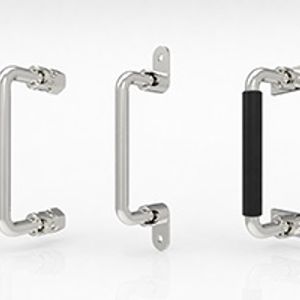
The internal pivot pin creates a point of wear, and you must check that the internal return springs or friction detents can survive dirt, dust, and thousands of open-close cycles.
Flush and recessed designs sit completely inside a cut pocket or panel cutout. They create a flat surface with zero projection. This flush fit is required on shipping flight cases, sliding panels, and machines that get wrapped or stacked tightly in warehouses.

Still, these handles cost more to install because you must cut precise holes into the panel, which steals internal cabinet space and can get in the way of internal wires.
Heavy-duty designs rely on thick metal cross-sections and wide mounting footprints, not just overall length. A true heavy-duty handle uses thick support ribs, broad mounting feet to spread out force, and large mounting bolts.

Plants use these parts when forces go beyond normal human strength, such as when a worker uses their entire body weight to pry open a heavy, sealed acoustic door.
Hygienic and easy-clean designs remove open threads, tight cracks, and sharp inside corners where bacteria or cleaning chemicals might hide. They feature smooth, rounded curves and polished, low-roughness surfaces. In food processing and drug plants, strict washdown routines limit which materials you can use.

As a result, the temperature resistance range for industrial pull handles built for these jobs often covers -40°C to +150°C to survive quick-freezing rooms and scalding steam cleaning.
Dimensions that dictate fit and operation
Do not use furniture measurements for industrial machinery. You must size factory hardware around real machine tolerances, assembly processes, and worker safety needs.
The center-to-center mounting distance is your most critical measurement during panel layout or hardware replacement. If your handle spacing misses the panel holes by even a fraction of a millimeter, your bolts will bind up during assembly, which strips the threads or bends the sheet metal. Many designers suggest a minimum center-to-center distance of 3-3/4 inches for basic access. Heavy equipment, however, often uses much wider spacing to distribute pulling forces across the door.
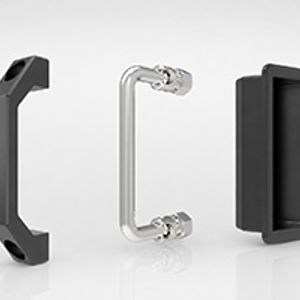
Grip length determines how many fingers fit on the handle, while grip clearance decides whether a hand can slide behind the bar at all. Projection measures how far the handle sticks out from the panel, which changes the total width of the machine. Grip shape controls comfort. A square bar with sharp corners creates painful pressure points during repeated use, but a smooth round or oval profile spreads the load evenly across the fingers.
Dimension | Installation and operation impact | Common problem |
Center-to-center distance | Dictates panel hole alignment and fastener shear stress | Hole misalignment forces cross-threading during assembly |
Grip length | Determines hand placement and leverage distribution | Insufficient length forces operators to use only two or three fingers |
Grip clearance | Defines the void between the grip and the panel surface | Shallow clearance prevents gloved hands from engaging the hardware |
Projection | Alters the maximum exterior envelope of the equipment | Hardware strikes adjacent walls or interferes with forklift operation |
Cross-section | Controls the pressure distribution on the operator's skin | Sharp edges cause fatigue and pain during repetitive operations |
Mounting foot size | Determines the contact area transferring load to the panel | Small footprints cause thin sheet metal to dimple under load |
Fastener size | Defines the maximum tensile and shear load the joint can take | Undersized threads strip out during high-torque installation |
Where pulling forces actually transfer in an enclosure
Engineers often make the mistake of thinking handle force equals the weight of the door. In reality, you must check handle strength against the entire mechanical system, not just the dead weight of the swinging panel.
When a worker pulls on a handle, the force moves through a connected chain of parts. First, the hand applies force straight to the grip. That pulling force creates a bending load at the base of the handle legs. Next, the legs transfer this load into the mounting bolts as tension and shear stress. The bolts then pull hard against the sheet metal, and the sheet metal transfers that energy into the door hinges and latch.
The resistance a worker feels rarely comes from the door panel itself. Hinges support the actual dead weight of a swinging door. Instead, tight environmental seals and latch friction create the real resistance. Squeezing a dense EPDM rubber gasket to hit a tight NEMA 4X or IP66 rating requires high clamping pressure. Overcoming that pressure, freeing a sticky rubber gasket that has baked onto the frame, or fighting air pressure differences inside an HVAC cabinet takes massive pulling effort, even on a lightweight sheet metal door.
Accessibility standards offer a great baseline for sensible pulling limits. For example, building codes set a maximum opening force for interior doors of 5 pounds. Industrial equipment is usually exempt from interior building codes, but this 5-pound rule is still a great target to stop worker fatigue. If a sealed enclosure takes fifty pounds of force to pop open, you need to use a larger handle and reinforce the sheet metal around it.
Why your panel will fail before the handle does
Solid steel or aluminum handles almost never snap in half in the field. Instead, failures happen right at the mounting joint between the handle and the enclosure. The thin sheet metal panel and the fasteners are usually the real weak links.
When a worker yanks on a handle, the mounting feet act like pry bars against the door face. If the feet are too small, they push all that force into a tiny spot on the sheet metal. On thin panels, this concentrated stress dimples, stretches, or permanently warps the metal. Over time, constant panel flexing fatigues the sheet metal, stretches the bolt holes, and leaves the handle permanently loose.
Your choice of fasteners changes how this joint holds up. Threaded inserts pressed into thin metal can pull straight out under heavy loads. Blind threaded holes in the handle legs rely on full thread engagement, so if your screws are too short, the threads will strip out under tension. Through-bolts with wide washers and locknuts make a much stronger joint, but workers must be able to reach the back of the panel during assembly.
To stop panel damage on heavy doors or high-traffic access panels, always use backing plates. A solid metal plate mounted behind the door skin clamps the thin sheet metal between the handle and the plate. This spreads the pulling force over a wide area, which lets the rigid door frame handle the load without bending the skin.
· Specifying aluminum pull handles rated for at least 500N of stress resistance ensures the hardware will withstand heavy mechanical strain without deforming.
· Operating equipment within the -40°C to +150°C temperature resistance range prevents pull handle material degradation across thermal cycling environments.
· Verifying an interior door opening force threshold below 5 pounds prevents localized panel strain while maintaining ADA compliance.
· Maintaining a minimum 1 1/2 inches handle clearance prevents user knuckle interference during high-force operation.
· Installing handles, pulls, and latches at a maximum mounting height of 48 inches above the floor guarantees accessible reach and proper leverage.
· Providing a minimum clear opening width of 32 inches when doors are open 90 degrees ensures unobstructed passage for equipment and personnel.
· Restricting floor threshold heights to a maximum of 1/2 inch prevents tripping hazards and reduces impact shock to low-mounted door panels.
Assembly order also changes which handle you can use. Many surface-mount styles need rear access so workers can tighten the mounting nuts from behind. If your door has a double-wall skin or thick internal insulation, nobody can reach the back side after the door is welded shut. For these designs, you must pick front-mounting handles or heavy-duty blind rivet nuts early in the engineering phase.
Matching materials to environmental exposure
Choose your materials based on chemical contact, heat cycles, and physical impacts, not just appearance. Picking the wrong metal or surface finish leads to rapid corrosion and early failure.
Aluminum delivers great strength without adding excess weight, and factories can extrude it into smooth, ergonomic curves. Its biggest industrial strength is anodizing. Anodized coatings create an ultra-hard, wear-resistant surface that will not chip off like cheap paint. However, aluminum can suffer galvanic corrosion if you bolt it directly to carbon steel in damp areas without insulating washers, and strong alkaline washdown cleaners will eat it away quickly.
Stainless steel is the standard choice for food washdowns, marine decks, and chemical plants. Even so, corrosion resistance varies by grade. Grade 304 stainless steel can still form light surface rust if exposed to heavy salt spray or pool chemicals. Grade 316 contains added molybdenum, which gives it much better defense against pitting. Whatever grade you pick, stainless steel needs proper chemical passivation to clear away free iron, and its heavy weight requires strong panel reinforcement.

Carbon steel delivers top-tier mechanical strength and impact resistance at a budget-friendly price. Because raw steel rusts quickly in moist air, its real-world life depends entirely on its outer coating. Zinc plating provides sacrificial protection, while powder-coat paint forms a tough plastic barrier over the steel. If a dropped tool or forklift blade gouges that paint down to raw steel, rust will crawl beneath the coating and ruin the part.
Engineering plastics, like glass-filled nylon, solve problems where you need thermal or electrical insulation. They do not conduct heat, so workers can grab them safely on hot curing ovens or freezing cold rooms. They also drop total weight on portable gear. However, plastics have lower tensile strength than metals, and prolonged sunlight can make certain plastics brittle or faded over time.
Material | Primary industrial advantage | Critical application constraints |
Aluminum | Lightweight, easily extruded, durable anodized finish | Vulnerable to galvanic corrosion and alkaline cleaners |
Stainless Steel | High chemical resistance, withstands aggressive washdowns | Heavy mass requires panel reinforcement, susceptible to chlorides if not 316 |
Carbon Steel | Maximum impact resistance and structural rigidity | Relies entirely on coating integrity; rusts rapidly if scratched |
Engineering Plastic | Thermal and electrical insulation, lightweight | Lower tensile strength, potential UV degradation outdoors |
· Model 79820 pull handles maintain structural performance across an operating temperature envelope of -40°C to +150°C.
· Aluminum pull handle specifications require a minimum stress resistance of 500N to prevent mechanical deformation under service loads.
· Accessible door pulls must be mounted at a maximum height of 48 inches above the finished floor to comply with physical access requirements.
· Interior door pulls must require no more than 5 pounds of opening force to prevent access blockage and non-compliance penalties.
· Hardware installations require a minimum clearance of 1 1/2 inches between the handle grip and the door face to ensure an unhindered grasp.
· Doors requiring accessibility compliance must provide a minimum clear opening width of 32 inches when positioned open at 90 degrees.
· Entrance transitions must maintain a maximum threshold height of 1/2 inch to eliminate tripping risks along access routes.
· Initial compliance failures incur a $75,000 fine for a single violation, escalating to $100,000+ for subsequent violations.
Ergonomics of grip, gloves and machine clearance
Designing for industrial workers is very different from designing consumer products. Factory handles must work for operators wearing thick safety gear, moving fast, and working inside cramped spaces.
The choice between bare hands and safety gloves decides your grip clearance. A gap that feels spacious to a bare hand turns into a painful pinch point when a worker wears thick leather gloves, insulated winter gear, or rubber chemical sleeves. If the gap is too tight, workers cannot wrap their fingers around the bar, forcing them to pull with their fingertips. This grip slips easily, cuts pulling leverage, and tires out hands.
Building codes require an ADA clearance of at least 1 1/2 inches between the grip and the panel. That works fine as a basic standard for bare hands, but heavy industrial jobs often need 2 inches or more. That extra room lets workers wear bulky insulated gloves without scraping their knuckles across the metal door.
Snagging is a major danger in busy plant aisles. Open-ended handles, where the grip extends past the legs, act like hooks. These open ends can snag loose jackets, tool lanyards, air lines, and power cords as people or carts move past. In narrow walkways or near messy cable runs, pick closed-loop handles or flush-mounted pulls to keep surfaces smooth and prevent accidents.
· Grip clearance — Operational impact: Determines if a gloved hand can wrap the bar; Common problem: Operator fingers get wedged between the hardware and the hot panel
· Handle length — Operational impact: Dictates how many hands can apply force; Common problem: Extra-wide drawers bind if pulled from a short, off-center handle
· Profile shape — Operational impact: Controls friction and skin pressure; Common problem: Square edges cut into gloves during heavy pulling tasks
· End geometry — Operational impact: Determines the snag risk of the hardware; Common problem: Open-ended bars catch air hoses and rip them from pneumatic tools
Diagnosing loose, flexing or failing hardware
When hardware breaks on the job, the handle casting itself is rarely the problem. Finding the real cause means checking the whole mechanical joint, door alignment, and room environment so the replacement handle does not fail the same way.
If a handle works loose over time, machine vibration is usually shaking the bolts free. Heavy equipment vibration quickly backs out standard nuts. If the panel bends noticeably before the door pops open, your sheet metal is too thin for that latch force. If the finish peels or pits, your chosen material cannot handle the plant's cleaning chemicals or ambient moisture.
Symptom | Likely cause | What to check |
Hardware loosens repeatedly | Machine vibration backing out fasteners | Verify the presence of thread-locking compounds, split washers, or prevailing torque nuts |
Panel flexes during operation | Insufficient sheet metal gauge or small footprint | Check if a rear backing plate can be installed to distribute the load |
Extreme force required to open | Over-compressed gaskets or latch misalignment | Measure the latch preload and inspect door hinges for sagging |
Surface coating peels or rusts | Chemical incompatibility or galvanic corrosion | Check cleaning agent pH and verify isolation between dissimilar metals |
Fastener threads strip out | Insufficient thread engagement in blind holes | Verify the screw length penetrates the handle leg by at least 1.5x the thread diameter |
Step-by-step checklist for specifying hardware
To get a clean fit and prevent expensive assembly line changes, follow this step-by-step mechanical checklist when specifying hardware:
1. Define the barrier resistance: Calculate the force needed to squeeze the door gaskets and release the latch. Never base your hardware choice purely on the dead weight of the door.
2. Select the structural geometry: Check if the room allows protruding surface-mount handles, or if narrow aisles require folding or flush-mount pulls.
3. Verify panel structural integrity: Check the sheet metal gauge. If the pulling force is high and the skin is thin, choose handles with wide mounting feet and add internal backing plates to your parts list.
4. Establish the dimensional constraints: Set your center-to-center hole spacing to match standard punch tools. Make sure the grip clearance leaves enough room for the thickest gloves used in the plant.
5. Match material to the environment: Check room temperatures, chemical exposure, and washdown needs. Choose passivated stainless steel for corrosive areas, anodized aluminum to save weight, or coated steel for dry, heavy-impact zones.
6. Confirm assembly sequencing: Check whether line workers can reach behind the panel to install nuts, or if you need front-mount handles and blind threaded inserts instead.
7. Audit for facility regulatory compliance: If your machine sits in a cleanroom or along an access walkway, make sure it meets local building codes. Walkway doors require a minimum clear opening width of 32 inches when opened to 90 degrees. Code also sets a maximum handle mounting height of 48 inches above the floor. Floor transitions near these doors allow a maximum threshold height of only 1/2 inch to prevent trips. Ignoring these building rules brings heavy fines, starting at $75,000 for a first violation and jumping past $100,000 for repeat offenses.
What to do when standard hardware falls short
Catalog parts handle most factory tasks, but custom industrial machinery can easily push standard hardware past its breaking point. When thick acoustic cabinets need extra leverage to break gasket suction, when transit cases need exact pocket cutouts, or when marine skids require special certified metals, standard catalog parts carry too much risk.
ForndLock Handles Series Introduction
ForndLock builds custom industrial hardware made to handle heavy loads, tight spaces, and harsh working environments. Our engineering team helps you match bolt torque ratings, sheet metal stiffeners, and durable surface coatings directly to your equipment design.
If your project calls for custom handle shapes, physical load testing, or native CAD models for clearance checks, solving these challenges early stops line shutdowns later. To get engineering help, quote high-volume runs, or build custom hardware for your machines, email your drawings and project specs to: [email protected].
Frequently asked questions
How to decide on pulls or knobs?
Base your choice on ergonomics, door function, and accessibility rules. Knobs work well on small, lightweight cabinet doors, but pulls offer much better leverage on heavy or wide drawers. For universal access and ADA compliance, pulls are the better choice because they allow a full-hand grip. Just ensure you leave at least 1 1/2 inches of clearance behind the bar so users do not have to pinch their fingers. When installing hardware, keep handles within comfortable reach, placing them no higher than 48 inches above the floor.
What are the trends for cabinet pulls in 2026?
Modern cabinet hardware focuses on clean industrial lines, textured surfaces, and rugged durability. Simple architectural shapes made from heavy-gauge steel, aluminum, and tough thermoplastics lead today's kitchen and bathroom designs. Popular finishes include tumbled satin, matte black powder coating, and warm brass, often matched with flat backplates. For performance, these designs rely on industrial reliability, using hardware rated for a -40°C to +150°C temperature resistance range and high mechanical strength to handle years of heavy daily use.