
Friction Torque Hinges: Types, Applications and Selection Guide
A friction torque hinge is a mechanical joint that uses internal friction to generate controlled resistance, allowing a panel, door, or lid to hold any angle without gas springs, latches, or extra support hardware. Instead of swinging freely on a pin like a conventional hinge, it relies on preloaded contact surfaces inside the barrel to resist rotation until an operator applies enough force to move it.
At ForndLock, our engineering team designs and manufactures friction torque hinges for control cabinets, inspection doors, display arms, and enclosure panels used across industrial automation, medical equipment, rail transit, and energy infrastructure. We work directly from customer drawings and load data, which means most of what we build starts as a torque calculation before it ever becomes a physical part.
This guide walks through what a friction torque hinge is, how it generates holding torque, the main types available, where each type fits, and how we approach selection when a standard configuration does not quite match a project's requirements. If your application involves a heavy access door, a display arm that needs to hold a viewing angle, or a panel exposed to vibration and temperature swings, the sections below should give you enough technical grounding to start narrowing down options.
What Is a Friction Torque Hinge?
A friction torque hinge is a hinge assembly that generates a defined rotational resistance through internal contact surfaces, enabling a panel to stay at any angle within its rotation range instead of swinging freely. The resistance comes from components pressed together inside the hinge body—typically a shaft, a friction element, and a preload mechanism—that create drag proportional to the contact pressure and the friction coefficient of the materials involved.

This is fundamentally different from a standard butt hinge, which offers essentially no resistance to rotation beyond the weight of its own pin and knuckle. A conventional hinge lets a door swing under gravity or external force with nothing holding it in place. A friction torque hinge is engineered so that gravity, vibration, or a light touch cannot move the panel on its own, but a deliberate push or pull from an operator can.
We design our friction torque hinges around this principle from the earliest stage of a project. Before we finalize a hinge's internal geometry, we look at the panel it will support, the angle range it needs to cover, and the environment it will operate in. The friction mechanism itself is only one part of the equation—how that mechanism interacts with the actual load is what determines whether a hinge performs correctly once it is installed.
ForndLock Friction & Torque Hinges
How Do Torque and Friction Hinges Differ?
The term torque hinge emphasizes the resistance value the hinge produces, while friction hinge emphasizes the internal mechanism that creates that resistance—in practice, the two terms describe the same functional component. Engineers and suppliers use both names interchangeably, and neither term points to a separate product category with different internal engineering.
Dimension | Friction Hinge | Torque Hinge |
Naming emphasis | Internal friction mechanism | Output resistance value |
Common usage context | Consumer electronics, furniture | Industrial equipment, precision instruments |
Selection focus | Feel, adjustability | Torque range, long-term stability |
In industrial specification work, we find it more useful to focus on the actual torque behavior of a hinge rather than which name is used to describe it. What matters is whether the hinge holds the required load at the required angle, how consistent that resistance stays over the rated cycle life, and whether the mounting geometry fits the application—not whether the datasheet says "friction hinge" or "torque hinge."
How Do Torque Hinges Generate Holding Torque?
Torque hinges generate holding torque through preloaded friction interfaces—metal, polymer, or composite surfaces pressed together inside the hinge barrel—that resist rotation until an external force exceeds the set resistance. During manufacturing, these interfaces are compressed to a specific preload, which sets the baseline resistance the hinge will produce throughout its service life.
Inside the barrel, the friction mechanism typically consists of a shaft running through one or more friction elements—washers, pads, or sleeves—held under compression by a spring, retaining ring, or threaded fastener. As the shaft rotates, the friction elements drag against the mating surface, converting the rotational input into resistive torque. The materials chosen for these elements, along with how tightly they are compressed, define how much force is needed to move the panel.
Holding force is the practical result of this mechanism: the hinge must produce enough resistance to counteract the gravitational moment created by the panel's own weight. If the holding force is too low relative to the load, the panel drifts or drops on its own. If it is too high, the panel becomes difficult to operate by hand. There is also a distinction worth understanding conceptually between breakaway torque—the resistance encountered right as motion begins—and running torque, the resistance felt as the panel continues moving through its arc. These two values are not always identical, and a hinge that feels stiff to start but smooth to move (or vice versa) is exhibiting this difference rather than a defect.
What Determines a Hinge's Torque Rating?
A hinge's torque rating is determined by the friction material, contact area, preload force, and shaft diameter engineered into the hinge assembly during manufacturing. Each of these variables can be adjusted independently to shift the torque rating up or down without necessarily changing the hinge's outer dimensions.
Friction material affects the coefficient of friction available at the contact surface—harder materials like hardened steel against steel produce different drag characteristics than a polymer pad against a metal shaft. Contact area determines how much surface is available to generate resistance; a wider friction washer or longer friction sleeve spreads the load differently than a smaller one. Preload force, set by a spring or fastener during assembly, directly scales the resistance produced at a given contact area. Shaft diameter affects the moment arm at which friction acts, meaning a larger shaft can produce more torque from the same contact pressure.
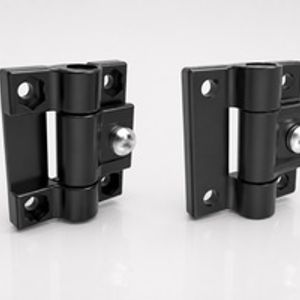
This is also where constant torque and adjustable torque designs diverge in their engineering approach. A constant torque hinge is built with a fixed preload that cannot be changed after assembly, which keeps the torque rating stable but locked in place. An adjustable torque hinge includes a mechanism—usually a set screw or hex adjustment—that lets the preload, and therefore the torque rating, be tuned after the hinge is already installed.
How Does Center of Gravity Affect Torque?
Center of gravity determines the moment arm the hinge must resist, so the same panel weight can require very different torque values depending on where the mass is distributed relative to the pivot axis. A ten-kilogram panel with its mass concentrated near the pivot requires far less holding torque than the same panel with its mass concentrated at the far edge.
The underlying relationship is straightforward: required torque is approximately equal to door weight multiplied by the distance from the pivot axis to the center of gravity. A heavier panel with its weight close to the hinge line can sometimes need less torque than a lighter panel with an off-center or extended mass distribution. This is why two panels of identical weight can call for hinges with noticeably different torque ratings.
We ask for this information early in any selection conversation because it changes the calculation more than weight alone. Engineers submitting drawings to us typically include panel dimensions and material, which lets our team estimate center of gravity even before a physical prototype exists.
What Types of Torque Hinges Exist?
Industrial torque hinges are commonly grouped into constant torque, adjustable torque, multi-axis, and detent types, each suited to different load, adjustability, and motion requirements. The classification generally follows three questions: is the resistance fixed or tunable, does the hinge rotate around one axis or several, and does it hold anywhere along the arc or only at fixed points.
What Is a Constant Torque Hinge?
A constant torque hinge is factory-set to a fixed resistance value that remains stable throughout its rotation range, making it suitable for applications where panel weight does not change. Because the preload is set once during manufacturing and not designed to be field-adjusted, these hinges tend to offer a simpler, more predictable long-term performance curve.
We see constant torque hinges specified most often for inspection doors, control panels, and equipment enclosures where the panel's weight and geometry are fixed by design and unlikely to change over the product's service life.
What Is an Adjustable Torque Hinge?
An adjustable torque hinge allows the resistance to be tuned after installation, typically through a set screw or hex adjustment, which suits applications where load or feel may need field correction. This flexibility is particularly useful during prototype development, when the final panel weight or mounted accessories are not fully locked down yet.
Adjustable torque hinges also show up in equipment where the load on the panel can vary—for example, a cover that sometimes carries additional mounted components and sometimes does not.
What Is a Multi-Axis Torque Hinge?
A multi-axis torque hinge combines two or more pivot points to support complex motion paths, such as tilting and rotating a display or instrument arm simultaneously. Rather than a single rotational axis, these designs stack or link multiple friction joints so the supported component can move through more than one plane of motion while still holding position at any combination of angles.
This type is common on medical display arms and precision instrument supports, where the operator needs to both tilt and swing a screen or sensor into a specific working position.
What Is a Detent Torque Hinge?
A detent torque hinge uses indexed stops to hold a panel only at predefined angles rather than anywhere along the arc, which suits applications requiring repeatable fixed positions. Instead of continuous friction across the full range of motion, the mechanism includes physical stops or notches that the hinge settles into, giving a distinct tactile confirmation when the panel reaches one of its set positions.
Type | Adjustable | Positioning | Typical Industrial Use |
Constant Torque | No | Continuous across full range | Control cabinet doors, equipment covers |
Adjustable Torque | Yes | Continuous across full range | Variable-load panels, prototype validation |
Multi-Axis | Depends on design | Compound motion path | Medical display arms, inspection equipment |
Detent | No | Fixed indexed angles | Folding tables, limited-position panels |
Standard configurations across these four types cover a large share of industrial requirements, but they do not cover all of them. When a project needs a torque range, mounting footprint, or environmental rating that falls outside what a catalog part offers, our engineering team works from the customer's drawings to build custom torque hinges around the exact load and space constraints involved.
Where Are Industrial Torque Hinges Applied?
Industrial torque hinges are applied wherever a panel, door, or arm must hold a set position under vibration, gravity, or repeated manual adjustment, including control cabinets, medical equipment, and transit interiors. The common thread across these applications is that an unsecured panel would either fall, drift, or create a safety hazard if left to swing freely.
How Are Hinges Used in Cabinets?
In control cabinets and electrical enclosures, torque hinges hold heavy access doors open during maintenance so technicians can work with both hands free. This matters in automated production lines, where an operator adjusting a control panel or servicing a switch cabinet needs the door to stay put at whatever angle it was left, without a second person or a mechanical prop holding it there.
We also see this requirement in distribution panels and machine enclosures, where the door itself may carry significant weight from mounted components on its interior face, adding to the torque calculation beyond the bare door weight.
How Are Hinges Used in Medical Equipment?
In medical and precision equipment, torque hinges position display arms, imaging panels, and instrument covers at exact viewing angles that must remain stable during use. A diagnostic display that drifts mid-procedure or a sensor cover that will not stay open creates real usability problems, which is why these applications typically call for tighter torque consistency and smoother multi-axis motion than a simple access door.
Beyond medical settings, we see similar precision requirements in rail transit interiors, where folding table boards and display stands need to hold position through vibration and repeated cycling, and in energy infrastructure, where substation and generator control panels need hinges rated for a wide temperature range and long-term outdoor exposure.
Industry Scenario | Typical Component | Key Requirement |
Industrial automation | Operation panels, control box doors | High torque stability, vibration resistance |
Medical equipment | Display arms, inspection panels | Smooth adjustment, multi-axis support |
Rail transit | Folding tables, display stands | Lightweight construction, cycle durability |
Energy and power | Distribution cabinet panels | Corrosion resistance, wide temperature tolerance |
How Do We Select the Right Hinge?
Selecting the right torque hinge requires calculating the required torque from door weight and center of gravity, then confirming hinge quantity, mounting structure, and safety margin against that value. This is a sequential process—torque calculation comes first, and everything else follows from that number.
How Do We Calculate Required Torque?
Required torque is calculated by multiplying the panel or door weight by the distance from the pivot axis to its center of gravity, then adding a safety margin for vibration or duty cycle. The basic relationship is torque equals weight multiplied by moment arm, but real-world applications rarely stop at that raw figure.
We typically recommend building in a margin somewhere in the range of twenty to thirty percent above the calculated minimum, particularly for equipment that will experience vibration, frequent cycling, or occasional impact loading. This margin accounts for real-world variation in panel weight, minor installation misalignment, and gradual wear over the hinge's service life. It is not a fixed rule for every application, but a reasonable starting point that our engineering team adjusts based on the specific duty cycle and environment described in a project's specifications.
How Many Hinges Does a Panel Need?
Hinge quantity depends on total panel weight, panel length, and how evenly the load must be distributed across the mounting edge to avoid sagging or uneven wear. A single hinge rated for the full torque requirement might work on a short, light panel, but longer or heavier panels generally need the load split across two or more hinges to prevent the panel from twisting or sagging at one end.
When multiple hinges share a panel, the required torque is not simply divided evenly—the distribution needs to account for how the panel's weight and center of gravity interact with each hinge's position along the mounting edge. This is a detail we work through directly with customers who send us panel dimensions alongside their torque requirements.
What Mounting Structure Should You Choose?
Mounting structure should match the panel's material thickness, available installation space, and whether the application requires surface-mounted, concealed, or flag-style hinge geometry. A surface-mounted hinge is generally the simplest to install and service, while a concealed hinge suits applications where exposed hardware would interfere with the finished appearance or create a snag point. Flag-style hinges, which allow the panel to be lifted off the pivot, add modularity for equipment that needs periodic panel removal.
Getting the mounting structure wrong does not just create an installation inconvenience—it can affect how accurately the rated torque translates into real-world holding performance, since misaligned or poorly supported mounting points introduce additional stress the hinge was not designed to absorb.
Parameter | Description | Impact |
Door weight | Total weight of the panel or door assembly | Sets the lower bound for required torque |
Center of gravity | Distance from pivot axis to the mass center | Determines the length of the moment arm |
Hinge quantity | Single or multiple hinges per panel | Determines how torque is distributed per unit |
Mounting structure | Installation method and available space | Determines suitable hinge geometry |
When a project's torque range, panel dimensions, or mounting space does not line up cleanly with a standard catalog hinge, sending drawings and torque requirements to our engineering team lets us run the calculation against the actual application rather than a generic assumption.
Which Materials Suit Torque Hinge Design?
Material selection for torque hinges depends on required load capacity, corrosion resistance, and operating temperature, with stainless steel, hardened alloy steel, and engineered polymers being the most common structural and friction-element choices. The structural body of the hinge and the friction elements inside it often use different materials, chosen for different reasons.
For the outer structure, stainless steel is a common choice where corrosion resistance matters, such as outdoor enclosures or coastal installations, while hardened alloy steel is often selected where higher load capacity and wear resistance are the priority. Aluminum alloys show up where weight reduction matters more than maximum load capacity, such as in transit interior applications. On the friction side, engineered polymers offer a smoother, quieter feel and are common in lower-torque applications, while bronze bushings and metal-on-metal friction pairs tend to hold up better under higher sustained loads and higher cycle counts.
Environmental factors weigh heavily into this decision. Humidity and salt exposure accelerate corrosion on unprotected steel components, which is why we look closely at plating, coating, or stainless substitution for any hinge headed into a marine, chemical, or outdoor power environment. Wide operating temperature ranges can change how a friction material behaves—some polymers stiffen in cold conditions or soften under sustained heat, which affects torque consistency over time. Dust and particulate exposure can work into the friction interface over repeated cycles, gradually altering the resistance the hinge produces. Choosing materials that match these conditions from the start is generally more reliable than trying to compensate for a mismatched material choice after installation, since friction elements that are not suited to their environment tend to drift away from their original torque rating faster than properly matched ones.
How Should Torque Hinges Be Installed?
Torque hinges should be installed with aligned mounting surfaces, correct fastener torque, and verified panel-to-hinge fit so the rated holding torque performs as designed once the panel is in service. A hinge rated correctly on paper can still underperform if the installation introduces misalignment or inconsistent fastening.
What Are Best Installation Practices?
Best installation practice includes checking mounting surface flatness, using the specified fastener torque, and confirming the panel's actual weight and center of gravity match the original hinge calculation. A mounting surface that is not flat can twist the hinge body slightly during installation, which changes how the internal friction elements sit against each other and can shift the effective torque away from its rated value.
Fastener torque matters for a similar reason—under-tightened mounting screws allow micro-movement at the mounting point over time, which gradually loosens the hinge's grip on the panel even if the hinge itself is performing correctly. It is also worth double-checking, before final installation, that the panel actually built matches the weight and center of gravity assumptions used during hinge selection. Design changes made after the initial torque calculation—added components, thicker material, extra brackets—can shift the load enough to require a different torque rating than originally specified.
How Do We Maintain Torque Stability?
Maintaining torque stability involves periodic inspection for surface wear, fastener loosening, and gradual torque drift, especially in high-cycle or vibration-heavy environments. Friction elements experience gradual wear every time the hinge cycles, and while a well-matched material selection slows this process considerably, it does not eliminate it entirely.
Reasonable maintenance checkpoints include watching for visible surface wear at the friction interface, checking that mounting fasteners remain tight, and paying attention to whether the panel's holding feel has changed noticeably compared to when it was first installed. In equipment where the panel must hold safely under repeated use, periodically verifying that the hinge still meets its required holding torque—rather than assuming it does—is a reasonable practice for high-cycle or safety-relevant applications, particularly where vibration or frequent handling accelerates wear.
Can Torque Hinges Be Custom Engineered?
Yes—when standard torque, size, or material configurations cannot meet a specific load, environment, or motion requirement, torque hinges can be custom engineered around the exact application parameters. Standard catalog hinges cover a meaningful share of common industrial needs, but many projects involve a panel weight, mounting footprint, or environmental exposure that falls outside a standard part's range.
We design and manufacture custom torque hinges by starting from a customer's drawings, load data, and environmental conditions rather than working backward from an existing catalog. Our process typically moves from reviewing the submitted specifications, through confirming torque calculations and mounting geometry, to producing a sample for evaluation before committing to a full production run. This lets an engineering team on the customer's side verify fit and feel on an actual unit before finalizing the design.
If your project involves a torque range, mounting constraint, or environmental condition that a standard hinge does not cover, sending us the relevant drawings and application details is the fastest way to find out what a custom-engineered option would look like.
ForndLock: Your Trusted Partner in Industrial Hardware
Conclusion
Friction torque hinges play a quiet but essential role in industrial equipment—holding access doors open during maintenance, keeping display arms steady at a working angle, and preventing heavy panels from dropping under their own weight. Getting the selection right is rarely a matter of picking a single torque number off a chart. It comes down to working through door weight, center of gravity, hinge quantity, mounting structure, material compatibility, and the environmental conditions the hinge will face over its service life, all together rather than in isolation. A hinge that looks correct on paper for one of these factors can still underperform if another factor was overlooked.
Send Us Your Project Details
If you are working through a torque hinge selection for an industrial panel, cabinet door, or display arm, we are glad to review the details directly. Send your drawings, specifications, torque requirements, and application details to [email protected], and our engineering team will review the load calculation, mounting geometry, and environmental conditions specific to your project.
We support custom torque hinges built around your exact parameters, engineering support during the design review stage, sample evaluation before committing to volume, and production support once the design is finalized. Send us your drawings and torque requirements, and our engineering team will work with you from initial review through sample evaluation and production.