Cam Latch Selection Guide for Outdoor Enclosures and Marine Environments
Knowing how to choose the right cam latch sounds straightforward until the latch you specified fails in the field. A cam latch that performs without issue inside a controlled factory environment can corrode, seize, or lose its sealing function within months when exposed to salt-laden air, UV cycling, and standing moisture. The consequences extend well beyond a corroded part — they mean enclosure seal failure, damaged electronics, and unplanned maintenance costs that dwarf the original hardware budget.
At ForndLock, we manufacture cam latches supplied to outdoor telecom enclosure projects, marine deck equipment OEMs, and offshore energy installations across multiple continents. We've seen firsthand what separates a six-month failure from a ten-year service life, and the difference almost never comes down to luck. It comes down to whether the specification process treated the environment as the primary selection filter — or as an afterthought.
This cam latch selection guide for outdoor enclosures and marine environments is not a general overview of latch types. It is written specifically for engineers, procurement specialists, and OEM clients making a real specification decision under real environmental constraints. If you need a general introduction to cam latch mechanics, that content exists elsewhere. This guide addresses the specific failure modes, material choices, IP rating implications, and dimensional parameters that determine whether your outdoor or marine installation holds up.
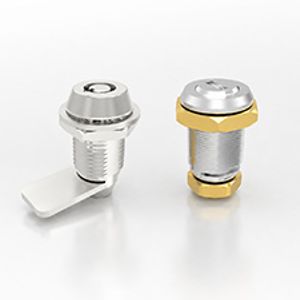
Why Does the Operating Environment Change Everything?
In outdoor and marine applications, the environment is not a secondary consideration — it is the primary selection filter, because material degradation, IP rating compatibility, and mechanical fatigue under thermal cycling will determine whether your latch lasts one season or one decade.
Standard indoor cam latch selection logic — load capacity, panel size, operation style — must be completely reordered when the enclosure lives outside or near saltwater. Engineers who apply indoor selection criteria to outdoor applications are not making a minor error; they are selecting from the wrong decision framework entirely.
Several environmental factors drive this reordering.
Coastal environments within 500 meters of the shoreline expose hardware to chloride concentrations 10 to 30 times higher than inland industrial sites. Offshore marine environments — deck-mounted enclosures, navigation equipment housings, instrument panels on workboats — represent the extreme end of this spectrum. Chloride ions attack metal surfaces through pitting corrosion, and they do so selectively: materials that appear identical in a catalog photo can have service life differences measured in years, not months.
Thermal cycling adds a second degradation mechanism that rarely appears in generic selection guides. Outdoor enclosures in equatorial or desert climates can cycle between 15°C and 65°C surface temperature within a single day. This repeated expansion and contraction degrades zinc alloy cam latches through micro-cracking at the cam pivot point — a failure mode that develops invisibly until the cam mechanism binds or fractures under normal operating torque.
The IP rating alignment issue is perhaps the most frequently overlooked constraint. The cam latch must not de-rate the enclosure's IP rating. An IP66-rated enclosure fitted with a latch that lacks a compatible gasket seat becomes, in practice, an IP54 enclosure. The latch cutout is the weakest point in the enclosure seal, and if the latch itself does not carry an independent IP rating with a documented gasket compression specification, the enclosure's rated protection is compromised from the moment of installation.
UV degradation on non-metallic components is a related concern. Latch head gaskets and polymer actuator components degrade under prolonged UV exposure even when the metal body remains intact. Material specification must account for UV stability across the full assembly, not just corrosion resistance on the metallic parts.
Finally, for marine deck applications specifically, vessel hull vibration creates continuous micro-vibration that can progressively loosen cam engagement over time if the latch lacks a positive-lock or compression feature. Workboats and offshore support vessels generate vibration profiles that are simply not present in land-based outdoor installations, and this must factor into latch type selection before material grade is even considered.
ForndLock Cam Latch Usage Guide
Is Stainless Steel Always Better Than Zinc Alloy for High Humidity Applications?
For genuine outdoor and marine environments, 316 stainless steel is not just the preferred choice — in high-salinity or permanently wet conditions, it is the only material that delivers predictable long-term performance, while zinc alloy remains viable only in sheltered or low-humidity outdoor settings with appropriate surface treatment.
This is the question we hear most often from procurement teams evaluating stainless steel cam latch vs zinc alloy for high humidity applications, and the answer requires more granularity than "stainless steel is better outdoors."
The zinc alloy failure timeline is documented in our internal accelerated testing. Standard die-cast zinc alloy (Zamak 3/5) with chrome plating, tested to ASTM B117 neutral salt spray protocol, shows first white rust appearance at 72 to 120 hours and red rust (base metal corrosion) at 200 to 300 hours. In real-world coastal environments, this translates to visible corrosion within three to six months — consistent with field reports from our clients in Southeast Asian port infrastructure projects who had previously sourced zinc alloy latches from general hardware suppliers. Zinc alloy with additional powder coating or epoxy finish can extend salt spray resistance to 500 to 700 hours, which is adequate for sheltered outdoor enclosures but falls short of what marine deck exposure demands.
The grade distinction within stainless steel matters more than most specifications acknowledge. 304 stainless steel (18-8) is frequently marketed as "marine grade" by non-specialist suppliers. It is not. Chloride pitting corrosion initiates on 304 SS in immersive saltwater or continuous salt fog exposure, typically appearing within 12 to 18 months. The absence of molybdenum in 304 SS leaves it vulnerable to the specific corrosion mechanism that coastal and marine environments generate.
316 stainless steel, with its 2 to 3% molybdenum addition, provides genuine resistance to chloride pitting. ForndLock's 316 SS cam latches have completed 1,000-hour neutral salt spray testing (ASTM B117) with no base metal corrosion — a benchmark we use as the minimum qualification threshold for marine-rated products. In practice, correctly specified and installed 316 SS cam latches demonstrate serviceable performance over 8 to 12 years in open marine deck environments.
The comparison below summarizes the performance differences across material options for the stainless steel cam latch vs zinc alloy for high humidity applications decision:
Parameter | Zinc Alloy (Zamak + Chrome) | Zinc Alloy (+ Powder Coat) | 304 SS | 316 SS |
Salt Spray Resistance (ASTM B117) | 72–300 hrs | 500–700 hrs | 500–800 hrs | 1,000+ hrs |
Chloride Pitting Risk | High | Medium-High | Medium | Low |
Suitable for Marine Deck? | No | No | Marginal | Yes |
Relative Unit Cost | Low | Low-Medium | Medium | Medium-High |
Expected Service Life (Coastal) | 3–9 months | 12–24 months | 3–5 years | 8–12 years |
The common mistake in specification, as one metallurgist we work with regularly puts it, is selecting material based on the enclosure's nominal environment rather than its worst-case exposure scenario. A telecom cabinet rated for "outdoor" use installed 50 meters from a harbor breakwater faces marine-class corrosion, not standard outdoor corrosion — and the latch specification must reflect that reality.
Zinc alloy does remain a defensible choice in specific scenarios: inland outdoor enclosures with roof or overhang protection and infrequent moisture contact; applications where the latch is recessed or shielded from direct weather exposure; and cost-sensitive projects where annual maintenance cycles are already built into the operational model. Outside these conditions, zinc alloy is a cost reduction that generates maintenance cost increases.
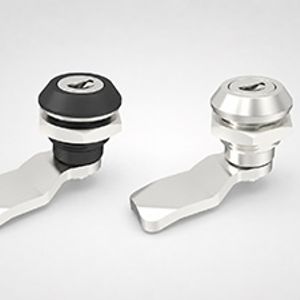
What IP Protection Level Does Your Cam Latch Actually Need?
The cam latch you select must match or exceed the IP rating of the enclosure itself — any mismatch at the latch cutout point will compromise the entire enclosure's ingress protection, regardless of how well the cabinet body is sealed.
This is a gap in most cam latch selection guides. IP ratings are mentioned in passing without explaining what they actually require from the latch as a discrete component.
IP65 protection — dust-tight and protected against water jets — requires a latch with a gasket seat that maintains its seal under direct water jet conditions (12.5 L/min at 30 kPa). This is the common requirement for outdoor electrical enclosures and is achievable with a well-specified quarter-turn cam latch carrying an integrated EPDM gasket.
IP66 is significantly more demanding: dust-tight and protected against powerful water jets at 100 L/min and 100 kPa. The gasket compression requirement increases substantially, meaning the cam latch must generate sufficient clamping force to maintain gasket integrity under this pressure. A latch that achieves IP65 does not automatically achieve IP66 — the cam geometry and compression force specification must be verified independently.
IP67 and IP68 — temporary and continuous immersion respectively — are relevant for below-deck marine applications or flood-prone outdoor installations. These ratings require compression-type cam latches with a documented gasket compression specification, not a standard quarter-turn latch. The distinction between "sealing against a water jet" and "sealing against hydrostatic pressure" is fundamental, and the hardware must reflect it.
The latch cutout problem is straightforward once understood: when a cam latch is installed, it creates an aperture in the enclosure panel. The sealing integrity at that point depends entirely on the latch's own gasket and the compression force its cam generates against the panel. A standard cam latch with no integrated gasket seat creates a direct ingress path — effectively a hole in the enclosure wall, regardless of how well the rest of the enclosure is sealed.
For engineers specifying cam latches for outdoor or marine enclosures, three verification steps are non-negotiable: confirm the latch manufacturer's independently stated IP rating (not the enclosure manufacturer's); verify gasket material compatibility with UV, ozone, and the deployment temperature range (EPDM is preferred over standard NBR for outdoor UV exposure); and confirm that cam compression force is documented in the latch specification, not assumed.
For North American projects, NEMA 4 (approximately equivalent to IP66) and NEMA 4X (IP66 plus corrosion resistance) are the standard outdoor enclosure ratings. Cam latches for NEMA 4X enclosures must be 316 SS or equivalent corrosion-resistant material — the "X" designation specifically addresses corrosion resistance, and a zinc alloy latch on a NEMA 4X enclosure is a direct specification contradiction.
How Did a Real Marine Project Reveal the True Cost of Wrong Specification?
A single incorrect material specification on a cam latch can trigger a cascade of costs — from emergency maintenance to equipment damage to full latch replacement across an entire fleet — that far exceeds the cost difference between zinc alloy and stainless steel.
A Norwegian offshore equipment OEM supplying instrument enclosures for North Sea workboat fleets had been using zinc alloy cam latches with chrome plating sourced from a general hardware supplier, specified for "outdoor" use. The specification appeared reasonable on paper. In practice, it was not matched to the actual exposure environment.
Within eight months of deployment on deck-mounted enclosures, approximately 60% of the cam latches showed visible corrosion at the cam pivot and body-panel interface. More critically, the corroded cam mechanisms had begun to bind — field technicians could no longer operate the latches with standard tools. Several enclosures required forced entry, damaging the panel cutout and compromising the IP66 seal that the enclosures had been designed and certified to maintain.
The client submitted failed samples to ForndLock for analysis. Our review identified three compounding issues: the base material was Zamak 5 with chrome plating rated to approximately 96 hours salt spray — wholly inadequate for North Sea exposure; the cam pivot had no lubricant retention feature, accelerating oxidation at the moving joint under continuous salt fog; and the latch had no integrated gasket seat, meaning the enclosure's IP66 rating had been compromised from day one of installation, regardless of the corrosion issue.
The solution was a complete latch replacement across the fleet with ForndLock 316 SS cam latches featuring EPDM gasket seats, electropolished finish (which reduces surface roughness and chloride adhesion compared to standard brushed finish), and a sealed cam pivot. The replacement units were validated to 1,000 hours neutral salt spray before shipment.
Follow-up inspection at 18 months post-replacement showed zero corrosion on the cam body or pivot across all deployed units. The client standardized the ForndLock 316 SS specification across their full enclosure product line. Estimated maintenance cost reduction: over 70% in latch-related field service calls during the following operational cycle. The cost difference between the original zinc alloy latches and the 316 SS replacements was recovered within the first avoided maintenance visit.
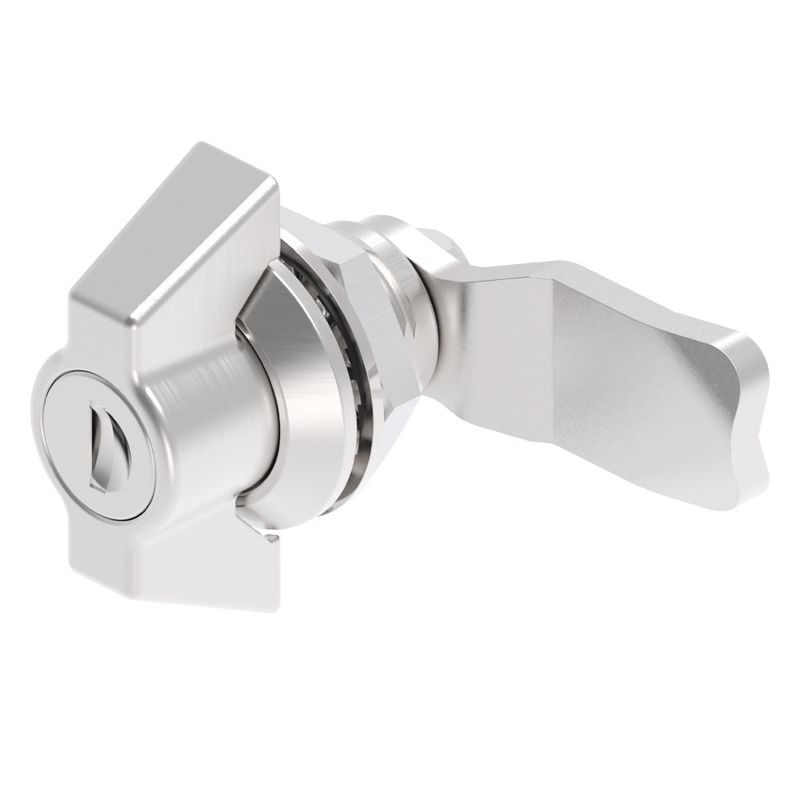
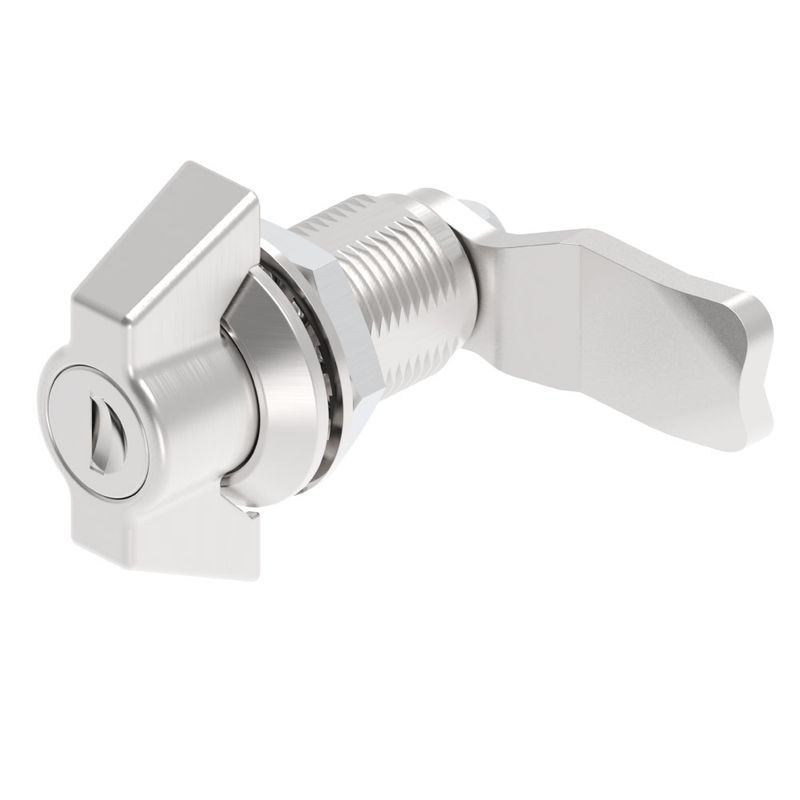
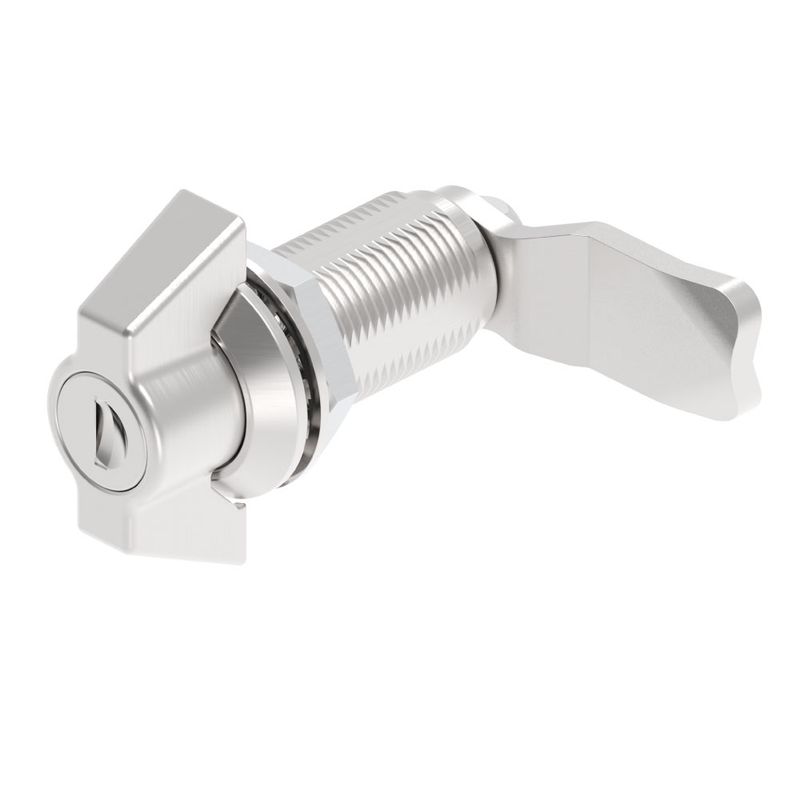
ForndLock: Quarter Turn Cam Lock with Key
What Specification Parameters Must Engineers Confirm Before Ordering?
Beyond material grade, a complete cam latch specification for outdoor or marine use must confirm panel thickness compatibility, cam grip range, gasket compression force, actuator head type, and keying requirement — missing any one of these parameters typically results in a reorder or a field modification.
Panel thickness and cam grip range are the starting point. Measure actual panel thickness at the latch cutout, including any gasket frame thickness. The cam grip range must be matched to ensure the cam fully engages the enclosure frame without over-travel or under-engagement. For marine enclosures with stainless steel panels — typically 1.5 to 3mm — grip range tolerance is tighter than for painted steel or GRP enclosures, and the margin for error is smaller.
Actuator head type deserves more attention in marine service than it typically receives. Slotted or square drive heads are standard but vulnerable to tool-slip in wet conditions. For marine deck applications, T-handle or L-handle variants allow gloved-hand operation without requiring a separate tool — a practical consideration when field technicians are working in rain or spray. Keyed cam latches are appropriate where enclosure access must be restricted to authorized personnel, as is common in offshore energy and marine navigation equipment installations.
Torque and compression force documentation is a non-negotiable requirement for IP66 and IP67 applications. Under-compression leaves the gasket seal leaking; over-compression accelerates gasket creep and long-term seal degradation. If a supplier cannot provide a documented compression force specification for their cam latch, that is a qualification failure, not a minor gap.
Surface finish specification for marine applications carries a measurable performance difference. Electropolished 316 SS outperforms standard passivated or brushed 316 SS in salt spray testing by approximately 15 to 25% longer time to first pitting initiation in our comparative testing. The electropolishing process removes surface micro-roughness that would otherwise trap chloride ions and initiate pitting sites. In open marine deck environments, this difference is meaningful over a multi-year service life.
Neutral Salt Spray Test for ForndLock Rotary Locks
Mixed-metal assemblies are a common and avoidable failure mode. A 316 SS cam latch body paired with carbon steel fasteners creates a galvanic corrosion cell at the fastener interface — the carbon steel will corrode preferentially and rapidly in a salt fog environment. All-316 SS assembly, including fasteners and mounting hardware, is the correct specification for marine applications.
Quick-reference specification checklist for outdoor and marine cam latch procurement:
· Material grade confirmed (316 SS for marine/open outdoor; 304 SS for sheltered outdoor; zinc alloy only for protected indoor-adjacent)
· Salt spray test hours documented by supplier (minimum 500 hours for outdoor; 1,000 hours for marine)
· IP rating of latch confirmed independently and matched to enclosure requirement
· Gasket material specified (EPDM recommended for UV/outdoor; NBR acceptable for sheltered)
· Panel thickness and cam grip range measured and matched
· Actuator head type selected for operational environment (gloved-hand, tool-operated, or keyed)
· Surface finish specified (electropolished preferred for marine deck)
· All fasteners confirmed as 316 SS to prevent galvanic corrosion at mounting interface
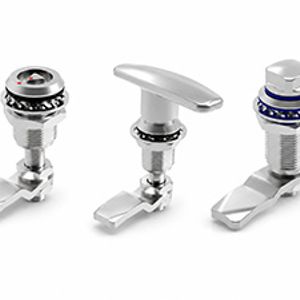
Frequently Asked Questions
Q1: Can I use a 304 stainless steel cam latch on a marine vessel if it's installed inside a protected housing?
304 SS is acceptable in genuinely protected below-deck locations with no direct salt air exposure — for example, an interior instrument panel in a sealed cabin environment. The practical problem is that "protected housing" is frequently overestimated in field conditions. Marine vessels have ventilation paths, hatch openings, and condensation cycles that introduce salt air into spaces nominally described as protected. For any installation on a marine vessel where the actual exposure environment cannot be guaranteed to be free of salt air, the default specification should be 316 SS. The cost difference between 304 and 316 SS at the individual latch level does not justify the risk of specifying the marginal material.
Q2: How many hours of salt spray testing should I require from a supplier for outdoor enclosure cam latches?
The tiered benchmark we apply: 500 hours minimum for standard outdoor enclosures in non-coastal environments; 1,000 hours minimum for coastal installations or any marine application. ASTM B117 neutral salt spray testing is the standard protocol — it exposes the sample to a continuous 5% sodium chloride fog at 35°C and measures time to first corrosion appearance on the base metal. When evaluating supplier test data, confirm the test was conducted on the complete assembled latch (not just the body material), and that the test report documents the specific failure mode and timing, not just a pass/fail result.
Q3: Does the cam latch need its own IP rating, or does the enclosure's IP rating cover the latch?
The latch requires its own independent IP rating. The enclosure's IP rating describes the performance of the complete sealed enclosure as a system — it does not extend to individual components installed in cutouts unless those components are independently rated and sealed. When a cam latch is installed in an enclosure panel, it creates an aperture that bypasses the enclosure body seal entirely. The only protection at that point is the latch's own gasket and its documented compression performance. Specifying an IP66 enclosure without verifying the latch's independent IP66 rating is a common error that produces an enclosure that is nominally rated but practically compromised.
Q4: What is the difference between electropolished and passivated 316 stainless steel cam latches, and does it matter for my application?
Passivation is a chemical treatment that removes free iron from the stainless steel surface and promotes a uniform chromium oxide layer — it is the standard finishing process for 316 SS hardware. Electropolishing goes further: it removes surface micro-peaks and embedded contaminants through an electrochemical process, producing a smoother, more chemically inert surface that resists chloride adhesion. In our comparative salt spray testing, electropolished 316 SS consistently shows 15 to 25% longer time to first pitting initiation compared to passivated 316 SS of the same base material. For marine deck and high-chloride environments, electropolished finish justifies its cost premium. For sheltered outdoor applications with only intermittent moisture exposure, standard passivated 316 SS provides adequate performance and the electropolished upgrade offers marginal additional benefit.
Q5: Can ForndLock supply cam latches with custom cam grip ranges or non-standard actuator heads for OEM enclosure projects?
Yes. ForndLock routinely produces custom cam grip ranges, non-standard actuator head configurations, and modified gasket seat geometries for OEM enclosure clients. The typical process involves drawing submission or panel sample review, followed by a prototype sample for dimensional and functional validation before production. Minimum order quantities for custom configurations vary by complexity. If you are working on an OEM enclosure project with specific panel thickness, IP rating, or environmental certification requirements, the most efficient path is to submit your enclosure drawings or dimensional specifications directly to our engineering team — we will provide a documented recommendation and sample proposal rather than a generic catalog reference.
Outdoor and marine cam latch selection involves project-specific constraints — panel thickness tolerances, enclosure brand compatibility, IP certification documentation requirements, fleet standardization — that no product catalog can resolve on its own. If you are specifying cam latches for an outdoor enclosure or marine application and need material validation data, salt spray test reports, samples, or a custom configuration review, send your project details or drawings to [email protected] — our engineering team will respond with a documented recommendation, not a generic catalog link.