
What Types of Hinges Exist and Which One Fits Your Application?
Most hinge selection mistakes don't happen because engineers don't know what a hinge is. They happen because the wrong hinge gets matched to the wrong load, the wrong motion requirement, or the wrong environment. At ForndLock, we see this pattern consistently across project inquiries — one of the most frequent examples is customers specifying standard residential-grade butt hinges on enclosure doors that weigh upward of 80 kg. The hinge fits the opening. It works on day one. But within months, the knuckle wears, the door sags, and the seal fails.
This guide organizes the types of hinges and their uses not by appearance or alphabetical listing, but by the variables that actually drive selection decisions: load capacity, motion requirement, access frequency, and operating environment. Work through those four variables in sequence, and the correct hinge family becomes clear. Skip them, and you're guessing.
Why Does Hinge Type Matter More Than Most People Realize?
The hinge type you select determines not just whether a door opens, but how long it opens reliably — the wrong match between hinge design and application load is one of the most common causes of premature hardware failure in industrial installations.
A hinge is not a passive connector. It is a load-bearing mechanical joint that accumulates stress with every cycle, every kilogram of door weight, and every exposure to its operating environment. Over a service life that might span tens of thousands of cycles, the difference between the right and wrong hinge specification compounds significantly.
Four variables thread through every hinge selection decision:
Load and door weight — this means static load (the dead weight of the door at rest) and dynamic stress (the force applied during opening, closing, wind loading, or pressure differential). Steel enclosure panels in industrial settings commonly range from 15 kg to 150 kg or more, and the bearing type requirement shifts substantially across that range. A plain-bearing butt hinge adequate for a 25 kg panel is not adequate for a 90 kg door cycling multiple times per shift.
Motion type — does the application require a standard 90° to 180° swing, full lift-off removal, controlled self-closing, or something more specialized? The motion requirement often determines the hinge family before load even enters the calculation.
Access frequency — a maintenance hatch opened twice a year places entirely different demands on a hinge than an operational door cycled 50 to 200 times per day. High cycle frequency shifts the specification toward ball-bearing or continuous hinge types, where plain-bearing alternatives would wear prematurely.
Operating environment — corrosive, hygienic, high-temperature, and standard indoor conditions each impose different material and finish requirements. Material selection follows from environment, not from personal preference or cost alone.
With those variables established, here is how the major hinge families map to them.
What Are the Core Hinge Types for Standard and Heavy-Duty Door Applications?
For most door applications — from interior access panels to heavy industrial enclosures — the decision comes down to four primary hinge families: butt/leaf hinges, ball-bearing hinges, continuous hinges, and weld-on hinges, each suited to a distinct load and frequency profile.
These are the workhorse types ForndLock most frequently supplies for door and panel applications. Understanding them as a progression from lightest to heaviest duty makes the selection logic easier to follow.
When Is a Butt or Leaf Hinge the Right Starting Point?
Butt hinges are the correct baseline choice for light-to-medium doors with low-to-moderate cycle frequency, where installation simplicity and cost efficiency outweigh the need for extended bearing life.
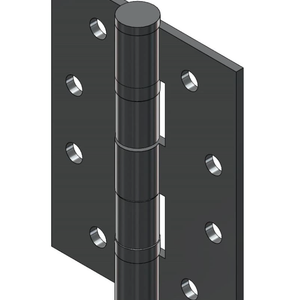
Two-leaf construction joined by a central knuckle pin — this is the most globally common hinge configuration, and for good reason. For doors up to approximately 40 to 60 kg (depending on leaf size and the number of hinges used), a properly specified butt hinge performs reliably.
Several variants are worth distinguishing in industrial contexts. Loose-pin butt hinges allow door removal without unscrewing the leaves — useful for maintenance panels that need to come off periodically. Fixed or non-removable pin variants offer better tamper resistance for secure enclosures. The security dogbolt variant adds a tab that engages the frame when the pin is removed, preventing the door from being extracted even if the pin is compromised — relevant wherever access control matters.
Where ForndLock consistently sees butt hinges misapplied is on enclosure doors that cycle hundreds of times daily. One customer came to us after experiencing accelerated wear on a control cabinet door that was accessed multiple times per shift by operators. The original specification used standard plain-bearing butt hinges. Switching to ball-bearing hinges of the same leaf dimensions resolved the wear issue entirely. The lesson: butt hinges are the right answer for the right frequency range, and that range has a ceiling.
When Do Ball-Bearing Hinges Become Necessary?
Ball-bearing hinges are necessary when door weight exceeds roughly 60 kg, when cycle frequency is high, or when smooth, low-friction operation must be maintained over the product's service life.
ForndLock Friction & Torque Hinges
The bearing mechanism works by seating lubricated steel balls between the knuckles, redistributing radial load and eliminating direct metal-on-metal contact during rotation. This reduces friction, reduces heat generation under high-cycle conditions, and dramatically extends service life compared to plain-bearing alternatives.
Specification typically involves choosing between 2-bearing and 4-bearing configurations. A 4-bearing hinge distributes load across more contact points and is appropriate for heavier doors or higher cycle applications. For heavy steel doors, high-traffic industrial access points, and machinery panels that are opened and closed repeatedly during normal operations, ball-bearing hinges are the standard specification. In food processing or marine environments, stainless steel ball-bearing hinges with appropriate bearing lubrication are required.
Why Would an Application Need a Continuous (Piano) Hinge?
Continuous hinges distribute load across the entire door height rather than concentrating stress at two or three points, making them the correct choice for long panels, lightweight but dimensionally large doors, or applications where warping or racking is a concern.
Think of it this way: three point-load hinges on a 1,200 mm tall enclosure door create three stress concentrations in the door skin and the frame. A continuous hinge running the full height of that same door acts as a distributed spine, eliminating those stress concentrations entirely. For thin-gauge sheet metal doors that would otherwise bow or rack under point-load hinge placement, continuous hinges solve a structural problem that adding more butt hinges cannot.
Full-length pin-and-barrel construction is available in steel and anodized aluminum. Common industrial applications include electrical enclosure doors, control panel lids, server rack doors, and toolbox lids. The geared continuous hinge variant uses gear-tooth meshing for heavier doors requiring synchronized, smooth operation — the gear engagement prevents the door from twisting under its own weight during the swing cycle.
ForndLock supplies continuous hinges in custom-cut lengths. Ordering to exact dimension is the standard practice for production applications, while field installations often cut to length on-site.
When Is a Weld-On Hinge the Right Choice Over a Screw-Fixed Hinge?
Weld-on hinges are the correct choice when the substrate is metal, when maximum structural integrity is required, or when screw-fixed leaves would create unacceptable pull-out risk under high load or impact.
The absence of fastener holes is the defining advantage. When a weld-on hinge leaf is properly welded to a steel structure, the leaf becomes part of the structure — there is no screw thread to strip, no pull-out force to calculate, no fastener pattern to space. For shipping containers, vault doors, armored enclosures, heavy steel gates, and fire doors, this structural continuity is not optional.
Heavy-duty weld-on hinges are commonly rated for doors exceeding 200 kg, which places them in a load class entirely above what screw-fixed butt hinges can reliably achieve. Mild steel is the standard material for welding compatibility; stainless variants are available for corrosive environments where both weld integrity and corrosion resistance are required.
One installation consideration that matters in practice: weld-on hinges require precise positioning before welding. Post-weld adjustment is not possible. Design tolerances need to account for this — a misaligned weld-on hinge cannot be shimmed or repositioned the way a screw-fixed hinge can.
What Hinge Types Are Used for Specialized Motion or Access Requirements?
When standard swing-and-hold motion is not enough — when a panel must be removed entirely, close automatically, or resist slamming — specialized hinge types address these motion and access requirements that general-purpose hinges cannot.
What Makes a Lift-Off Hinge Right for Maintenance Access?
Lift-off hinges allow a door or panel to be removed from its frame by simply lifting upward — no tools, no unscrewing — which makes them the correct specification for access panels requiring frequent removal during maintenance or changeover.
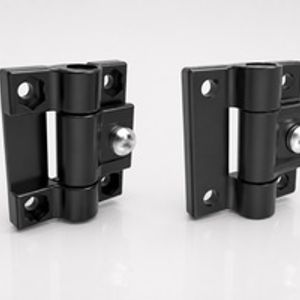
The mechanism is straightforward: a male leaf carries a fixed pin; the female leaf slides free when the door is lifted vertically. No tools required, no hinge screws to remove, no risk of losing fasteners in a production environment. For electrical enclosures, removable machine guards, cleanroom panels, and access hatches, this tool-free removal capability has real operational value.
Handedness is a specification detail that generates a disproportionate number of ordering errors. Lift-off hinges are handed — the direction of lift must be specified at ordering, because a left-hand lift-off hinge cannot be used as a right-hand lift-off hinge. Load capacity is also more limited than continuous or weld-on types; lift-off hinges are appropriate for panels up to approximately 30 to 50 kg depending on hinge size.
ForndLock receives frequent requests for lift-off hinges in 316 stainless steel for food-grade equipment, specifically for panels that are removed daily for cleaning. The material requirement is non-negotiable in those environments, and standard zinc-plated carbon steel lift-off hinges are not an acceptable substitute.
When Should You Specify a Self-Closing or Spring Hinge?
Self-closing hinges are required wherever a door must return to a closed position without user action — fire-rated corridors, cleanrooms, server rooms, and secure enclosures all commonly mandate self-closing hardware.
The spring-loaded mechanism is integrated into the knuckle. Tension is adjustable in most industrial-grade models, which allows the closing force to be calibrated to the door weight — critical because an over-tensioned spring on a heavy door creates user force requirements that become a safety issue, while an under-tensioned spring on a light door may not reliably close against a door seal.
Single-action spring hinges close from the open position. Double-action spring hinges close from either direction — relevant for pass-through doors in production environments. Fire door compliance in many jurisdictions explicitly requires self-closing hardware, and specifying the correct spring tension for the door weight is part of the compliance calculation, not an afterthought.
The damper or soft-close variant adds a hydraulic damping mechanism that controls close speed. This prevents slamming, reduces impact loads on seals and frames, and is increasingly specified for sensitive electronic enclosures where repeated door slam would compromise gasket integrity over time. Spring fatigue life is a real consideration: industrial-grade spring hinges are rated for significantly higher cycle counts than residential equivalents, and that specification should be verified against the application's expected cycle frequency.
Are Concealed Hinges Relevant in Industrial or Heavy-Duty Contexts?
Concealed hinges are relevant in industrial contexts primarily when the application combines aesthetic requirements with access control — think high-end control panels, architectural metalwork, or enclosures where exposed hardware creates tamper or snagging risk.
The cup-and-arm mechanism recesses into the door face, making the hardware invisible when the door is closed. Industrial-grade concealed hinges are a different product category from furniture cup hinges — load ratings, material specifications, and adjustment ranges are not comparable, and substituting one for the other is a specification error ForndLock occasionally has to correct during design review.
Applications include premium enclosure doors, architectural entrance systems, and medical equipment housings where flush exterior surfaces are part of the design brief. The installation tolerance requirement is tighter than surface-mounted types — precise boring is required, and misalignment cannot be corrected after installation the way surface-mounted hinges can be shimmed. ForndLock supplies concealed hinges primarily as part of complete door hardware packages where the customer's design brief specifies flush exterior surfaces as a hard requirement.
How Do You Match Hinge Material and Finish to Your Operating Environment?
Hinge type selection is only half the decision — the material and surface finish must match the operating environment, because a correctly specified hinge type in the wrong material will fail just as surely as the wrong hinge type entirely.
Which Hinge Materials Suit Corrosive or Outdoor Environments?
Stainless steel (grade 304 or 316) is the standard specification for corrosive, marine, or outdoor environments, with grade 316 required where chloride exposure is significant — standard carbon steel with zinc plating is not adequate for prolonged outdoor or chemical exposure.
Carbon steel offers the highest strength at the lowest cost and is appropriate for indoor, protected applications with controlled humidity. Any moisture exposure requires a protective coating, and that coating has a finite service life. Zinc plating provides basic corrosion protection adequate for light-duty indoor use; hot-dip galvanizing extends that protection significantly for outdoor structural applications; powder coat adds aesthetic durability but is not a substitute for corrosion-resistant base material in aggressive environments.
Grade 304 stainless handles most outdoor and light-chemical environments without issue. Grade 316 adds molybdenum to the alloy, which substantially improves chloride resistance — coastal installations, chemical processing facilities, and food and beverage environments where cleaning chemicals are used regularly all warrant 316 as the minimum specification. Salt spray testing per ASTM B117 is the standard method for evaluating coating durability; zinc-plated carbon steel typically achieves 96 to 200 hours before red rust, while 316 stainless can exceed 1,000 hours — a meaningful difference when specifying hardware for outdoor or marine service.
Aluminum is lightweight and naturally corrosion-resistant, making it appropriate for continuous hinges on aluminum-framed enclosures. It is not appropriate where high impact loads or weld-on installation is required.
Does Temperature or Hygienic Requirement Change the Hinge Specification?
High-temperature environments and hygienic applications both require material and design modifications that go beyond standard hinge selection — stainless steel with smooth, crevice-free surfaces is mandatory in food-grade contexts, while high-temperature applications may require specific lubricant-free bearing designs.
Standard bearing lubricants degrade above approximately 120°C to 150°C depending on the grease formulation. For ovens, kilns, industrial heating equipment, and other elevated-temperature applications, dry-film lubricated or self-lubricating bearing materials are required to maintain bearing function across the operating temperature range.
Food processing and pharmaceutical environments impose a different set of requirements. Smooth external surfaces with no exposed threads, no crevices, and no recesses that can trap product or cleaning fluid are mandatory. Electropolished stainless steel is preferred because the electropolishing process removes surface micro-roughness that standard passivation leaves behind. Zinc-plated or cadmium-plated hardware is not acceptable in these environments — both materials present contamination risk.
ForndLock encountered this exact issue during a design review for a food processing customer who had initially specified zinc-plated butt hinges on a panel adjacent to a product handling area. The correction to electropolished 316 stainless was made before production, avoiding a compliance issue that would have required a retrofit. Catching material mismatches at the drawing review stage is significantly less expensive than correcting them in the field.
How Do You Actually Select the Right Hinge for Your Specific Project?
Selecting the right hinge requires working through four questions in sequence: What is the door weight and dimensions? How often will it cycle? What motion or access behavior is required? What is the operating environment — and only then does the hinge type and material become clear.
Step 1 is establishing load. Weigh the door or panel and account for dynamic load — wind pressure, pressure differential across the enclosure, or the force a user applies during operation. ForndLock recommends a minimum 1.5× safety factor on static weight for industrial applications. A 60 kg door should be specified against hinges with a combined rated capacity of at least 90 kg.
Step 2 is defining cycle frequency. Occasional maintenance access — fewer than 500 cycles per year — places very different demands on a hinge than an operational door cycled 50,000 to 200,000 times over its service life. High cycle frequency is the single most common reason a plain-bearing butt hinge specification should be upgraded to ball-bearing or continuous.
Step 3 is determining the motion requirement. Standard swing covers the majority of applications. Lift-off is required where tool-free panel removal is operationally necessary. Self-closing is required wherever compliance mandates it or where an unlatched door creates a process or safety risk. Controlled close protects seals and sensitive internal components from impact.
Step 4 is assessing the environment. This feeds directly into material and finish selection and cannot be treated as an afterthought.
ForndLock Free Swing Hinges Product Range
Common specification errors ForndLock encounters in project inquiries: undersized leaf area for the actual door weight; residential hinge grades specified on industrial cycle frequencies; handedness ignored on lift-off hinge orders; aluminum hinges requested for weld-on applications. A real example — a control panel manufacturer came to ForndLock with a door warping problem on a 1,200 mm tall enclosure. The root cause was three-point butt hinge placement creating stress concentrations in a thin-gauge door skin. Switching to a continuous hinge running the full door height resolved the warping entirely without any change to the door material or frame design.
Application Type | Recommended Hinge Family | Material | Key Specification Note |
Light enclosure panel, low cycle | Butt / leaf hinge | Carbon steel or 304 SS | Verify leaf size for door weight |
Heavy enclosure door, high cycle | Ball-bearing hinge | 304 or 316 SS | Specify bearing count for load |
Tall or thin-gauge panel | Continuous hinge | Steel or aluminum | Order to exact door height |
Vault, fire door, heavy gate | Weld-on hinge | Mild steel or 316 SS | Pre-weld positioning is final |
Maintenance access panel | Lift-off hinge | 316 SS for food/marine | Specify handedness at ordering |
Fire-rated or secure corridor | Self-closing spring hinge | Steel | Match spring tension to door weight |
Premium enclosure, flush exterior | Concealed hinge | Industrial-grade only | Precise boring required |
Outdoor or coastal installation | Any type | 316 SS minimum | Verify ASTM B117 hour rating on finish |
Understanding the types of hinges and their uses is ultimately a precision exercise, not a commodity selection. The right specification prevents downtime, avoids warranty claims, and eliminates retrofit costs that are always more expensive than getting the specification right the first time. At ForndLock, we work with engineering teams and procurement departments on hinge specification from initial drawing review through to custom manufacturing and sampling — whether the requirement is a standard industrial hinge, a non-standard dimension, a specific material certification, or a prototype run.
If you have project requirements, drawings, or custom specifications to discuss, send them directly to [email protected]. We'll review the application and come back with a specification recommendation or a custom manufacturing proposal.
What Questions Do Engineers Most Often Ask About Hinge Selection?
How many hinges does a heavy industrial door actually need?
The number of hinges required depends on door weight, height, and hinge load rating — as a general rule, load should be distributed across hinges so no single hinge carries more than its rated capacity, with a minimum safety margin of 1.5×. For doors exceeding 100 kg, four or more hinges are typically required. Continuous hinges eliminate this calculation entirely by distributing load uniformly across the full door height.
Can I use the same hinge type for both interior and exterior applications?
The hinge type may be the same, but the material and finish must change — a butt hinge suitable for an interior enclosure in carbon steel will corrode rapidly in an outdoor or marine environment where 316 stainless is required. Hinge type follows the motion and load requirement; material follows the environment. Treating them as independent decisions is the correct approach.
What is the difference between a piano hinge and a continuous hinge?
They are the same product — "piano hinge" is the common name and "continuous hinge" is the technical term; both refer to a full-length pin-and-barrel hinge, though industrial continuous hinges are manufactured to heavier gauges than the piano-application originals. When specifying for industrial enclosures or heavy panels, always confirm the gauge and load rating rather than assuming the product matches the application by name alone.
How do I specify a hinge for a fire-rated door?
Fire-rated door hinges must comply with the door assembly's certification requirements — this typically means steel or stainless steel construction, a minimum number of hinges per door height, and in many cases a self-closing mechanism; brass hinges are not acceptable due to their low melting point. Always verify that the hinge specification is consistent with the full door assembly certification, not just the hinge in isolation.
Does ForndLock supply custom hinge dimensions or non-standard materials?
Yes — ForndLock manufactures hinges to custom dimensions, non-standard materials, and specific certifications for industrial and OEM applications; project requirements and drawings can be submitted directly to [email protected] for engineering review and sampling. Custom continuous hinge lengths, non-standard leaf dimensions, material certification requirements, and prototype quantities are all within our standard manufacturing scope.