
Types of Industrial Door Pull Handles: Uses and Manufacturer Selection Guide
Fixed U-shaped pull handles suit many conventional industrial doors. Tubular handles provide a longer gripping area for large doors. Folding and recessed handles reduce external projection. Offset handles improve access around frames and nearby hardware. Heavy-duty handles are intended for greater operating forces and demanding environments. The final decision depends on the door movement, required pull force, grip clearance, mounting structure, and operating environment. This guide walks through the main types of industrial door pull handles, where each one belongs, how to evaluate grip and mounting strength, and how to select a manufacturer capable of supporting drawing review, customization, and sample validation. At ForndLock, we work with equipment manufacturers and engineers on exactly these decisions, so the sections below move from product selection through to manufacturer evaluation.
ForndLock Industrial Handle Series
What Is an Industrial Door Pull Handle?
An industrial door pull handle is a fixed or moving component that gives the operator a gripping surface for pulling, sliding, lifting, or otherwise controlling a door, lid, or access panel.
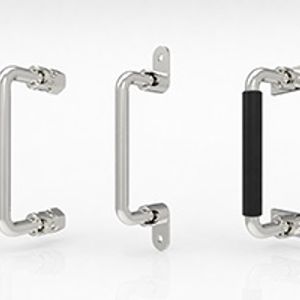
It is a mechanical interface between the human hand and the moving element of an enclosure, machine guard, or transport case. A pull handle normally does not actuate a locking or latching mechanism on its own — it provides the grip that lets the operator apply force, while the securing function, if required, is usually handled by a separate lock or latch. Understanding this distinction matters because specifying the wrong category of hardware for the job — say, expecting a plain pull handle to also secure a door under vibration — leads to premature failure or an unsafe installation.
How Is a Pull Handle Different from a Lever or Locking Handle?
A pull handle is passive and does not actuate a latch, while lever handles, T-handles, L-handles, locking handles, and latch-operating handles are designed to engage or release a locking or latching mechanism. A lever handle typically rotates a shaft that drives a latch bolt or cam. T-handles and L-handles often combine a gripping surface with a key cylinder or quarter-turn mechanism that operates a rod or cam lock. Locking handles integrate a securing function directly into the grip. Latch-operating handles are mechanically linked to compression latches or rotary latches. Carrying handles, by contrast, are intended for lifting or transporting a panel or case rather than opening it in place. A pull handle can be — and often is — used alongside one of these other components: the pull handle gives the operator something to hold while a separate quarter-turn lock or compression latch does the securing work. Confusing these categories during specification is a common source of mismatched hardware on a bill of materials.

Which Dimensions Define an Industrial Pull Handle?
An industrial pull handle is defined by overall length, usable grip length, grip diameter or width, mounting-center distance, projection, finger clearance, leg height, fastener size, panel cutout, and mounting direction. Overall length is the full physical dimension of the part, while usable grip length is the portion an operator can actually wrap a hand or fingers around without interference from end caps, legs, or mounting hardware. Grip diameter or width affects comfort and how well a gloved hand can close around the handle. Mounting-center distance determines hole spacing on the door panel. Projection is how far the handle stands off the panel surface, which affects both accessibility and snagging risk. Finger clearance is the gap between the grip and the panel surface, and leg height is one factor that establishes it. Fastener size, panel cutout (for recessed designs), and mounting direction round out the parameters an engineering drawing needs to specify clearly. We recommend that any request for quotation include a labeled dimensional diagram rather than a verbal description, since small differences in projection or mounting centers can make a handle incompatible with an existing panel cutout.
What Types of Industrial Door Pull Handles Are Available?
Industrial pull handles are generally available as fixed U-shaped or bridge handles, tubular or bar handles, offset handles, folding or drop handles, recessed or flush handles, heavy-duty handles, and ergonomic or coated handles. Each type answers a different combination of grip, clearance, mounting, and operating-environment requirements, and no single design is correct for every door.
Handle Type | Structural Feature | Recommended Uses | Main Advantage | Main Limitation |
Fixed U-shaped / bridge | Two mounting legs, open grip span | Cabinets, control enclosures, machine doors | Simple, immediate grip access | External projection, possible snagging |
Tubular / bar | Extended straight or bent tube | Large doors, two-handed operation | Long usable grip length | Requires more mounting-panel stiffness |
Offset | Grip positioned away from mounting face | Clearance around frames, locks, switches | Access around obstructions | Increased leverage and twisting at mounts |
Folding / drop | Pivoting grip, stored flat | Transport cases, mobile equipment | Reduced stored projection | Moving parts, potential rattling |
Recessed / flush | Grip set into a panel cutout | Sliding doors, stacked cases | Minimal projection | Reduced grip space, glove access limits |
Heavy-duty | Reinforced cross-section, robust mounting | High-force or demanding environments | Greater structural margin (when verified) | Cost, weight, and unverified load claims risk |
Ergonomic / coated | Rounded or coated grip surface | Frequent operation, gloved use | Comfort and slip resistance | Coating wear, chemical sensitivity |
When Should You Use Fixed U-Shaped or Bridge Pull Handles?
Fixed U-shaped or bridge pull handles suit electrical cabinets, control enclosures, machine doors, access panels, drawers, and equipment covers where sufficient projection space is available and no folding or flush function is required. Their structure is simple: two mounting legs support a bridge that the operator grips directly, with no moving parts to maintain. This simplicity translates into easy installation, low long-term maintenance, and compatibility with several mounting methods, from through-bolts to rear-threaded studs. The trade-off is that a fixed handle always projects from the panel surface, which can snag clothing, cables, or straps, and it cannot be retracted for tight installations or transport. In practice, fixed handles are often the correct default choice whenever there is enough clearance around the door and no specific requirement for flush storage or impact protection — reaching for a more complex design when a fixed handle would do only adds cost and potential failure points.

When Should You Use Tubular or Bar Pull Handles?
Tubular or bar pull handles are suited to large equipment doors, long cabinet doors, and applications requiring two-handed operation or flexible hand placement along the grip. Because the usable grip length extends across most of the handle's span, the operator is not locked into a single hand position, which is useful when doors are heavy or when different operators have different reach requirements. Engineering considerations include the tube diameter (which affects both strength and comfort), whether the tube is bent or straight, the mounting-center distance relative to door width, and how much the supporting panel can resist flexing under an off-center pull. Because the loaded span is longer than on a compact U-shaped handle, fastener loads at each end can be higher for the same applied force, so panel stiffness near the mounting points deserves particular attention.
When Should You Use Offset Pull Handles?
Offset pull handles create clearance around door frames, raised edges, locks, latches, switches, protective covers, or nearby equipment by positioning the grip away from the mounting surface.

This geometry is useful whenever a straight, flush-mounted handle would place the operator's hand too close to an obstruction, or where a raised door lip prevents fingers from reaching a handle mounted directly on the panel. The trade-off is mechanical: moving the grip away from the mounting face increases the leverage arm, which increases twisting and bending forces transferred to the mounting points during pulling. An offset handle that looks structurally similar to a fixed handle can therefore load its fasteners and panel differently, and this should be checked rather than assumed.
When Should You Use Folding or Drop Handles?
Folding or drop handles reduce stored projection on transport cases, mobile equipment, compact machinery, and installations where a fixed handle would be exposed to impact or interference. Three common retention approaches exist: gravity-return handles that fall back into a stored position under their own weight, friction-retained handles that stay in whichever position they are moved to, and spring-return handles that actively return to a stored or deployed position. Each has trade-offs. Gravity-return designs depend on correct orientation and can swing loose under vibration if not oriented correctly. Friction-retained handles can loosen over repeated cycles and begin to rattle. Spring-return handles add moving parts that can fatigue or fail to return if contaminated or damaged. Beyond the return method, engineers should evaluate stored projection versus deployed projection, ease of deployment while wearing gloves, pinch points between the handle and the panel during folding, and whether vibration during transport could cause accidental deployment.
When Should You Use Recessed or Flush Pull Handles?
Recessed or flush pull handles are suited to sliding doors, transport equipment, walkways, stacked cases, and compact machinery where a projecting handle could be damaged or obstruct movement. These designs require a panel cutout sized to the handle body, and the installation depth must be checked against the internal clearance behind the panel — a deep recessed handle can interfere with cabling, brackets, or other components on the inside of a door. Sealing and drainage matter for outdoor or washdown applications, since a recess can collect water or debris if it is not designed with adequate drainage. Panel stiffness around the cutout also needs review, since removing material for the cutout can locally weaken a thin sheet-metal door. The main functional limitation is reduced grip space: recessed handles are harder to operate with thick gloves, and finger access can be tight, so this trade-off should be weighed carefully against the low-projection benefit before specifying a flush design purely for appearance.
When Should You Use Heavy-Duty Pull Handles?
Heavy-duty pull handles are intended for greater operating forces and demanding environments, but the "heavy-duty" designation must be supported by verified construction details and test conditions rather than by name alone. A handle described as heavy-duty should be evaluated on its actual cross-section, material, handle-leg design, weld quality where welding is used, thread engagement depth, fastener strength, and whether backing plates are specified for the mounting panel. Pull direction relative to the handle's strongest axis also matters, since a handle that performs well under a straight pull may behave differently under an off-axis or twisting load. We do not state that a given handle supports a specific load figure unless that figure comes from a defined and verifiable test — a "heavy-duty" label without supporting data should be treated as a marketing term rather than an engineering specification, and any load claim used in project documentation should be confirmed with the manufacturer before being relied upon.
When Should You Use Ergonomic or Coated Pull Handles?
Ergonomic or coated pull handles improve comfort and control for frequent operation, gloved operators, and oily, wet, cold, or hot equipment surfaces. A larger grip diameter with rounded edges distributes contact pressure across more of the hand, which matters for operators who use a given door many times per shift. Non-slip surface treatments help maintain grip in oily or wet conditions, and coatings can offer a degree of thermal isolation on equipment that runs hot or cold. The limitations are practical: coatings wear with repeated use and can be damaged by aggressive cleaning chemicals or abrasive contact, and chemical compatibility should be checked against the specific solvents or cleaning agents used in the facility. Cleanability is also a factor — a textured non-slip surface can be harder to clean than a smooth one in food-contact or sanitary environments.
Where Should Each Industrial Pull Handle Type Be Used?
The correct pull handle depends on the specific application — electrical enclosures, machine guards, sliding doors, lift-up covers, or outdoor and transport equipment each favor a different combination of handle types.
Application | Recommended Handle Type | Alternative Option | Key Engineering Concern |
Electrical/control enclosures | Fixed or offset | Recessed, heavy-duty | Gasket compression, lock clearance |
Machine guards/automation | Fixed or folding | Offset, heavy-duty | Vibration, impact, walkway clearance |
Sliding industrial doors | Recessed/flush | Low-profile offset | Lateral pull, frame interference |
Lift-up covers/lids | Fixed, oriented for upward pull | Bar handle with damping hardware | Lid balance, pinch points |
Outdoor/transport equipment | Corrosion-resistant, low-profile | Folding or recessed | Corrosion, shock, snagging |
Which Pull Handles Work Best for Electrical and Control Enclosures?
Fixed, offset, recessed, and heavy-duty handles are the main options for electrical and control enclosures, with the choice depending on gasket compression, lock position, and glove use. Door dimensions and panel thickness set the practical limits on grip length and mounting-center spacing. Where a door uses a compressible gasket, handle position and pulling geometry influence how evenly that gasket compresses across the seal line — an off-center or awkwardly positioned handle can encourage uneven closing force. Lock position matters because the handle and lock should not interfere with each other during one-handed operation. Outdoor-rated enclosures add corrosion resistance to the selection criteria, and internal equipment clearance behind the door should be checked before specifying a recessed handle with any real installation depth.
Which Pull Handles Work Best for Machine Guards and Automation Equipment?
Fixed, folding, offset, and heavy-duty handles are commonly used on machine guards and automation equipment, where vibration, impact, and frequent access must be balanced against safety guarding requirements. Guards that operators access many times per shift benefit from a handle shape that supports quick, low-effort operation without snagging on clothing or nearby cabling. Walkway clearance around moving machinery may rule out a projecting fixed handle in favor of a folding or recessed design. Vibration and impact exposure, common near rotating or reciprocating equipment, raise the importance of fastener retention — a handle that is structurally adequate can still loosen over time if the fastening method was not selected with vibration in mind.
Which Pull Handles Work Best for Sliding Industrial Doors?
Sliding industrial doors generally require recessed or flush handles, or low-profile offset handles, because the pulling direction is lateral and frame clearance is limited. Since the door moves parallel to the frame rather than swinging away from it, a projecting handle can strike the frame, an adjacent panel, or an end stop. Recessed-handle depth must leave enough internal clearance for the door to travel its full range without contacting internal brackets or wiring. Finger safety at the leading and trailing edges of the door also needs review, particularly where the door overlaps an adjacent panel or wall opening during travel.
Which Pull Handles Work Best for Lift-Up Covers and Horizontal Lids?
Lift-up covers and horizontal lids typically require handles oriented for upward pulling, often combined with gas springs, torque hinges, or damping systems to control lid movement. The handle's orientation should match the direction of the intended pulling motion — a handle designed for a forward pull on a swing door is not necessarily comfortable or safe for an upward lift. One- or two-handed operation depends on lid size and weight; larger lids often need two handles positioned to balance the lifting effort. Where a gas spring or torque hinge assists the lid, the handle mainly needs to initiate movement rather than support the full weight, but pinch points between the lid and the enclosure body during closing should still be checked.
Which Pull Handles Work Best for Outdoor and Transportation Equipment?
Outdoor and transportation equipment generally require corrosion-resistant, low-profile handles that resist vibration, shock, and accidental snagging during handling. Rain, humidity, and in some cases salt exposure make material and finish selection critical, and vibration or shock loading during transit adds fatigue considerations that indoor equipment rarely faces. A low-profile or recessed handle reduces the risk of the handle catching on straps, packaging, or adjacent cargo during loading and unloading. Drainage around the mounting area helps prevent trapped moisture, and fastener loosening under sustained vibration should be addressed with an appropriate mounting method rather than relying on the handle's material alone.
How Should Manufacturers Select the Correct Handle Size and Grip?
Handle size and grip should be selected based on how the door is operated — one-handed or two-handed, bare-hand or gloved, occasional or frequent — rather than by a single universal dimension.
How Much Usable Grip Length Is Required?
Usable grip length depends on whether operation is fingertip, one-handed, or two-handed, and whether the operator wears gloves, with no single dimension applying to every condition. A door that opens with light resistance and occasional use may only need enough grip length for two or three fingers. A heavier door requiring a firm two-handed pull needs a grip long enough to accommodate both hands without them overlapping. Frequency of operation also matters: a handle used dozens of times per shift benefits from a more generous grip length than one used only during occasional maintenance. Because these conditions vary by application, we avoid quoting a single "standard" grip-length figure without reference to the specific door, load, and operator conditions involved.
How Much Finger and Glove Clearance Should Be Provided?
Finger and glove clearance depends on hand size, glove thickness, handle diameter, required pulling force, and the presence of nearby locks or frame projections. A thick winter or chemical-resistant glove can occupy significantly more space around the fingers and knuckles than a bare hand or a thin work glove, and clearance that feels adequate on a drawing can prove tight once a sample is tested with the actual glove used on the factory floor. Nearby hardware — a lock body, a latch handle, or a raised door lip — can reduce effective clearance even when the handle itself has a generous stand-off. We recommend testing production-intent samples with the actual gloves used in the application rather than relying on general clearance assumptions.
How Should Handle Projection Be Evaluated?
Handle projection should be evaluated by weighing improved grip access against walkway obstruction, snagging risk, and transport or stacking limitations. More projection generally makes a handle easier to grip, particularly with gloves, but it also increases the chance of catching on clothing, cables, or passing equipment, and it can complicate packaging or stacking for cases and cabinets that are shipped or stored close together. When projection cannot be accommodated safely — near a walkway, inside a transport case, or on equipment that must nest with other units — a folding or recessed design should replace a fixed projecting handle, even though it adds moving parts or a panel cutout.
How Should Handle Orientation Match the Door Movement?
Handle orientation should match the door's movement — forward pulling for swing doors, lateral pulling for sliding doors, and upward pulling for lift-up covers — to avoid awkward wrist positions or off-axis loads. A handle mounted correctly in terms of position but oriented for the wrong pulling direction forces the operator into an unnatural wrist angle, which increases both operator fatigue and off-axis loading on the handle's mounting points. Two-handed control of large panels adds a further consideration: both handles should be positioned and oriented so that the applied forces stay roughly symmetric, reducing the tendency for the panel to twist during opening.
How Should Pull Force and Mounting Strength Be Evaluated?
Pull force and mounting strength must be evaluated together because the handle, fasteners, door panel, and reinforcement form a single load path. A handle rated or built for a certain force is only as strong as the weakest link in that path.
Which Forces Act on an Industrial Pull Handle?
An industrial pull handle experiences normal operating force plus gasket compression, latch resistance, door misalignment, shock loading, and foreseeable misuse — not door weight alone. Gasket compression can require a noticeably higher initial force to break the seal before the door starts moving. Latch resistance adds a further force spike at the moment of release. A door that has become slightly misaligned in its frame may need more force to open than the original design anticipated. Off-axis pulling, two-handed use that applies force unevenly, vibration that loosens fasteners over time, and foreseeable misuse — such as an operator using the handle to pull themselves up, or hanging tools from it — should all be considered when estimating the actual load the handle and its mounting will see in service.
Which Pull-Handle Mounting Method Should Be Used?
The right mounting method — through-bolt, rear-threaded, threaded stud, threaded insert, front mounting, or welded — depends on panel access, panel thickness, and required strength.
Mounting Method | Advantages | Limitations | Suitable Applications |
Through-bolt | High strength, simple inspection | Requires access to both panel sides | Doors with rear access |
Rear-threaded | Clean front appearance | Requires precise rear thread alignment | Enclosures with accessible interior |
Threaded studs | Fast assembly | Stud pull-out risk on thin panels | Moderate-load applications |
Threaded inserts | Improves thin-panel strength | Added installation step | Thin sheet-metal doors |
Front mounting | No rear access needed | Limited to lighter loads generally | Sealed or inaccessible-rear panels |
Welded mounting | Very high strength when done correctly | Not reversible, needs weld inspection | Heavy-duty structural applications |
How Should Thin Sheet-Metal Doors Be Reinforced?
Thin sheet-metal doors often require backing plates, large washers, threaded inserts, or local stiffeners because a structurally strong handle can still fail if its mounting panel is too weak. Edge distance from the panel border affects how much material resists tearing under load, and panel deformation around the mounting holes can occur even before the fasteners themselves fail. Fastener pull-through — where the fastener head or nut pulls through the sheet metal rather than the fastener breaking — is a common failure mode on thin panels subjected to repeated loading, and stress concentration around mounting holes can lead to fatigue cracking over time even under loads well below the panel's static strength. The practical takeaway for engineers is that handle selection and panel reinforcement should be reviewed together, not treated as separate decisions.
What Should Be Included in a Pull-Load Test?
A meaningful pull-load test must define force direction, mounting method, panel material, panel thickness, fastener type, load duration, permanent-deformation limit, failure criteria, safety factor, and test temperature when relevant. Without these parameters defined in advance, a claim that a handle has been "pull tested" provides little useful information — the same handle can pass easily on a thick, well-reinforced panel and fail on a thin, unsupported one. Any test result referenced in a specification or supplier communication should include enough detail for the reader to judge whether the test conditions match the actual application.
Which Materials and Finishes Should Manufacturers Choose?
Material and finish selection should be based on required strength, corrosion exposure, weight limits, and cleanability rather than appearance alone.
Material | Main Strengths | Main Limitations | Suitable Environments |
Carbon steel | High strength, cost-effective | Requires coating to resist corrosion | Dry indoor equipment |
Stainless steel | Good corrosion resistance, durable | Higher cost, grade-dependent performance | Outdoor, washdown, coastal (grade-dependent) |
Aluminum | Lightweight, corrosion-resistant surface oxide | Lower strength than steel, softer surface | Weight-sensitive applications |
Zinc alloy | Good for complex cast shapes | Limited strength versus steel | Indoor or moderate-duty applications |
Engineering plastic | Lightweight, electrical insulation | Temperature and UV sensitivity | Electrical enclosures, insulated applications |
When Should Steel or Stainless Steel Pull Handles Be Used?

Steel and stainless steel handles are typically selected for higher strength, weldability, and corrosion resistance, though no single stainless grade suits every corrosive environment. Carbon steel offers strength at a lower cost but requires a surface treatment to resist corrosion in anything but a dry indoor environment. Stainless steel resists corrosion more effectively without additional coating, but different stainless grades perform differently — a grade adequate for a dry or lightly humid indoor setting may not be adequate for coastal salt exposure or aggressive chemical washdown. The specific grade and its documented performance in the intended environment should be confirmed rather than assumed from the general term "stainless steel."
When Should Aluminum, Zinc Alloy, or Plastic Handles Be Used?
Aluminum, zinc alloy, or plastic handles are typically selected for lower weight, complex shapes, or electrical insulation, subject to expected operating force and temperature. Aluminum suits applications where reducing overall equipment weight matters, such as portable enclosures, though its lower strength relative to steel means mounting and cross-section need closer attention. Zinc alloy allows more complex cast geometries at moderate cost but is generally reserved for lighter-duty applications. Engineering plastics offer electrical insulation and impact resistance in some formulations, but UV exposure, high temperatures, and certain chemicals can degrade plastic components over time, so the expected operating environment should be checked against the specific plastic grade being proposed.
Which Surface Finish Is Appropriate for the Operating Environment?
Surface finish — zinc plating, powder coating, passivation, polishing, anodizing, or elastomer coating — should be matched to whether the equipment operates indoors, outdoors, in washdown, or in coastal conditions. Zinc plating provides a cost-effective corrosion barrier for dry to moderately humid indoor equipment. Powder coating adds both corrosion resistance and color options and holds up reasonably well outdoors, though coating damage exposes the base metal beneath. Passivation treatments improve the inherent corrosion resistance of stainless steel. Polishing is largely cosmetic but can also reduce surface imperfections that trap moisture. Anodizing is specific to aluminum and improves surface hardness and corrosion resistance. Elastomer or plastic coatings improve grip comfort but need chemical-compatibility checks in washdown or high-contact settings.
When Do Cleanability and Hygiene Affect Handle Selection?
Cleanability and hygiene affect handle selection when smooth surfaces, minimal dirt traps, and chemical-resistant finishes are required for washdown or sanitary environments. Exposed threads, sharp internal corners, and textured non-slip coatings can all act as dirt traps that are harder to clean thoroughly than a smooth, continuous surface. Cleaning chemicals used in food-processing or pharmaceutical settings can also degrade certain coatings faster than expected, so chemical compatibility should be verified for the actual cleaning regime rather than assumed. Where hygiene is a priority, replaceable grip components can simplify maintenance by allowing a worn or damaged grip to be swapped without replacing the entire handle assembly.
How Should Pull Handles Work with Locks, Latches, Hinges, and Seals?
A pull handle should be evaluated as part of a complete access system, since its position relative to the latch and hinges affects gasket compression, door alignment, and operator reach. Treating the handle as an isolated component, disconnected from the rest of the door hardware, is a common source of downstream problems.
ForndLock 90° Folding Handles & Stainless Steel Pull Handles
Where Should the Pull Handle Be Positioned Relative to the Latch?
Handle position relative to the latch affects one-handed operation, closing leverage, gasket compression, and lock accessibility. A handle positioned too far from the latch can make one-handed closing awkward, since the operator's leverage is reduced. A handle positioned too close to the latch or lock body can create interference during operation, particularly with gloved hands. Where a gasketed door needs even compression across its seal, handle position can influence how consistently the operator applies closing force across the door's width.
How Can Pull-Handle Position Affect the Hinges and Door Panel?
Off-center handle position can create panel flex, hinge misalignment, twisting loads, and uneven gasket compression over repeated use. A door pulled repeatedly from one corner, rather than from a position that distributes force more evenly, can gradually develop panel flex or begin to twist relative to its hinge line. Over time, this uneven loading can contribute to door sag, inconsistent gasket sealing, or accelerated wear at the hinge points — none of which is caused by the handle itself, but all of which are influenced by where the handle is positioned.
When Should a Pull Handle Be Combined with a Separate Locking Handle?
A pull handle should be combined with a separate securing component — such as a quarter-turn lock, compression latch, or rotary latch — when the application requires controlled closing force in addition to a gripping surface. In many industrial doors, the pull handle's job is limited to giving the operator something to hold while opening or closing the door, while a quarter-turn lock provides a defined turning action to secure the door, a compression latch draws the door tight against a gasket, or a rotary latch engages a hook or cam for a more positive closure. Multi-point locking systems extend this principle to larger doors that need securing at more than one point along their edge. The point is not to promote any specific product here, but to recognize that grip and securing are often two separate engineering functions, even when they appear side by side on the same door.
What Common Pull-Handle Selection Mistakes Cause Failure?
Most pull-handle failures trace back to loose mounting, deformed panels, corrosion, insufficient clearance, or fastener loosening under vibration rather than the handle itself.
Problem | Likely Cause | Engineering Check | Corrective Action |
Loose handle | Under-torqued or vibrating fasteners | Fastener type and thread engagement | Add locking fasteners or threaded inserts |
Deformed door panel | Insufficient panel reinforcement | Panel thickness versus load | Add backing plate or stiffener |
Cracks around mounting holes | Stress concentration, fatigue | Edge distance, cyclic load history | Redistribute load, add reinforcement |
Fastener pull-through | Thin panel, undersized washer | Washer size versus hole diameter | Use larger washers or threaded inserts |
Corrosion | Wrong material/finish for environment | Environmental exposure review | Reselect material or finish |
Insufficient glove clearance | Clearance not tested with actual gloves | Sample testing with real gloves | Increase projection or grip diameter |
Handle rattling | Loose fasteners, worn folding mechanism | Fastener torque, mechanism wear | Retighten, replace worn components |
Folding handle failing to return | Weak spring, contamination, wrong orientation | Return mechanism inspection | Clean, replace spring, correct orientation |
Recessed handle difficult to grip | Cutout too shallow, insufficient clearance | Installation depth and grip access | Increase recess depth or grip size |
Frame interference | Handle projection not checked against frame | Door travel path review | Reposition or change handle type |
Lock or latch interference | Handle and lock not reviewed together | Combined layout check | Reposition components |
Fastener loosening under vibration | No vibration-resistant fastening method | Vibration exposure assessment | Use locking fasteners or thread-locking compound |
Why Can a Strong Pull Handle Still Fail in Service?
A structurally strong pull handle can still fail in service if the door panel, fasteners, threaded inserts, welds, or reinforcement around it are inadequate. The handle itself is only one link in the load path. A well-built handle mounted with undersized fasteners, on an under-reinforced panel, or with poor thread engagement in a threaded insert, can still loosen, deform its surrounding panel, or pull free over time. Diagnosing a field failure therefore requires examining the whole assembly, not just the handle.

Why Can a Correctly Mounted Handle Still Be Difficult to Use?
A correctly mounted handle can still be difficult to use if clearance, orientation, grip diameter, or nearby hardware were not evaluated together with actual operating conditions. A handle that is mechanically sound on the drawing can still frustrate operators in the field if the door itself resists opening due to gasket friction, if the surrounding surface is slippery, or if the wrist angle required to reach and pull the handle is awkward given its position and orientation. These are usability issues rather than structural ones, but they are just as important to catch before production.
What Should Be Tested Before Production Approval?
Before production approval, teams should test assembly fit, grip comfort, gloved operation, pull force, panel deformation, fastener retention, and cyclic or folding function. A practical pre-production checklist includes: assembly fit on the actual door or a representative sample panel; grip comfort for the range of hand sizes expected; gloved operation with the actual gloves used on site; measured pull force under realistic conditions; visual and dimensional checks for panel deformation after repeated operation; fastener retention after cyclic loading; confirmation of the full door opening path without hardware interference; cyclic operation testing appropriate to expected use frequency; vibration exposure where relevant; impact resistance where relevant; corrosion behavior under the expected environment; compatibility with the facility's cleaning chemicals; and, for folding or drop handles, confirmation that the return function operates reliably after repeated cycles.
How Can a Real Application Case Improve Pull-Handle Selection?
A documented application review shows how handle selection issues are typically identified and corrected in practice, rather than assumed from a catalog description.
What Problem Did the Original Door-Handle Design Create?
The original design in this type of case commonly falls short in one of a few recognizable ways: insufficient glove clearance, excessive door-opening force, panel deformation, corrosion, hardware interference, or handle projection that conflicts with nearby equipment. In a typical enclosure project, for example, operators wearing standard work gloves may report difficulty gripping a handle that was specified based on bare-hand dimensions, or a handle mounted on a thin sheet-metal door may show early signs of panel deformation around the mounting holes after repeated cycles.
How Did We Evaluate the Application?
In reviewing an application like this, our engineering process at ForndLock typically starts with the door drawing, panel thickness, door movement, and pull direction, followed by latch position, grip clearance, mounting method, and the operating environment. Reviewing the drawing alongside the actual reported problem — rather than jumping straight to a handle recommendation — helps confirm whether the issue is really about the handle itself, the mounting, the panel, or a combination of all three.
How Was the Revised Handle Validated?
Validation of a revised handle design generally proceeds through drawing confirmation, sample installation on a representative panel, grip evaluation with the gloves actually used on site, pull testing, cycle testing, and environmental testing appropriate to the application. We do not publish specific numerical improvement figures or named customer results unless they have been verified and confirmed for release, since unverified figures create misleading expectations for other projects with different conditions.
How Should You Select an Industrial Door Pull Handle Manufacturer?

Selecting a manufacturer requires evaluating manufacturing capability, engineering support, customization, quality control, testing, sample support, and project communication together, not price alone.
Evaluation Area | What to Verify | Evidence to Request | Warning Sign |
Manufacturing capability | Processes matching your handle design | Process list, sample parts | Vague or unconfirmed capability claims |
Customization | Support for dimensional and material changes | Drawing-based quote process | Treats customization as trivial |
Engineering support | Application and drawing review | Written feedback on your drawing | No questions asked before quoting |
Quality control | Defined inspection stages | Inspection records or process description | No defined inspection process |
Testing | Defined test setup and criteria | Test method description | Cannot explain test conditions |
Sample support | Willingness to provide samples | Sample lead time and process | Refuses samples before large orders |
Communication | Clear, responsive technical dialogue | Response to technical questions | Generic, non-technical replies |
Which Manufacturing Capabilities Should the Manufacturer Have?
A suitable manufacturer should be able to support the specific processes required by your handle design, which may include metal forming, tube bending, machining, casting, plastic molding, welding, threaded-insert installation, surface treatment, grip coating, and final assembly. Not every handle design requires every process, so the relevant question is whether the manufacturer's capabilities match your specific design rather than whether they claim to do everything.
How Should You Evaluate the Manufacturer's Customization Capability?
Customization capability should be evaluated by whether the manufacturer supports custom grip length, custom projection, custom mounting centers, custom hole patterns, alternative materials, alternative finishes, special studs or inserts, prototype development, production tooling, and drawing-based production. Customization that begins with a controlled drawing — one with dimensions, tolerances, and materials clearly specified and formally accepted by both sides — is far more reliable than customization based on a verbal description or a rough sketch. We recommend treating the drawing, not the sales conversation, as the reference document for any custom order.
What Engineering Support Should a Reliable Manufacturer Provide?
A reliable manufacturer should provide application review, drawing evaluation, grip-clearance review, mounting-strength feedback, material recommendations, manufacturing-feasibility feedback, sample development, test planning, and drawing revision control. A manufacturer that asks detailed questions about your door, its movement, the environment, and the operator's needs before recommending a handle is generally a better technical partner than one that offers a recommendation immediately based on limited information.
Which Quality-Control Processes Should Be Verified?
Buyers should verify incoming-material inspection, dimensional inspection, thread inspection, weld inspection, surface-finish inspection, assembly inspection, functional inspection, batch traceability, final sampling, and nonconformance management. Requesting documentation of these processes — inspection records, sampling plans, or a description of how nonconforming parts are handled — gives a clearer picture of manufacturing discipline than a general statement that "quality is important" to the supplier.
Which Product Tests Should the Manufacturer Support?
Depending on the application, relevant tests include static pull-load testing, cyclic pull testing, fastener-retention testing, folding-function testing, vibration testing, impact testing, corrosion testing, coating-adhesion testing, temperature testing, and chemical-compatibility testing. The word "tested" on its own carries little value unless the manufacturer can describe the test setup, the conditions applied, and the acceptance criteria used to judge pass or fail. A buyer should feel comfortable asking these follow-up questions before accepting a test claim at face value.
Why Should Samples Be Tested on the Actual Door Assembly?
Testing a handle in isolation, disconnected from the actual door assembly, may not reveal panel deformation, fastener pull-through, frame interference, insufficient glove clearance, latch conflict, door twisting, vibration noise, or installation difficulty. A handle can perform well on a test rig and still create problems once mounted on the real panel, in the real environment, and operated by real personnel. This is why sample validation on the actual (or a fully representative) door assembly is a meaningful step, not an optional formality.
What Project-Support Factors Should Be Compared?
Project support should be compared across technical communication, drawing response time, sample availability, tooling requirements, minimum order requirements, production lead time, change management, packaging, inspection documentation, production consistency, and delivery support. These factors influence how smoothly a project moves from initial inquiry to finished parts, and they are worth discussing early rather than discovering partway through a project.
What Warning Signs Indicate an Unsuitable Manufacturer?
Warning signs include recommending a handle without requesting application information, refusing to provide controlled drawings, unclear material or finish specifications, unsupported load claims, no defined inspection process, inconsistent sample and production specifications, poor revision control, an inability to explain test conditions, and treating customization as a simple dimensional change without application review. Any one of these on its own may not disqualify a supplier, but several appearing together suggest a process that is not well controlled from a technical standpoint.
ForndLock Handles Series Introduction
How Can a Manufacturer Scorecard Support the Final Decision?
A manufacturer scorecard comparing relevant product experience, manufacturing capability, engineering support, customization, quality control, testing capability, sample support, production consistency, communication, and delivery support gives a structured basis for the final decision. Scoring each supplier against these categories, rather than relying on a single impression from a sales conversation, helps separate suppliers who are genuinely capable from those who simply describe themselves well. Price comparisons are most useful once technical suitability and quality requirements have already been confirmed across the shortlisted suppliers — comparing price before that point risks selecting on the wrong basis entirely.
What Information Should You Send to ForndLock for a Handle Recommendation?
A useful inquiry should include the door or panel drawing, door movement direction, panel dimensions, panel material, panel thickness, required handle position, preferred mounting centers, available projection, grip and glove requirements, expected pulling force, lock and latch position, hinge position, indoor or outdoor environment, temperature range, corrosion exposure, vibration exposure, cycle target, material preference, finish preference, estimated quantity, and sample requirements. Sending this information together, rather than piecemeal, allows a faster and more accurate first recommendation, since handle selection depends on the interaction of all these factors rather than any single one. Correct selection ultimately requires the handle, the mounting structure, the door movement, related hardware, and the operating environment to be evaluated together — not as separate decisions made in isolation.
ForndLock: Your Trusted Partner in Industrial Hardware
Need a Reliable Industrial Door Pull Handle Manufacturer for Your Project?
We can help evaluate handle type, grip clearance, mounting strength, material, finish, and customization requirements for your equipment door.
At ForndLock, we support industrial equipment, enclosure, and access-hardware projects with product selection, drawing evaluation, custom development, and sample testing. Contact us for:
· Pull-handle type selection
· Application evaluation
· Grip and glove-clearance review
· Mounting and panel review
· Material and finish recommendations
· Custom dimensions
· Custom mounting centers
· Drawing evaluation
· Prototype development
· Sample testing
· Production-quality support
Email: [email protected]