
SS304 vs SS316 Stainless Steel Hinges: Which Grade Is Better for Outdoor Applications?
When designing heavy-duty outdoor equipment, engineers and procurement officers frequently face a critical decision regarding hardware components that will dictate the long-term success or failure of their entire project. The selection of structural hardware is rarely a simple aesthetic choice; rather, it is a complex metallurgical calculation. At ForndLock, our decades of manufacturing experience have shown us that professionals often underestimate the severe impact that environmental exposure has on mechanical joints. Understanding the fundamental material properties is non-negotiable when evaluating the differences between stainless steel hinge grades SS304 vs SS316 for outdoor applications. A poorly specified hinge can lead to catastrophic structural failures, compromised safety, and astronomical maintenance costs.
To navigate this complex landscape, professionals must deeply analyze The Material and Usage Range of Hinge components before finalizing their blueprints. Visual inspections are entirely insufficient because these two alloys look identical to the naked eye. As a premium hardware manufacturer, we recognize the industry's need for transparent, data-driven insights rather than generic marketing claims. The purpose of this comprehensive technical guide is to provide OEM clients and industrial designers with exclusive laboratory testing data, real-world metallurgical analysis, and first-hand manufacturing case studies. By examining the precise chemical compositions, thermal thresholds, and environmental limits of these alloys, our engineering team aims to equip you with the exact knowledge required to make failure-proof procurement decisions for your most demanding industrial projects.

What Differentiates SS304 From SS316 Grades?
The primary difference between these two grades lies in their chemical makeup, specifically the addition of molybdenum in SS316, which significantly enhances its resistance to pitting and chloride corrosion.
From a manufacturing perspective, understanding this elemental distinction is the foundation of proper hardware specification. At ForndLock, we process thousands of tons of raw steel, and we constantly educate our OEM clients on why these microscopic chemical variances result in drastically different field performances. Both alloys belong to the austenitic family of stainless steels, meaning they are non-magnetic and highly formable. However, their internal crystalline structures behave differently when exposed to aggressive atmospheric conditions. Because a standard SS304 hinge and an SS316 hinge share the exact same visual finish, weight, and machining characteristics, visual identification is impossible. This visual identicality is precisely why procurement teams must demand certified material test reports from trusted manufacturers. When you source hardware from our facilities, every batch is accompanied by rigorous documentation verifying that the chemical composition matches your exact engineering requirements, ensuring that no substandard alloys compromise your final product.
How Does Chemical Composition Impact Durability?
The specific alloy blend determines a hinge's lifespan, as the 2% to 3% molybdenum content in SS316 prevents molecular breakdown when exposed to harsh environmental elements.
To fully grasp the durability of these materials, we must analyze their precise chemical breakdowns. SS304 is globally recognized as the standard commercial grade, featuring an 18/8 composition, which translates to 18 percent chromium and 8 percent nickel. This combination creates a robust protective oxide layer on the surface of the metal, providing excellent baseline protection against general oxidation. However, when deployed in aggressive outdoor environments, this standard oxide layer can be breached. SS316, on the other hand, utilizes a 16/10/2 composition, comprising 16 percent chromium, 10 percent nickel, and crucially, 2 percent molybdenum.
According to our lead metallurgist at ForndLock, this specific addition of molybdenum acts as a microscopic shield against chloride ions, which are the primary culprits behind rapid metal degradation. When chloride ions from saltwater or industrial chemicals attack the metal surface, the molybdenum stabilizes the passive film, instantly repairing microscopic abrasions before deep pitting can occur. We do not just view these elements as textbook definitions; we see them as the active defense mechanisms that prevent structural failure in heavy-duty access panels, electrical enclosures, and industrial machinery operating in unforgiving climates.
Why Do Salt Spray Tests Matter?
These accelerated laboratory tests provide engineers with quantifiable data on how quickly a hinge will rust, proving that SS316 can withstand significantly longer continuous saline exposure without failing.
In the ForndLock quality assurance laboratories, we do not rely on theoretical estimations; we subject our hardware to brutal, accelerated environmental simulations. Neutral Salt Spray testing is the industry standard for evaluating corrosion resistance, and our in-house data reveals stark contrasts between the two grades. During a recent comparative analysis simulating a highly aggressive coastal environment, we placed both our standard SS304 hinges and our premium SS316 hinges into a sealed testing chamber with a continuous five percent sodium chloride fog.
The results were definitive and highly relevant for any engineer drafting hardware specifications. The SS304 hinges began exhibiting microscopic signs of red rust after approximately 120 hours of continuous exposure. While this is entirely acceptable for standard inland applications, it signals a rapid degradation curve for marine environments. Conversely, the ForndLock SS316 hinges remained perfectly pristine, maintaining their structural integrity and surface finish well past the 500-hour mark. It was not until approximately 850 hours that the SS316 samples showed even the faintest signs of surface oxidation. This quantifiable data proves that investing in the higher-grade alloy exponentially increases the lifespan of the equipment, drastically reducing the frequency of hardware replacement and maintenance interventions for end-users.
How To Select Proper Hinge Materials?
Choosing the right alloy requires evaluating thermal thresholds and chemical exposure levels to ensure the hardware does not fail under extreme operational stress.
Moving beyond pure chemical properties, the specification process must focus heavily on practical application scenarios. Engineers cannot simply choose the most expensive material and assume it is the correct fit; they must perform a comprehensive environmental baseline assessment. Beyond standard weather resistance, designers must account for strict safety regulations, load-bearing requirements, and the specific industrial atmospheric conditions where the OEM equipment will ultimately reside. At ForndLock, we guide procurement officers through a rigorous checklist to ensure the selected hardware aligns perfectly with the operational realities of the final installation site.
What Material Fits Fire Rated Doors?
Austenitic stainless steels are the optimal choices because their extraordinarily high melting points maintain structural integrity during critical fire emergencies.
When discussing life-safety infrastructure, the conversation shifts from corrosion resistance to thermal stability. Fire rated doors require hardware that can withstand extreme temperatures without warping, sagging, or melting, as a failed hinge would create a draft gap, allowing flames and toxic smoke to spread rapidly. Both SS304 and SS316 belong to the austenitic family, granting them exceptionally high melting points that exceed 1400 degrees Celsius.
However, material selection is only half the equation. Our ForndLock engineering team designs these hinges with specific dimensional tolerances and heavy-duty pin configurations designed specifically to prevent door sagging under extreme heat. We utilize thicker gauge metals and reinforced knuckles to ensure that even when the surrounding door materials begin to expand or degrade during a severe fire emergency, the hinges hold the door firmly in its frame. This guarantees that critical evacuation routes remain operable and compliant with stringent international safety codes, providing peace of mind to architectural engineers and facility managers alike.
Which Hinges Survive Harsh Corrosive Environments?
Only marine-grade SS316 hinges can reliably survive these conditions due to their unique ability to resist chloride-induced stress corrosion cracking.
Industrial facilities present some of the most destructive atmospheric conditions on the planet. When clients ask us how to choose hinge material for fire rated doors and corrosive environments, we immediately direct them toward our marine-grade hardware portfolio. Facilities such as chemical processing plants, pulp and paper mills, and municipal wastewater treatment centers are saturated with airborne solvents, acidic vapors, and highly concentrated cleaning agents. In these settings, standard hardware will experience rapid galvanic corrosion, leading to immediate mechanical binding.
Understanding how to choose hinge material for fire rated doors and corrosive environments requires analyzing specific chemical interactions. To illustrate this, our engineering team has compiled a text-based comparison matrix showing how our hardware performs against specific industrial chemicals:
Chemical Exposure --- SS304 Performance --- SS316 Performance
Sulfuric Acid --- Rapid Pitting and Degradation --- High Resistance and Stability
Sodium Chloride --- Moderate Surface Rust --- Pristine Surface Integrity
Acetic Acid --- Moderate Discoloration --- Excellent Structural Defense
This data demonstrates why SS316 is the only viable option for environments where chemical washdowns are a daily occurrence. The molybdenum content actively neutralizes the acidic attacks, ensuring the hinges continue to operate smoothly over decades of use.
How Did ForndLock Solve Marine Corrosion?
Our engineering team resolved a severe hardware failure issue for an offshore client by replacing standard alloys with custom-engineered SS316 heavy-duty hinges.
To truly understand the value of proper metallurgical selection, we must look at real-world industrial applications. A major marine equipment manufacturer located in Norway, specializing in the production of offshore wind turbine control cabinets, recently approached ForndLock facing a catastrophic equipment crisis. The combination of relentless North Sea weather and highly sensitive internal electronics meant that any hardware failure would result in massive financial losses. This case study serves as an irrefutable demonstration of our problem-solving capabilities and the vital importance of specifying the correct alloy from the very beginning of the design phase.
What Was The Offshore Equipment Problem?
The client experienced rapid galvanic corrosion and mechanical binding on their control panel enclosures within three months of deployment in the North Sea.
The pain points for this Norwegian OEM client were severe and escalating rapidly. They had initially sourced standard SS304 hinges from a generic, low-cost supplier, assuming the basic stainless designation would be sufficient for outdoor use. However, the operational environment consisted of constant saltwater spray, freezing temperatures, and relentless gale-force winds. Within just three months of deployment, the generic hinges began to seize up entirely.
The galvanic corrosion was so aggressive that the hinge knuckles fused together, making it physically impossible for maintenance crews to open the access panels without utilizing heavy cutting tools. This prevented technicians from accessing critical electrical components, leading to massive turbine downtime. When the client sent the failed competitor hinges to our ForndLock testing facility, our diagnostic process revealed the exact failure mechanisms. Using spectroscopy and micro-hardness testing, we identified deep chloride pitting that had penetrated the internal pin structure. The lack of molybdenum in the competitor's 304 alloy left the metal completely defenseless against the continuous saline barrage, resulting in a total mechanical breakdown.
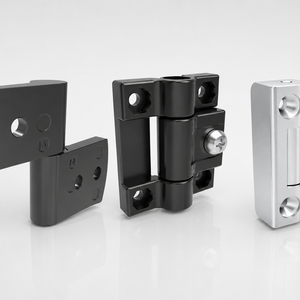
ForndLock Hinge Product Range
How Did SS316 Improve Project Outcomes?
Upgrading to our specialized SS316 hinges eliminated rust-related downtime entirely, extending the maintenance cycle of the client's equipment by more than five years.
Following our comprehensive failure analysis, ForndLock engineers developed a highly specialized hardware solution tailored specifically for the North Sea environment. We replaced the generic hardware with our custom-machined SS316 heavy-duty hinges. Furthermore, we did not just rely on the raw alloy; we subjected the finished hinges to a specialized chemical passivation treatment to maximize the chromium oxide layer's thickness. We also integrated self-lubricating internal pins to prevent any future mechanical binding caused by freezing temperatures or micro-debris.
The final results transformed the client's operational efficiency. After installing the ForndLock SS316 hardware, the offshore enclosures experienced zero structural degradation after extensive, multi-year field use. The maintenance crews could easily access the control panels regardless of the weather conditions. This precise metallurgical upgrade drastically reduced the client's warranty claims, eliminated the need for emergency repair dispatches, and slashed their overall maintenance costs. It proved that investing in premium hardware at the manufacturing stage yields massive dividends in field reliability.
Which Grade Fits Your Engineering Project?
The ideal choice depends entirely on your specific environmental baseline, balancing the cost-efficiency of SS304 against the extreme durability of SS316.
As we summarize this highly technical discussion, procurement officers and industrial engineers must synthesize this data to make actionable purchasing decisions. It is crucial to understand that hardware specification is an exercise in precise optimization. Over-specifying an alloy for a benign environment wastes valuable project budget, while under-specifying an alloy for a harsh environment guarantees catastrophic field failures and ruined brand reputations. The goal is to match the exact metallurgical capabilities of the hinge to the specific atmospheric demands of the installation site.
Is SS304 Sufficient For Your Design?
This grade is perfectly adequate for inland outdoor applications, freshwater exposure, and standard architectural projects where aggressive chlorides are not present.
Engineers should confidently choose ForndLock's SS304 hinges when their equipment will be installed in environments that demand high strength and basic weather resistance without the threat of severe chemical exposure. By selecting this grade for the appropriate applications, procurement teams can significantly optimize their manufacturing budgets. Clear use cases for SS304 include standard commercial HVAC units mounted on inland rooftops, telecommunication boxes situated in urban or suburban environments, and food processing zones that do not utilize highly concentrated acidic washdown procedures. In these scenarios, the 18/8 chemical composition provides more than enough defense against standard rain, humidity, and atmospheric oxidation, ensuring a long and reliable product lifecycle.
When Should You Mandate SS316 Usage?
You must specify this higher grade for any project located near a coastline, industrial chemical plants, or areas subject to heavy de-icing salts.
There are strict environmental parameters where compromise is simply not an option. If your OEM equipment is scheduled for installation within a five-mile radius of the ocean, the airborne salinity will rapidly destroy standard alloys. Similarly, applications exposed to constant industrial solvents, marine vessels, offshore oil rigs, and transportation equipment subjected to heavy winter de-icing salts require the ultimate defense mechanism. In these scenarios, specifying SS316 is absolutely non-negotiable. The addition of molybdenum is the only way to prevent rapid pitting and mechanical failure. ForndLock has the advanced manufacturing capability to mass-produce these high-grade, corrosion-resistant components to your exact dimensional tolerances, ensuring that your most critical infrastructure remains secure under the harshest conditions on earth.
How To Finalize Your Hardware Selection?
Partnering with an experienced manufacturer guarantees the integrity of your final product, whether your project demands the reliable versatility of SS304 or the ultimate corrosion resistance of SS316.
Navigating the complexities of metallurgical selection is a task that should never be left to guesswork. As we have detailed through laboratory data and real-world offshore case studies, the difference between success and failure often comes down to microscopic chemical elements. Knowing exactly how to choose hinge material for fire rated doors and corrosive environments empowers your engineering team to build safer, more durable, and highly cost-effective products. Our role as a dedicated manufacturer is to provide you with the technical transparency and engineering support required to make those decisions with absolute confidence. Ready to specify the perfect hardware for your next heavy-duty project? Send your project requirements, technical drawings, or requests for physical samples directly to our engineering team at: [email protected].