
Large Over Center Latches: Types, Applications and Selection Guide
When a large door panel, equipment guard, or shipping case will not stay closed under vibration or repeated handling, the problem is rarely the panel itself. It is usually the fastener. Small toggle catches or light draw latches are simply not built to pull heavy panels together and hold that tension over thousands of open-close cycles. At ForndLock, we regularly hear from engineers and buyers who assumed that a larger latch body automatically meant a stronger closure, only to find the assembly still rattled loose or the keeper deformed under load.
Large over center latches solve this problem through a lever-and-linkage mechanism that pulls two components together and locks past a geometric center point. But selecting one is not a matter of matching bolt-hole spacing. From our engineering experience, we often see selection problems when buyers focus only on latch body size and skip working load, clamping force, hook or keeper position, adjustment range, panel rigidity, vibration exposure, and corrosion environment. This guide walks through how these latches work, the main types available, where they are typically applied, and how to select, install, and maintain them without relying on guesswork or oversized assumptions.
What Is a Large Over Center Latch?
A large over center latch is a heavy duty mechanical fastener that uses a handle, linkage, hook or loop, and a fixed pivot point to pull two components together and hold them in a stable closed position past a geometric center point.
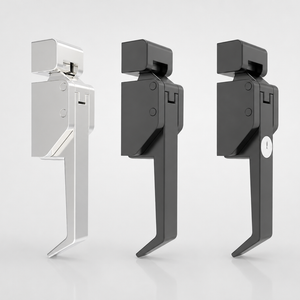
Structurally, the latch is built from a body mounted to one surface, an operating handle connected through a linkage, a hook, wire loop, or rigid link that engages a keeper (also called a catch plate or striker), and a pivot point around which the linkage travels. Closing the handle drives the hook toward the keeper, drawing the two mounting surfaces together and creating clamping force at the joint.
The primary function is straightforward: pull two parts together, generate and hold clamping tension, resist vibration-induced loosening, and allow fast, repeatable opening without tools. Large versions differ from small toggle catches in more than overall dimensions. Body wall thickness, pivot pin diameter, rivet or fastener strength, handle length for leverage, and adjustment travel all typically scale up together in a genuine heavy duty design.
It is worth stating plainly: "large" describes size and duty class, not unlimited load capacity or guaranteed safety. Actual holding capability still depends on the specific model, its material, its pin and rivet strength, and how it is mounted—not on the word "large" alone.
ForndLock Over Center Draw Latches
How Does the Over-Center Mechanism Work?
The over-center mechanism works by moving the linkage past a geometric center point during closing, which places the system into a mechanically stable position that resists opening without additional force.
The closing sequence generally follows four steps. First, the operator positions the hook or loop over the keeper. Second, as the handle is pressed down, the linkage draws the hook further onto the keeper, pulling the mounting surfaces closer together. Third, continued handle travel pushes the pivot linkage past the centreline between the fixed and moving pivot points. Fourth, once past that point, the geometry settles into a stable closed position where the forces acting on the linkage resist further movement in the opening direction.
The reason this resists accidental opening is geometric rather than frictional: on one side of the center point, tension in the linkage pulls the handle toward closed; on the other side, it would pull toward open. Sitting just past center means normal vibration or light contact does not generate enough force to push the linkage back across that point.
The handle length functions as a lever, so a longer handle allows more clamping force for a given hand effort, while an adjustable hook or threaded rod changes the effective closed distance to increase or decrease tension. Keeper alignment matters here too—if the keeper is offset or the mounting face is not flat, the linkage may not fully seat past center, undermining the mechanism regardless of latch quality.
It is important not to overstate what this mechanism does on its own. Passing over center creates a stable closed position, but it is not equivalent to a positive lock. Vibration, impact, or a sharp knock to the handle can still drive the linkage back across center in some designs, which is exactly why safety catches and secondary locking exist as separate features rather than assumptions built into the base mechanism.
Large Over Center Latch, Draw Latch and Toggle Latch: What Is the Difference?
Over center latch, draw latch and toggle latch are related but not always identical terms, and the actual difference depends on the linkage structure, travel, adjustment method and locking function rather than the name alone.
"Draw latch" emphasizes the function of pulling two parts together—drawing them closer as the handle closes. "Over-center latch" (or over-center latch in American usage) emphasizes the geometric locking action once the linkage passes the center point. "Toggle latch" often describes the same lever-and-pivot structure but is used more loosely across catalogues to refer to almost any latch with a hinged handle and hook.
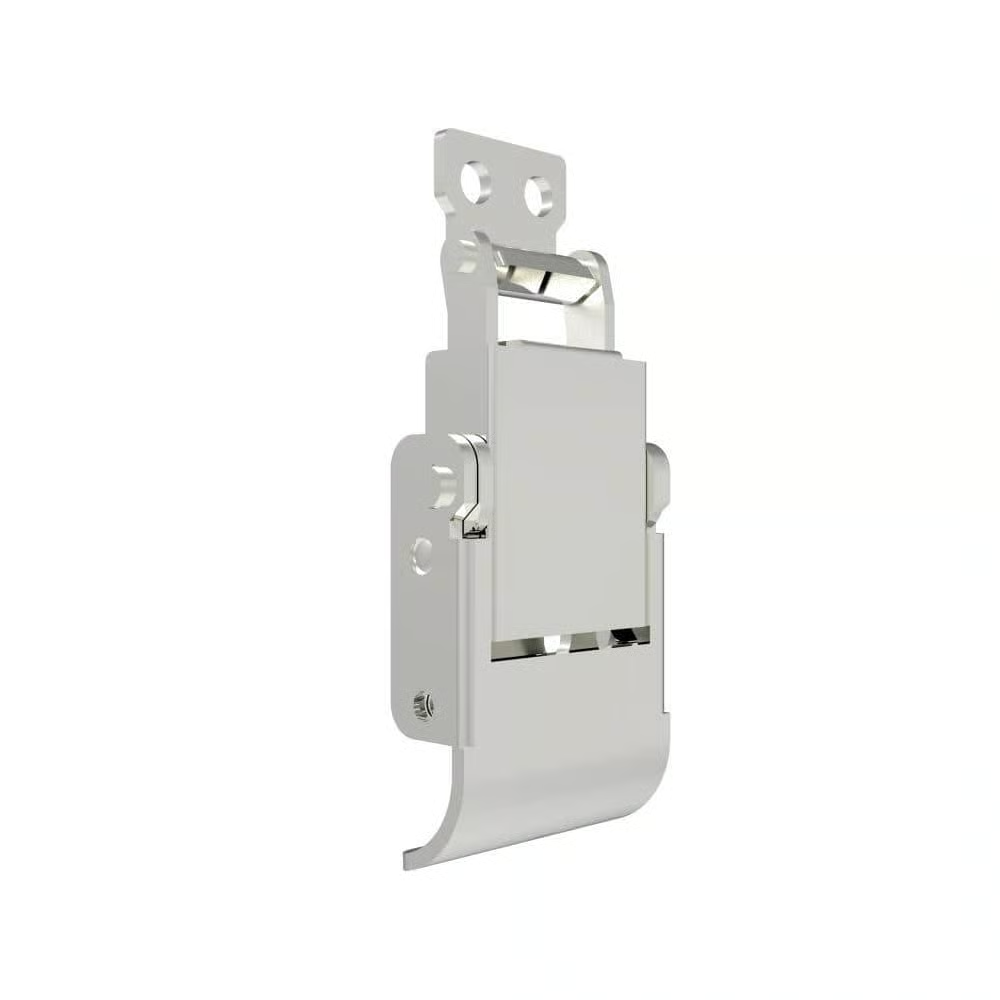
In practice, many manufacturers and distributors use these three terms interchangeably for what is structurally the same family of fastener, while others draw finer distinctions based on whether the latch is adjustable, spring-loaded, or fixed. Tension latch and pull-down latch are additional names that occasionally appear for similar designs, particularly in trailer and case hardware catalogues.
Because naming is inconsistent across suppliers, we recommend looking past the label and checking four things directly: the linkage structure (rigid link, wire loop, or hook), the available travel and adjustment range, the locking function (does it include a safety catch or padlock hole), and the stated duty rating. Two products both labeled "over center latch" can have meaningfully different clamping capability and adjustment range.

Table 1: Over Center Latch, Draw Latch and Toggle Latch Terminology
Term | Main Structural Emphasis | Typical Function | Selection Note |
Over center latch / over-center latch | Linkage passing a geometric center point | Stable, self-holding closed position | Check whether a safety catch is included for vibration resistance |
Draw latch | Hook or loop drawing two surfaces together | Tensioning and gap closure | Confirm adjustment range matches panel tolerance |
Toggle latch | Lever-and-pivot action, often used broadly | General quick-release fastening | Verify duty rating rather than relying on the name |
What Are the Main Types of Large Over Center Latches?
Large over center latches are commonly built as fixed, adjustable, spring-loaded, safety-catch, padlockable, and hook or loop variants, each suited to a different combination of load, tolerance, and security requirement.

What Are Fixed Over Center Latches?
A fixed over center latch has a set keeper position and clamping distance, which suits applications where the door or panel position remains stable and dimensional tolerance is limited. These designs tend to be simpler, with fewer moving parts to wear or loosen, and they typically cost less than adjustable versions. They work best where manufacturing tolerances are tight and consistent, such as fixed machinery covers with a repeatable mounting geometry.
What Are Adjustable Over Center Latches?
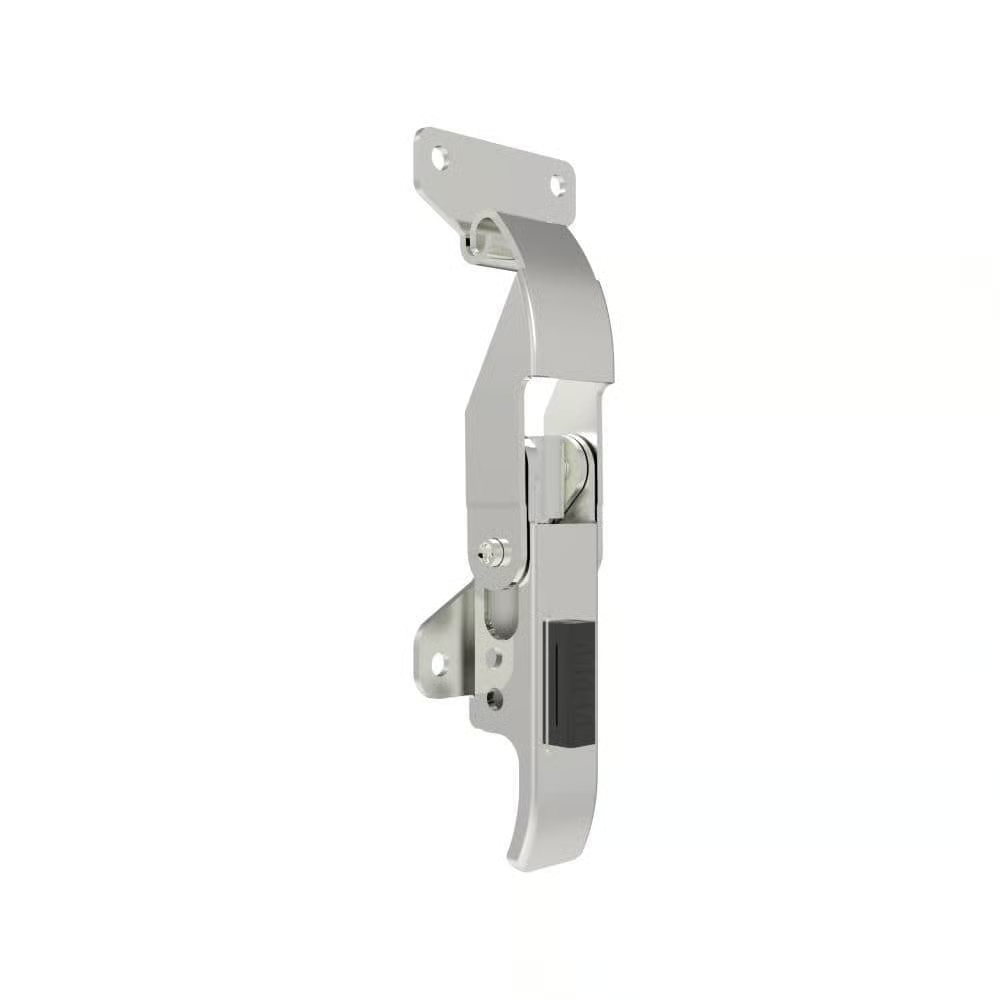
An adjustable over center latch uses a threaded hook, U-bolt, or similar structure to fine-tune the clamping distance, which helps compensate for seal compression, manufacturing tolerance, or long-term wear. Adjustment should be treated as a tuning feature within a defined range, not a way to force additional clamping force by shortening the rod beyond its intended travel—doing so can overload the pivot pin, distort the hook, or prevent the linkage from properly passing over center.
What Are Spring-Loaded Over Center Latches?

A spring-loaded over center latch uses a spring element to absorb dimensional change, vibration, or slight movement while still maintaining tension on the closure. The spring's travel, the load it is expected to carry, and its fatigue life over repeated cycles all need to be matched to the application; a spring sized for occasional light use will behave differently under continuous vibration than one designed for that duty.
What Are Safety-Catch Over Center Latches?

A safety-catch over center latch adds a secondary retaining feature that reduces the risk of the handle opening from vibration, impact, or accidental contact. This is typically a small spring-loaded latch or clip that holds the handle down independently of the over-center geometry, and it is generally worth considering wherever the base mechanism alone might not be reliable under continuous shock or vibration.
What Are Padlockable Over Center Latches?

A padlockable over center latch includes a hole or fitting for a padlock, which controls unauthorized access but does not by itself increase the latch's structural load capacity. This feature addresses security, not strength, and should not be treated as a substitute for a properly rated latch body and keeper.
How Do Hook-Type and Loop-Type Latches Compare?
Hook, wire loop, U-bolt, and rigid link engagement styles differ mainly in adjustment range, keeper compatibility, mounting space, and assembly tolerance rather than in basic holding principle. Wire loops tend to tolerate more misalignment during engagement, while rigid hooks and links typically offer a more defined, repeatable clamping position. The right choice usually comes down to available mounting space and how much tolerance the application allows during closing.
How Do Concealed and Exposed Mounting Designs Compare?
Exposed mounting simplifies installation and inspection, while concealed or semi-concealed mounting improves appearance and protection at the cost of reduced access for maintenance. Exposed designs are generally easier to service in the field, which matters for equipment that sees frequent latch inspection or replacement.
Table 5: Large Over Center Latch Type Comparison
Type | Adjustment Capability | Typical Load Consideration | Best Suited For |
Fixed | None | Stable, defined by fixed geometry | Tight-tolerance, stable panel mounting |
Adjustable | Threaded hook or U-bolt within a defined range | Tunable within design limits | Applications with seal compression or wear over time |
Spring-loaded | Spring travel absorbs movement | Depends on spring rating and fatigue life | Vibration-prone or dimensionally variable joints |
Safety-catch | Secondary retaining feature, not a tension adjustment | Same as base latch, plus reduced accidental-opening risk | High vibration or impact exposure |
Padlockable | Security feature, not load-related | Unaffected by padlock addition | Access control on toolboxes, cases, enclosures |
Hook/loop variants | Varies by engagement style | Depends on hook or loop cross-section and material | Applications with alignment tolerance concerns |
What Applications Use Large Over Center Latches?
Large over center latches are selected differently across machinery covers, agricultural equipment, vehicles, transport cases, generator enclosures, industrial panels, and marine equipment because each application presents a distinct combination of load, vibration, and environmental exposure.
How Are Large Over Center Latches Used on Machinery Covers and Guards?
On machinery covers and guards, the latch must resist operating vibration and allow frequent, repeatable opening for maintenance access, which often makes a safety catch worth considering. Covers that are opened multiple times per shift benefit from designs with predictable, low-effort operation alongside vibration resistance.
How Are Large Over Center Latches Used on Agricultural and Construction Equipment?
Agricultural and construction equipment expose latches to dirt, moisture, continuous vibration, impact, and outdoor corrosion, which typically points toward steel or stainless steel depending on the exposure level. Latch bodies here also need enough clearance for gloved-hand operation in field conditions.
How Are Large Over Center Latches Used on Commercial Vehicles and Trailers?
On commercial vehicles and trailers, latches securing body panels, toolboxes, battery boxes, and engine covers must withstand road vibration and chassis flex, which often justifies secondary locking. Panel flex over rough roads can also mean the keeper position shifts slightly relative to the latch body, which adjustable designs handle better than fixed ones.
How Are Large Over Center Latches Used on Transport Cases and Large Containers?
Transport cases and large containers often require multiple latch points, adequate seal compression, and padlockable features to manage stacking loads, shipping shock, and access control together. Multiple latch points also help distribute clamping pressure more evenly across a long case lid.
How Are Large Over Center Latches Used on Generator and Power Equipment Enclosures?
Generator and power equipment enclosures need latches that maintain a consistent door seal under outdoor exposure and vibration while still allowing frequent, controlled access for servicing. Seal compression consistency is often as important here as raw clamping force, since a loose seal affects noise containment and weather protection.
How Are Large Over Center Latches Used on Industrial Enclosures and Equipment Panels?
Large thin-panel enclosures often distribute clamping across multiple latch points to manage panel deflection and maintain consistent seal pressure across the closure. A single oversized latch on a thin panel can actually cause localized flexing near the latch point rather than solving the sealing problem.
How Are Large Over Center Latches Used in Marine and Outdoor Equipment?
Marine and outdoor equipment generally call for stainless steel latches selected with attention to dissimilar metal contact and drainage, since no single stainless grade suits every marine environment. Grade selection, fastener compatibility, and water drainage around the keeper all influence long-term performance more than the latch body alone.
Table 2: Application, Exposure, and Selection Focus
Application | Load/Vibration Profile | Environmental Exposure | Key Selection Focus |
Machinery covers and guards | Moderate vibration, frequent cycling | Indoor, moderate contamination | Safety catch, repeatable operation |
Agricultural/construction equipment | High vibration, impact | Dirt, moisture, outdoor corrosion | Steel or stainless, secure engagement |
Commercial vehicles and trailers | Road vibration, chassis flex | Outdoor, road spray, temperature swings | Secondary locking, adjustment range |
Transport cases and containers | Shipping shock, stacking load | Variable, handling environments | Multiple latch points, padlockable option |
Generator/power enclosures | Vibration, thermal cycling | Outdoor, weather exposure | Consistent seal compression |
Industrial enclosures/panels | Panel deflection under load | Indoor to semi-outdoor | Multiple latch points for even clamping |
Marine and outdoor equipment | Variable, often high impact | Salt spray, moisture, corrosion | Stainless grade, dissimilar metal compatibility |
How Do You Select the Right Large Over Center Latch?
Selecting the right large over center latch requires working through working load, clamping force, grip range, panel rigidity, vibration exposure, mounting space, adjustment type, and secondary locking as a connected set of decisions rather than isolated specifications.
How Do You Determine the Required Working Load?
Determining the required working load means separating working load, holding force, and ultimate or breaking load, since manufacturers may test these under different conditions and a breaking load figure should never be treated as a normal operating value. Real-world working load should account for the static weight or force acting on the door, added vibration or shock loading, and occasional accidental force from contact or misuse. We recommend keeping a reasonable engineering margin rather than selecting a latch whose rated capacity sits close to the expected everyday load, and verifying critical applications against the actual assembled structure rather than assuming a uniform safety factor applies across all products.
How Do You Evaluate the Required Clamping Force?
Evaluating clamping force means finding a level that fully compresses the seal or closes the gap without deforming the door, keeper, latch body, or seal itself. Too little clamping force leaves gaps or lets the seal spring back; too much can distort thin panels or overstress the keeper mounting.
How Do You Measure the Grip Range and Clamping Distance?
Measuring grip range and clamping distance requires checking the mounting face to keeper position, closed center distance, opening clearance, adjustment range, seal compression, and assembly tolerance, not just the latch's overall body length. A latch that looks correctly sized on a spec sheet can still fail to reach full engagement if the actual installed dimensions differ from the catalogue drawing.
How Do Door Size and Rigidity Affect the Number of Latches Needed?
A larger door does not automatically call for a single larger latch, since a flexible thin panel may instead need multiple latch points positioned to distribute clamping pressure evenly. Panel stiffness, not just size, determines whether one heavy latch or several moderate latches will produce a more even, reliable seal.
How Do You Evaluate Vibration and Impact Exposure?
Evaluating vibration and impact exposure involves considering continuous vibration, cyclic shock, road loads, equipment start-stop cycles, and panel resonance, which together often justify a secondary safety catch or a keeper designed for stable engagement. Applications with intermittent light use have very different requirements from those running continuously on vibrating machinery.
How Do You Check Available Mounting Space?
Checking available mounting space means accounting for latch body length and width, handle swing clearance, hand access, keeper space, fastener clearance, and interference with hinges, seals, or internal equipment. Handle swing clearance in particular is often overlooked until installation, when a latch cannot fully open or close due to nearby structure.
How Do You Select the Required Adjustment Type?
Selecting the adjustment type means comparing fixed, threaded hook, U-bolt, spring-loaded, tool-adjustable, and hand-adjustable designs against the tolerance, maintenance access, and tamper-resistance the application needs. Hand-adjustable designs are convenient for field tuning but may not suit applications where tamper-resistance matters.
When Is Secondary Locking Required?
Secondary locking, such as a safety catch, retaining pin, padlock hole, or lock wire, becomes worth considering whenever accidental opening from vibration or unauthorized access poses a real risk, though none of these features increases the latch's structural load rating. These are risk-reduction features layered onto an already appropriately rated latch, not substitutes for correct load selection.
How Do You Select Materials and Surface Treatments?
Material and surface treatment selection for large over center latches depends on corrosion exposure, mechanical strength requirements, and compatibility with the surrounding structure rather than appearance alone.
When Is Zinc-Plated Carbon Steel Suitable?
Zinc-plated carbon steel suits indoor or general industrial use where strength and cost matter most, though corrosion risk increases once the plating is scratched or worn through. It remains a common choice for machinery covers and enclosures kept away from persistent moisture.
When Is Stainless Steel the Better Choice?
Stainless steel is generally preferred for moist, outdoor, or frequently cleaned environments, but strength and corrosion resistance need to be evaluated separately across different grades, and galling risk at threaded or pivot points should be considered. Grade 304 and 316 differ in corrosion resistance, and neither should be assumed suitable for every outdoor or marine condition without checking the specific exposure.
What Are the Benefits of Painted and Powder-Coated Steel?
Painted or powder-coated steel adds appearance and an extra protective layer, though scratches and coating thickness at edges can still create localized corrosion or assembly clearance issues. Coating thickness near mounting holes or pivot points can also slightly affect fit if not accounted for during design.
Why Does Material Compatibility Matter?
Material compatibility matters because pairing dissimilar metals between the latch body, keeper, and fasteners can accelerate corrosion in moist environments, which is why isolation washers or matched materials are often worth considering. A stainless latch mounted with plain steel fasteners on an aluminum panel, for example, creates several potential corrosion pairings at once.
Table 3: Material and Surface Treatment Comparison
Material or Finish | Main Advantage | Suitable Environment | Key Limitation |
Zinc-plated carbon steel | Strength at lower cost | Indoor, general industrial | Corrosion risk once plating is worn |
Stainless steel (304/316) | Good corrosion resistance, grade-dependent | Outdoor, washdown, moderate marine | Galling risk at threads/pivots, grade selection matters |
Painted/powder-coated steel | Appearance plus added protective layer | Indoor to light outdoor use | Edge coating thickness, scratch vulnerability |
Zinc die-cast alloy | Cost-effective for moderate loads | Indoor, light-duty enclosures | Lower strength than forged or stamped steel |
What Mounting and Keeper Options Should You Consider?
Mounting and keeper options—including surface mount, concealed mount, weld-on keeper, screw-mounted keeper, hook keeper, flat keeper, and adjustable keeper—form part of the overall closure system rather than a secondary accessory.
The keeper's material thickness, mounting rigidity, and position relative to the latch body directly affect the load the assembly can actually carry in practice. A well-rated latch body mounted onto a thin, poorly supported keeper or a flexible door panel can still fail at the keeper or panel long before the latch body itself is stressed. Weld-on keepers generally offer the most rigid engagement point for heavy duty applications, while screw-mounted keepers allow easier replacement but depend on adequate backing structure. Adjustable keepers can help correct minor misalignment during installation, but they should be checked for secure locking once set, since a keeper that shifts under load undermines the entire closure.
What Are the Best Practices for Installation?
Reliable installation depends on confirming alignment before drilling, mounting on a rigid surface, setting the correct adjustment, verifying keeper engagement, and testing the assembled latch under realistic conditions.
Why Must You Confirm Alignment Before Drilling?
Confirming alignment before drilling means marking the latch body and keeper position in the closed state and checking the operating travel to prevent side-loading or angled entry into the keeper. Dry-fitting the assembly before committing to permanent holes avoids costly rework.
Why Is a Rigid Mounting Surface Necessary?
A rigid mounting surface is necessary because thin panel deflection under load can be addressed with a backing plate or reinforcement, and the fastening method—rivets, bolts, or welding—affects how the load is actually distributed. Bolting through a backing plate generally spreads load more evenly than a small number of rivets on a thin skin panel.
How Do You Set the Correct Adjustment?
Setting the correct adjustment means starting with low tension, adjusting gradually, confirming the linkage fully passes the center point, and locking the adjustment nut or retaining feature afterward rather than forcing excessive tension by pressing the handle down. Forcing an under-adjusted latch closed by hand can stress the pin or hook well beyond its intended working range.
How Do You Verify Keeper Engagement?
Verifying keeper engagement involves checking engagement depth, center alignment, side load, full seating after closing, and whether the handle shows any unusual rebound. Any rebound or spring-back after closing usually signals that the linkage has not properly passed over center.
How Do You Test the Installed Assembly?
Testing the installed assembly means cycling it open and closed repeatedly under normal operating force, then checking retention after vibration, seal compression, panel deflection, fastener tightness, and secondary locking function. There is no single torque or force value that applies universally across latch models and mounting materials, so this verification step should be based on the specific installed assembly rather than a generic number.
What Are Common Selection and Installation Mistakes?
The most common selection and installation mistakes include choosing by body size alone, treating breaking load as working load, ignoring panel or keeper strength, over-tightening the adjustment, and skipping sample verification before volume production.
Beyond these, we frequently see: latch and keeper mounted out of alignment, causing side-loading during closing; insufficient clearance left for handle swing, which prevents full operation; high-vibration applications installed without a safety catch, leading to gradual loosening; outdoor installations using zinc-plated steel where stainless would better suit the exposure; seal compression range not checked against the latch's actual clamping travel; too few latch points on a large flexible panel, causing uneven sealing; mounting fasteners or backing structure too weak for the rated load, shifting failure away from the latch and into the panel; and, perhaps most avoidably, moving straight into volume production without confirming fit, adjustment range, and load behavior on an actual sample assembly. Each of these issues is preventable with a short verification step before finalizing a design or placing a large order.
How Should You Maintain and Inspect Large Over Center Latches?
Ongoing maintenance means regularly inspecting the latch body, pivot pins, rivets, hook, threaded adjuster, and keeper for corrosion, cracking, bending, looseness, or unusual wear, then replacing rather than bending back any permanently deformed part.
Inspection should include checking whether the adjustment lock nut has loosened over time, clearing dirt, dust, or other contamination from the pivot and hook area, and applying lubrication appropriate to the product and environment where specified. It is also worth confirming that the handle can still travel fully past the center point without unusual resistance or slack, and checking that any safety catch, retaining pin, or padlock hole is still functioning as intended. Any part showing permanent deformation, visible cracking, or heavy wear should be replaced rather than straightened and reused, since a bent hook or stretched pin hole rarely returns to its original strength. For critical applications, we suggest establishing a regular inspection schedule and keeping basic maintenance records, though the right interval depends on the specific duty cycle and environment rather than a fixed period that applies to every installation.
When Is a Custom Large Over Center Latch Required?
A custom large over center latch becomes worth considering when standard clamping distance, adjustment range, mounting space, panel structure, material, surface treatment, or locking features do not match the application, and simply enlarging an existing body does not guarantee the required performance.
Typical triggers for custom development include: standard clamping distances that do not fit the actual door or panel geometry, adjustment range that falls short of what tolerance or seal compression requires, mounting space constrained by surrounding structure, a non-standard panel or keeper design, material or surface treatment needs outside the common catalogue options, a requirement for a specific safety catch or padlock configuration, handle shape adjustments for clearance or ergonomics, unusual mounting hole positions dictated by existing tooling, load or environmental conditions beyond typical standard ratings, and the need to match an existing assembly already in production. Even in custom development, the structure, material, pin sizing, mounting face, and keeper design all still need proper evaluation—a custom latch is not exempt from the same engineering checks that apply to standard products.
What Information Should You Provide When Requesting a Latch?
A useful latch inquiry typically includes the application, door or panel dimensions and material, required working load, expected clamping force, closed mounting distance, adjustment range, keeper design, mounting space, vibration and impact conditions, environment, preferred material and surface treatment, locking requirements, drawings or samples, and expected order quantity.
Providing this information up front generally shortens the review process and reduces the risk of selecting a latch that looks right on paper but does not perform correctly once installed.
Table 4: Information to Provide With an Inquiry
Parameter | Why It Matters | Example Detail to Provide |
Application and environment | Determines exposure and duty class | Outdoor trailer toolbox, coastal region |
Panel dimensions and material | Affects rigidity and latch point count | 3mm steel panel, 600mm width |
Required working load | Sets minimum duty rating | Estimated 150kg static plus vibration |
Clamping distance and adjustment range | Confirms fit and tuning capability | Closed distance 45–55mm |
Mounting space and handle clearance | Avoids installation interference | 80mm depth available, side access only |
Material/finish preference | Matches corrosion resistance to environment | 316 stainless preferred |
Locking requirements | Confirms need for safety catch or padlock hole | Padlockable, no key lock needed |
Drawings, samples, or photos | Reduces miscommunication on fit | CAD file or physical sample panel |
Expected quantity | Affects production planning | Initial trial order, then ongoing volume |
How Does ForndLock Support Custom Large Over Center Latches?
At ForndLock, we support custom large over center latches by reviewing drawings and mounting dimensions, confirming working load and closure requirements, matching the latch body to the keeper, selecting material and surface treatment, adjusting the hook or mounting positions, and developing safety catch or padlockable features before sample confirmation and volume production.
ForndLock: Your Trusted Partner in Industrial Hardware
Customers typically come to us when a standard catalogue latch does not quite fit their panel geometry, their environment demands a specific material grade, or their assembly needs a particular handle shape, mounting hole layout, or locking feature. Our engineering team considers the application environment first, then checks the submitted drawings and installed dimensions, confirms the expected working load and how the closure needs to behave, and works out how the latch body, hook, and keeper should be matched for reliable engagement. From there, we discuss material and surface treatment options suited to the exposure conditions, and adjust hook position, mounting holes, or handle configuration as needed.
To move a request forward efficiently, it helps to have the panel dimensions and material, expected load and environment, adjustment range, and any locking requirements ready to share. We recommend sample confirmation before committing to volume production, since even a well-engineered design benefits from a physical check on the actual assembly rather than relying on drawings alone.
Reliable closure on a large panel or enclosure is never just a matter of latch body size. It depends on how working load, clamping distance, adjustment range, panel rigidity, keeper design, environmental exposure, and locking requirements fit together as a system. Standard catalogue models can cover many of these combinations, but they still deserve a proper specification check rather than a size-based guess.
Where a standard latch does not line up with the application—whether due to mounting space, load, environment, or a locking feature that is missing—a drawing review and sample evaluation are worth the extra step before committing to a production run.
If you are currently specifying large over center latches for equipment panels, vehicle bodies, machinery guards, industrial enclosures, or a custom assembly, we welcome you to send us your product or equipment drawings, mounting dimensions, working load, adjustment range, material and surface treatment requirements, application environment, safety locking requirements, and expected order quantity. Our team will review the working load, mounting distance, adjustment range, material, keeper design, and locking needs, and support you through sample evaluation and volume production. You can reach us at [email protected].