
Industrial Locking Systems: Security, Applications and Selection Guide
What Is an Industrial Locking System?
An industrial locking system is a coordinated set of hardware—including the lock mechanism, latch, cam, handle and mounting structure—engineered to secure equipment doors and enclosures rather than a single standalone lock.
Unlike a residential door lock, an industrial locking system rarely consists of one part. A quarter-turn lock includes a cylinder, a cam, and a strike or catch mounted to the frame. A compression latch adds a housing, a rotating cam profile and a gasket interface. A swing handle system may combine a handle, a rod-driven multi-point mechanism and several latch points along one door edge.

Different applications require different locking structures. A small electrical cabinet with infrequent access may only need a single quarter-turn lock, while a large outdoor equipment housing with a heavy door and gasket sealing typically requires a compression or multi-point swing handle arrangement. We evaluate each project against the door size, access pattern and environment before recommending a specific mechanism.
What Makes Up an Industrial Locking System?
An industrial locking system is built from four functional layers: the lock mechanism, the latching components, the operating components, and the door or enclosure structure that supports them.
Each layer contributes a different function, and weakness in any one layer limits the performance of the whole assembly.
ForndLock Industrial Lock Series
What Locking Mechanisms Are Used?
Common locking mechanisms include quarter-turn locks, cam locks and rotary locking mechanisms, each converting a simple hand or key motion into latch movement.
Quarter-turn locks rotate a small tab a fixed angle to engage a catch, making them fast to operate. Cam locks use a key-driven cylinder to rotate a cam tab behind the panel. Rotary locking mechanisms use a curved hook that pulls the door tight as it rotates, which is why they appear in higher-load applications where a simple tab is not sufficient.
What Are Common Latching Components?
Latching components—compression latches, rotary latches and multi-point locking bars—determine how firmly a door engages the frame under load.

A compression latch draws the door inward against a gasket, improving sealing performance. A rotary latch provides a self-locking hook that resists being pulled open under vibration or pressure. Multi-point locking bars distribute load across several engagement points along a larger door, reducing stress on any single latch.
What Operating Components Control Access?
Operating components such as keys, handles, wing knobs and tool-operated fasteners define how an authorized user actually opens the door.
A keyed cylinder restricts access to holders of a matching key. A handle or wing knob allows tool-free operation for frequent access. Tool-operated fasteners, such as hex or triangular drives, limit opening to personnel carrying the correct tool, which is common on utility and outdoor enclosures where casual access should be discouraged.
How Does Door Structure Affect Locks?
Lock performance is directly limited by door stiffness, frame strength and mounting design, since even a well-built lock cannot compensate for a weak enclosure structure.
A rigid lock mounted on a thin, flexible panel will not achieve proper latch engagement, because the door itself deforms under closing pressure. Frame strength determines whether the strike or catch stays aligned over repeated cycles. This is why our engineering team reviews door drawings alongside the lock specification rather than treating the lock as an isolated part.
What Types of Industrial Locking Systems Are Used?
The most common industrial locking system types are quarter-turn, compression, rotary latch, cam lock and swing handle systems, each suited to different door sizes, sealing needs and access frequencies.
What Are Quarter-Turn Locking Systems?
Quarter-turn locking systems use a compact mechanism operated by a short rotational motion, making them suited to small cabinets requiring fast, frequent access.
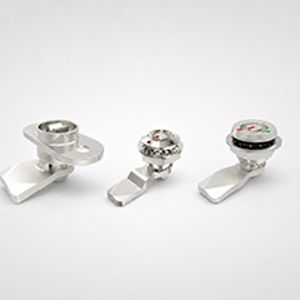
They are simple to install, require minimal panel cutout, and work well where sealing performance is a secondary concern.
What Are Compression Locking Systems?
Compression locking systems generate inward clamping force against a gasket, making them preferred where sealing performance and vibration resistance matter more than speed of access.
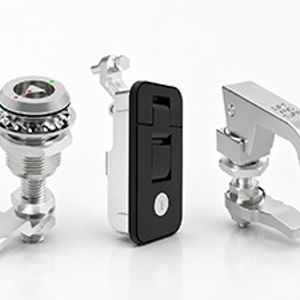
The clamping action helps maintain consistent gasket contact around the full door perimeter, which supports dust and moisture resistance in enclosures exposed to variable conditions.
What Are Rotary Latch Systems?
Rotary latch systems provide a self-locking hook engagement that resists pull-out forces, which is why they are common on machinery and vehicle enclosures.
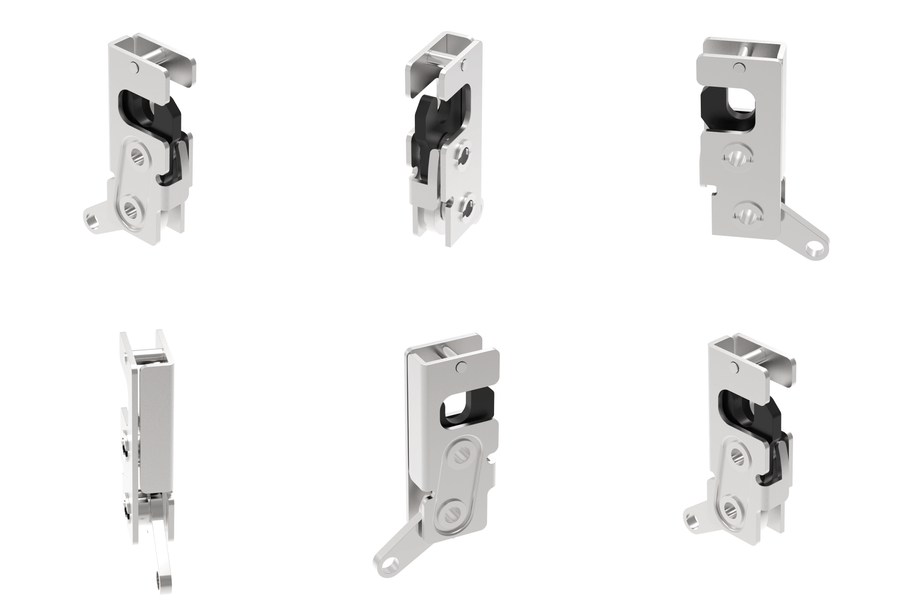
The hook geometry tightens under load rather than loosening, an important characteristic for doors subject to continuous mechanical vibration or road-induced shock.
What Are Cam Lock Systems?
Cam lock systems use a simple rotating tab controlled by a key cylinder, offering straightforward key-controlled access for lighter-duty panels.

They are economical, easy to specify, and suitable for panels where load and sealing requirements are modest.
What Are Swing Handle Systems?
Swing handle systems combine a lever handle with multi-point locking rods, allowing large cabinet doors to be secured at several points with a single motion.
This design is common on larger electrical cabinets and machinery access doors where a single latch point would not distribute closing force evenly.
Type | Structure | Typical Application | Advantage | Limitation |
Quarter-turn | Rotating tab and catch | Small cabinets, frequent access | Fast operation, compact | Limited sealing, lower load capacity |
Compression latch | Cam-driven inward clamp | Sealed enclosures, vibration zones | Consistent gasket compression | Higher installation precision needed |
Rotary latch | Self-locking hook | Machinery, vehicle enclosures | Resists pull-out under load | Requires accurate striker alignment |
Cam lock | Key-driven rotating cam | Light-duty panels | Simple, economical | Limited holding force for large doors |
Swing handle | Lever with multi-point rods | Large cabinets, control enclosures | Distributes load across points | Larger footprint, higher part count |
How Do Industrial Locking Systems Improve Security?
Industrial locking systems improve security through four combined factors—controlled access, mechanical retention, environmental protection and vibration resistance—rather than through any single feature.
How Does Access Control Work?
Access control is managed through key systems, tool-only operation and restricted-access hardware that limit who can open a given door.
Key management defines who holds access, tool operation adds a practical barrier against casual entry, and restricted-access hardware can be specified where multiple doors need coordinated key control.
What Provides Mechanical Retention?
Mechanical retention depends on proper latch engagement, correct cam position and adequate locking strength relative to the door's size and load.
A latch that only partially engages, or a cam positioned incorrectly during installation, reduces holding force well below the rated capacity of the hardware itself.
How Do Locks Resist Environments?
Environmental protection is achieved by pairing the lock with appropriate sealing and corrosion-resistant materials to limit dust, moisture and temperature-related degradation.
The lock does not work alone here—gasket condition, enclosure sealing and material finish all contribute to how well the assembly resists dust, moisture, corrosion and temperature swings over time.
How Do Locks Resist Vibration?
Vibration resistance depends on latch preload and mounting rigidity, which matter most in vehicle-mounted and machinery-mounted enclosures subject to repeated opening cycles.
We evaluate vehicle vibration, machinery operation and repeated opening cycles as separate stress factors, because a lock suited to a stationary cabinet may loosen or wear prematurely in a mobile or high-vibration application. No locking hardware eliminates mechanical stress entirely; the goal is matching latch preload and mounting rigidity to the expected duty cycle.
Where Are Industrial Locking Systems Used?
Industrial locking systems are used across electrical cabinets, control panels, machinery enclosures, outdoor equipment housings and transportation equipment, with each application driving different locking priorities.
What Do Electrical Cabinets Need?
Electrical cabinets require locks that support maintenance access frequency while maintaining sealed environmental protection around live components.
Maintenance personnel need practical, repeatable access, but the enclosure still needs to keep dust and moisture away from live components between service visits.
What Do Control Panels Need?
Control panels require locks rated for frequent operation cycles without loosening, since operators access them multiple times per shift.
Access management matters here too, since operators and supervisors may need different levels of access to the same panel.
What Do Machinery Enclosures Need?
Machinery enclosures require latches that maintain door retention under continuous mechanical vibration during equipment operation.
Latch selection for these applications favors self-tightening geometries over simple friction-based catches.
What Do Outdoor Cabinets Need?
Outdoor equipment cabinets require corrosion-resistant materials and weather-tolerant sealing to withstand prolonged exposure.
Material selection becomes a primary consideration, since standard zinc-plated components degrade faster under sustained outdoor exposure than stainless steel alternatives.
What Do Transportation Systems Need?
Energy and transportation equipment require locking systems validated for long-term reliability under continuous shock, vibration and duty-cycle stress.
These applications benefit from prototype validation before full production, since field conditions are harder to fully replicate on a bench test.
How to Select the Right Locking System?
Selecting the right industrial locking system starts with defining application requirements, then matching the locking mechanism, door structure, environment and materials to those requirements.
This is the section engineering and purchasing teams return to most often, since selection mistakes here tend to surface only after installation.
What Application Requirements Should You Define?
Application requirements should cover equipment type, expected access frequency, required security level and the operating environment before any hardware is selected.
Starting with these four variables prevents specifying hardware that fits the door opening but not the operating conditions.
How Do You Choose a Mechanism?
The correct locking mechanism depends on door size, door weight, opening frequency and whether sealing performance is required.
A heavier door generally needs a mechanism with a higher rated holding force and often benefits from multi-point locking rather than a single latch point.
How Do You Evaluate Door Structure?
Door structure evaluation includes panel thickness, door stiffness, frame structure and the intended mounting position of the lock.
We review these details on the drawing stage, because correcting a structural mismatch after tooling is far more costly than adjusting the design early.
Why Do Environmental Conditions Matter?
Environmental conditions—moisture, dust, salt, chemicals and temperature—determine which sealing grade and material finish the locking system requires.
A locking system suited to an indoor control room is rarely suited to a coastal or chemical-processing environment without material or sealing adjustments.
Which Materials Should You Select?
Material selection among zinc alloy, stainless steel and steel components depends on the operating environment, mechanical load and required surface treatment.
Material | Typical Use Case | Consideration |
Zinc alloy | Indoor cabinets, moderate load | Cost-effective, good castability, limited corrosion resistance without coating |
Stainless steel | Outdoor, washdown, chemical exposure | Higher corrosion resistance, higher material cost |
Steel components | High-load mechanical parts | Strength for load-bearing elements, requires surface treatment for corrosion protection |
Our engineering team recommends materials based on the environment and mechanical requirement stated for the project, along with the surface treatment needed to meet that environment.
What Installation Factors Should You Consider?
Installation and maintenance planning should account for cutout dimensions, mounting method, part replaceability and long-term maintenance access.
A lock that performs well mechanically can still create field problems if the cutout tolerance is too tight or replacement parts are difficult to source later.
What Determines Overall Enclosure Security?
Overall enclosure security depends on mechanical design, access management and enclosure protection working together, since no single lock component determines the complete protection level.
How Does Mechanical Design Affect Security?
Mechanical design—lock structure, latch engagement and mounting strength—forms the physical basis of resistance to forced or repeated operation.
We assess mounting strength alongside the lock body itself, since a strong lock fastened to a thin panel with insufficient screws will still underperform.
How Does Access Management Work?
Access management relies on key systems, authorized-access planning and, where required, tool-operated hardware to control who can open the enclosure.
Planning key hierarchies early avoids later complications when multiple departments or contractors need different access levels to the same equipment fleet.
What Else Affects Enclosure Protection?
Enclosure protection also depends on door gaskets, overall enclosure structure and installation quality, all of which work alongside the lock itself.
A single lock component does not determine the entire protection level of the equipment. We are direct with engineering teams about this: the lock is one part of a system that also includes the gasket, the panel design and the quality of the installation itself.
What Selection Mistakes Should You Avoid?
The most common selection mistakes involve choosing hardware by appearance alone, ignoring door structure, or overlooking environmental and vibration conditions that determine real-world performance.
Across industrial projects, recurring issues tend to trace back to a small number of avoidable causes: lock selection mismatched to the application, door alignment issues discovered after installation, weak mounting structure behind an otherwise adequate lock, incorrect environment selection for the material used, and vibration problems that only appear once equipment is in continuous operation.
Mistake | Potential Problem | Better Approach |
Selecting only by appearance | Hardware does not match load or sealing needs | Define application requirements before choosing hardware |
Ignoring door structure | Latch cannot achieve proper engagement | Review panel thickness and stiffness with the lock supplier |
Choosing wrong lock type | Access frequency or load exceeds hardware rating | Match mechanism type to door size and usage pattern |
Ignoring environment | Premature corrosion or seal failure | Select materials and sealing grade for actual conditions |
Poor access management | Uncontrolled or inconsistent key access | Plan key systems and authorization levels early |
Ignoring vibration | Loosening or latch fatigue over time | Specify latch preload and mounting rigidity for the duty cycle |
No prototype validation | Fit or operation issues found after full production | Validate samples on the actual door before committing to volume |
How Should You Install and Maintain Locks?
Reliable long-term performance depends on correct installation—confirmed mounting dimensions and latch engagement—followed by routine maintenance checks for wear and corrosion.
What Are Key Installation Steps?
Installation should confirm mounting dimensions, check latch engagement, align door and frame, and verify smooth operation before commissioning.
Skipping alignment checks at installation is one of the more common sources of premature wear, since a misaligned door places uneven load on the latch every time it closes.
What Maintenance Tasks Are Needed?
Ongoing maintenance should inspect for wear, check for corrosion, verify locking performance and confirm mounting condition remains secure.
A brief periodic inspection catches most degradation before it results in a functional failure, particularly in outdoor or high-vibration installations.
How to Choose a Reliable Lock Manufacturer?
A reliable industrial locking system manufacturer should demonstrate engineering capability, custom development capability, material and manufacturing capability, prototype validation and production consistency.
What Engineering Capability Should You Expect?
Engineering capability should include drawing review, application analysis and locking solution recommendation based on the actual door and environment.
A supplier that recommends hardware without reviewing the door drawing or the operating environment is working with incomplete information.
What Custom Development Should Suppliers Offer?
Custom development capability should cover lock customization, cam design, latch modification and support for special mounting requirements.
Standard hardware fits many projects, but non-standard door thicknesses, unusual mounting positions or specific cam profiles often require targeted modification.
What Manufacturing Capability Should You Check?
Manufacturing capability should include zinc alloy casting, stainless steel processing, surface treatment and consistent assembly quality.
These capabilities determine whether a custom design can actually be produced at the tolerances and finish specified on the drawing.
Why Does Prototype Validation Matter?
Prototype validation matters because sample production and installation verification reveal fit and operation issues before full production begins.
Testing a sample on the actual door, rather than relying on drawings alone, is the most reliable way to confirm that the mechanism, cutout and latch engagement work as designed.
How Is Production Consistency Ensured?
Production consistency depends on dimension control, assembly quality checks and batch-to-batch consistency across ongoing orders.
This is the same standard our team applies when reviewing our own production process for ongoing projects, since a single well-performing sample means little if later batches vary in fit or finish.
How Does ForndLock Support Custom Projects?
At ForndLock, we support industrial locking system projects from application review and drawing evaluation through custom development, prototype validation and production support.
Our process typically covers application review, drawing evaluation, lock mechanism selection, custom development where needed, material recommendation, prototype validation and production support once the design is confirmed. We manufacture components including cam locks, compression latches, rotary latches and swing handle systems, and our engineering team can work from either a defined specification or an early-stage application description.
To evaluate a project, we ask for the application details, drawings if available, door specifications, the operating environment and the expected quantity. If a project involves special mounting dimensions or a corrosive environment, sharing drawings early allows our engineering team to flag structural or material concerns before tooling begins.
Conclusion
Reliable industrial security comes from the complete locking system—mechanism, door structure, environment and installation working together—rather than from any single component.
Selecting the right hardware means working through the lock mechanism, the door structure, the operating environment, the access requirements and the installation method as a connected set of decisions, not as separate purchasing line items. Evaluating a manufacturer follows a similar logic: engineering capability, customization support and production consistency matter more than any single product feature on a data sheet.
If a current or upcoming project needs this kind of system-level evaluation for a specific equipment environment, sharing the application details is the most direct way to start that conversation.
Get in Touch
ForndLock can support industrial locking system selection, customization and production for enclosures, cabinets, control panels, machinery doors and outdoor equipment housings. To begin a project review, send the equipment application, drawings, door specifications, locking requirements, operating environment and expected quantity to [email protected]. Our engineering team will review the details and follow up with mechanism recommendations, material guidance and next steps for prototype validation.