
Industrial Hinges: Types, Applications and Selection Guide
Choosing the right industrial hinge means matching load capacity, environment, mounting structure, and duty cycle to a hinge type and material that can perform reliably over the equipment's service life. This guide is not a company introduction — it is a working reference for equipment manufacturers, mechanical engineers, purchasing teams, and industrial project managers who need to specify hinges that will hold up under real operating conditions rather than fail after a short service period.
At ForndLock, we design and manufacture industrial hinges for enclosures, machinery, and access panels, and we approach hinge selection the same way we approach any structural component: define the load, define the environment, then match the structure and material to those conditions. In the sections that follow, we walk through how industrial hinges differ from standard hardware, what factors drive selection, which hinge types and materials are commonly specified, where these components are used, and how to avoid the mistakes that shorten hinge life. Along the way, we cover industrial hinge selection logic, the main types of industrial hinges, and where custom industrial hinges make sense when catalog parts fall short.
What Are Industrial Hinges?
Industrial hinges are heavy-duty mechanical pivot components engineered to support significant loads, resist harsh environments, and operate reliably over thousands of open-close cycles on doors, panels, and enclosures. They differ from furniture or residential hinges in almost every dimension — leaf thickness, pin diameter, material grade, and the presence of bearing structures that reduce friction and wear.
ForndLock Hinge Product Range
Every industrial hinge shares the same basic anatomy: a leaf (the flat mounting surface that attaches to the door or frame), a pin (the rotating shaft that carries the load), a knuckle (the rolled or machined section that houses the pin), and, in higher-duty designs, a bearing that separates the pin from the knuckle surface to reduce metal-to-metal wear. How these elements are sized and combined determines whether a hinge can carry a 15-kilogram access panel or a heavy machine guard that opens hundreds of times per shift.
The word "industrial" in this context is not a marketing label — it describes a performance tier. An industrial hinge is expected to carry more weight, tolerate more environmental exposure, and complete more duty cycles than a hinge intended for cabinetry or light furniture. That performance requirement is what shapes everything discussed in the sections below: which type of hinge to specify, which material to use, and how to install and maintain it once it is in service.
What Factors Determine Industrial Hinge Selection?
Industrial hinge selection depends on five interrelated factors — load capacity, door weight, environmental exposure, mounting structure, and operating frequency — that together determine hinge type, material, and dimensions. None of these factors should be evaluated in isolation. A hinge sized correctly for load but installed on the wrong mounting structure, or specified in the wrong material for its environment, will still fail prematurely.
Our engineering team generally works through these factors in sequence, starting with the mechanical load and finishing with how often the door or panel will actually be operated.
Selection Factor | Engineering Impact | Typical Solution |
Load capacity | Determines leaf thickness and pin diameter | Heavy duty or bearing-assisted hinges |
Door weight | Determines hinge count and spacing along the edge | Additional hinge points or a full-length piano hinge |
Environment | Determines material grade and surface treatment | Stainless steel or a corrosion-resistant coating |
Mounting structure | Determines fixing method and joint strength | Welded fixing versus bolted fixing |
Operating frequency | Determines wear resistance and bearing requirement | Bearing-equipped or torque hinges |
How Does Load Capacity Affect Selection?
Load capacity determines the hinge's pin diameter, leaf thickness, and bearing structure, since undersized hinges will deform or fail under repeated stress. A hinge subjected to a static load — a door that opens occasionally and closes flush — experiences different stress than one under dynamic load, where repeated opening and closing introduces cyclic fatigue in the pin and knuckle.
When we review a drawing, our engineering team looks at both the static weight the hinge will carry and the dynamic forces introduced by opening angle, impact closing, and any side loading from wind or vibration. Sizing a hinge for static weight alone often leads to premature knuckle wear once the part goes into real service.
Why Does Door Weight Matter?
Door weight directly determines how many hinges are required and how the load is distributed across mounting points. A heavier door concentrates more stress at each hinge point, which means either adding hinges along the edge or switching to a continuous, full-length design that spreads the load evenly rather than at two or three discrete points. As a general engineering approach, the heavier and larger the panel, the more distributed the support needs to be — this is why large machine guards and cabinet doors often move from two-hinge to three- or four-hinge configurations, or to piano-style hinges entirely.
How Does Environment Affect Hinge Choice?
The operating environment — humidity, chemicals, temperature, or outdoor exposure — determines whether stainless steel, coated steel, or corrosion-resistant alloys are required. A hinge specified for a dry, climate-controlled indoor cabinet has very different requirements from one exposed to washdown cycles, coastal humidity, or de-icing chemicals. Selecting the wrong material for the environment is one of the most common causes of hinge failure, because corrosion attacks the pin-and-knuckle interface long before the leaf itself shows visible damage.
Why Does Mounting Structure Matter?
Mounting structure determines whether a hinge should be welded, bolted, or surface mounted, which affects both installation strength and future maintenance access. Thin sheet metal enclosures generally call for surface-mounted or bolted hinges with adequate backing to prevent pull-through under load, while thick structural steel frames on heavy machinery are often better served by weld-on hinges that transfer load directly into the frame without relying on fasteners.
How Does Operating Frequency Affect Selection?
Operating frequency determines the required wear resistance and bearing type, since high-cycle applications need smoother, lower-friction rotation than occasional-access panels. A production-line access door that opens dozens of times per shift needs a hinge with a bearing structure to manage friction and wear over its expected life. A maintenance panel that opens a handful of times per year has far more flexibility in hinge selection, since fatigue and wear are not the limiting factors.
What Types of Industrial Hinges Exist?
Industrial hinges are available in several structural types — including surface mounted, concealed, lift-off, piano, heavy duty, torque, free swinging, and corner external hinges — each engineered for a different balance of load, access, and appearance. Classifying hinges by a single trait, such as material or size alone, is not enough to guide a real selection decision. Structure, mounting method, and functional behavior all need to be considered together.
Hinge Type | Structural Feature | Best Suited For |
Surface mounted hinges | Attaches externally without recessed cuts | Electrical cabinets, machine panels |
Concealed hinges | Hidden from view when the door is closed | Equipment doors where appearance matters |
Lift-off hinges | Allows tool-free removal of the door | Panels needing frequent maintenance access |
Piano hinges | Full-length leaf with even load distribution | Large doors, cabinet covers |
Heavy duty hinges | Thicker leaves, reinforced pins | Heavy equipment doors, industrial oven doors |
Torque hinges | Built-in friction to hold position | Control panels, display mounts |
Low-resistance, unrestricted rotation | Access doors that must self-close reliably | |
Corner external hinges | Mounted on the outer edge of a corner | Bent cabinet corners, edge structures |
What Are Surface Mounted Hinges?

Surface mounted hinges attach directly to the panel and frame surfaces without requiring recessed cuts, making them fast to install on sheet metal enclosures. Because there is no need to machine a mortise or pocket into the panel, these hinges reduce fabrication time and simplify assembly on standard electrical and machine enclosures.
What Are Concealed Hinges?
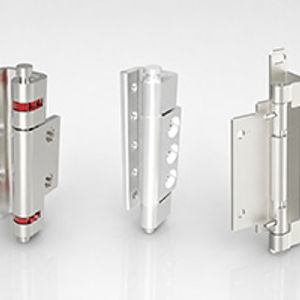
Concealed hinges remain hidden when the door is closed, which is preferred where equipment appearance or security is a priority. By keeping the hinge mechanism inside the cabinet or door frame, concealed designs reduce the risk of tampering and give equipment a cleaner exterior profile, which matters in customer-facing installations or security-sensitive enclosures.
What Are Lift-Off Hinges?
Lift-off hinges allow the door to be lifted free of the frame without tools, which speeds up maintenance on frequently accessed panels.

This design is particularly useful where a panel needs to be removed entirely for cleaning, inspection, or component replacement rather than simply swung open. When we work with engineers on lift-off hinge programs, we typically review the panel thickness and expected load first, since the pin-and-socket geometry has to be sized precisely to prevent the door from lifting off unintentionally during normal operation while still separating easily during planned maintenance.
What Are Piano Hinges?

Piano hinges run the full length of the panel edge, distributing load evenly and reducing stress concentration compared to point-mounted hinges. This continuous support structure is why piano hinges are the default choice for large doors and covers where a small number of discrete hinge points would otherwise create localized stress and eventual sagging.
What Are Heavy Duty Hinges?
Heavy duty hinges use thicker leaves, reinforced pins, and often bearing structures to support doors that exceed the load range of standard hinges.

These designs are specified when the calculated load — static plus dynamic — exceeds what a standard-gauge hinge can safely carry over its intended service life, typically on industrial doors, machine guards, and equipment enclosures subject to frequent access.
What Are Torque Hinges?
Torque hinges use a built-in friction mechanism to hold a panel or display in any open position without additional supports. This is useful on control panels and instrument mounts where an operator needs the panel to stay open at a chosen angle without a separate prop, stay, or gas spring adding cost and complexity to the assembly.
What Are Free Swinging Hinges?
Free swinging hinges rotate with minimal resistance, which is preferred for doors that need to close reliably under their own weight or a spring assist. Unlike torque hinges, which are engineered to resist movement, free swinging designs are chosen specifically because low friction allows gravity or a spring mechanism to return the door to a closed position consistently.
What Are Corner External Hinges?
Corner external hinges mount on the outer edge of a cabinet or enclosure corner, suiting structures where internal space is limited.

This mounting position frees up interior clearance for components, wiring, or seals, which matters on compact enclosures where every millimeter of internal space is already allocated.
Which Materials Are Used for Industrial Hinges?
Industrial hinges are commonly manufactured from stainless steel, carbon steel, zinc alloy, or aluminum, with material choice driven by load requirements, corrosion exposure, and cost targets. Material selection is inseparable from the environmental analysis discussed earlier — the same hinge geometry can perform very differently depending on the alloy and finish specified.
Material | Strength | Corrosion Resistance | Typical Use |
Stainless steel | High | Excellent | Outdoor, food, and medical equipment |
Steel | High | Moderate, needs surface treatment | General machinery, indoor cabinets |
Zinc alloy | Moderate | Moderate | Light-to-medium duty, cost-sensitive builds |
Aluminum | Moderate to low | Good, naturally corrosion resistant | Weight-sensitive transportation equipment |
Why Choose Stainless Steel Hinges?
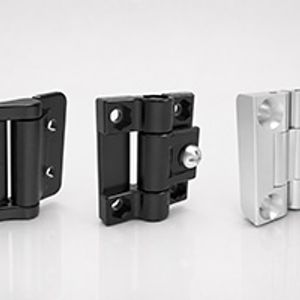
Stainless steel hinges resist corrosion in wet, chemical, or outdoor environments, making them the default choice for food, medical, and marine-adjacent applications. The passive oxide layer on stainless steel continues to protect the hinge even after repeated washdown or exposure to cleaning chemicals, which is why this material dominates hygiene-critical equipment.
Why Choose Carbon Steel Hinges?
Carbon steel hinges offer high strength at lower cost, making them suitable for indoor machinery where corrosion exposure is limited. With an appropriate surface treatment such as zinc plating, carbon steel hinges remain a cost-effective choice for enclosures and equipment operating in controlled indoor environments.
Why Choose Zinc Alloy Hinges?
Zinc alloy hinges balance moderate strength with lower cost, fitting light-to-medium duty enclosures where budget is a key constraint. This makes zinc alloy a practical option for applications that do not carry heavy structural loads or face aggressive environmental exposure, but still need a durable metal hinge rather than a plastic component.
Why Choose Aluminum Hinges?
Aluminum hinges reduce overall weight while maintaining adequate corrosion resistance, which benefits transportation and mobile equipment applications. Where every kilogram affects fuel efficiency or payload capacity, aluminum hinges provide a practical compromise between structural performance and weight savings.
Where Are Industrial Hinges Commonly Used?
Industrial hinges are used across electrical cabinets, machinery covers, outdoor enclosures, transportation equipment, and food or medical equipment, with each application placing different demands on load, sealing, and hygiene. Understanding the application context is often the fastest way to narrow down both hinge type and material before running a detailed load analysis.
How Are Hinges Used in Electrical Cabinets?
Electrical cabinets typically require concealed or torque hinges that maintain enclosure sealing while allowing safe, repeated access to internal components. Sealing integrity matters here because many electrical enclosures carry an ingress protection rating that depends on the door closing flush and consistently against a gasket. When we support customers building control cabinets, we often review the panel dimensions and mounting cutouts on the drawing to confirm the hinge position will not interfere with gasket compression or internal component clearance.
How Are Hinges Used in Machinery?
Machinery guards and access panels typically require heavy duty or piano hinges to withstand vibration and repeated opening during maintenance. Vibration from rotating equipment places additional cyclic stress on hinge pins, which is why bearing-equipped or reinforced designs are generally preferred over lighter-duty alternatives in this setting.
How Are Hinges Used Outdoors?
Outdoor enclosures require corrosion-resistant hinges, typically in stainless steel, to withstand rain, humidity, and temperature cycling over years of service. Temperature cycling in particular can loosen fasteners and accelerate wear at the pin-and-knuckle interface, which is why outdoor-rated hinges are usually specified with tighter tolerances and more corrosion-resistant materials than their indoor equivalents.
How Are Hinges Used in Transportation Equipment?
Transportation equipment such as trailers and rail cars often requires lightweight or heavy duty hinges that can tolerate continuous vibration and load shifting. The combination of constant motion, load shifting during transit, and exposure to road spray or weather makes hinge selection for transportation applications a balance between structural strength and material durability under sustained vibration.
How Are Hinges Used in Food and Medical Equipment?
Food and medical equipment typically requires smooth, crevice-free stainless steel hinges that support washdown cleaning and hygienic operating conditions. Hinge geometry in these settings is often specified to avoid gaps or crevices where contaminants could accumulate, reinforcing why stainless steel with a smooth surface finish remains the standard material choice.
How Do Industrial Hinges Differ From Standard Hinges?
Industrial hinges differ from standard hinges in leaf thickness, pin strength, bearing structure, and duty-cycle rating, which allows them to carry heavier loads and operate longer without failure. A standard hinge designed for furniture or light cabinetry is simply not built to the same tolerances or material specifications.
Dimension | Industrial Hinges | Standard Hinges |
Material thickness | Heavier gauge leaves | Thin, lightweight leaves |
Load rating | Rated for higher static and dynamic loads | Rated for light, occasional use |
Cycle life | Engineered for high-frequency operation | Not rated for continuous heavy use |
Mounting method | Welded or heavy-duty bolted fixing | Screw-fixed, lighter fasteners |
The reason a standard hinge underperforms in industrial settings is not a matter of quality — it is a matter of design intent. Standard hinges are optimized for appearance and cost on light-duty applications, while industrial hinges are optimized for load-bearing performance and long-term reliability under conditions that would fatigue or corrode a lighter design within a short service period.
What Are the Best Installation Practices?
Proper hinge installation depends on correct alignment, adequate fastening into structural material, and leaving sufficient clearance for the full opening angle without binding. Before installation begins, it is worth confirming the mounting surface can actually support the specified load — a hinge rated correctly for the door weight will still fail if it is fastened into thin, unsupported sheet metal rather than a reinforced mounting point.
For welded installations, alignment should be checked and tacked before final welding to avoid distorting the leaf or introducing pin misalignment from heat. For bolted installations, fasteners should be matched to the hinge's load rating rather than substituted with lighter hardware to save cost, since undersized fasteners are a common point of early failure. In both cases, verifying clearance through the full opening angle before final fixing prevents binding that would otherwise place unplanned lateral stress on the pin.
How Should Industrial Hinges Be Maintained?
Industrial hinges require periodic inspection for wear, lubrication of pin-and-knuckle interfaces, and prompt replacement once play or misalignment develops. Maintenance intervals should be set based on actual duty cycle and environmental exposure rather than a fixed calendar schedule — a hinge operating in a dusty, high-cycle production environment needs more frequent attention than one on a rarely accessed indoor panel.
Lubrication at the pin-and-knuckle interface reduces friction and slows wear, particularly on hinges without integrated bearings. Any hinge showing play, uneven closing, or visible corrosion at the pin should be flagged for replacement before it progresses to leaf deformation or complete failure, since a failing hinge can place unexpected load on adjacent hinges and accelerate their wear as well.
What Selection Mistakes Should You Avoid?
The most common selection mistakes include undersizing load capacity, ignoring environmental exposure, and mismatching hinge type to mounting structure, all of which shorten service life. Each of these mistakes tends to surface only after the equipment is in service, which makes upfront selection discipline far more cost-effective than field corrections.
Undersizing load capacity is the most frequent error, often because only the static door weight is considered while dynamic loading from repeated operation is overlooked. Ignoring environmental exposure — specifying carbon steel for an outdoor or washdown application, for example — leads to corrosion at the pin long before the leaf shows visible damage. Mismatching hinge type to mounting structure, such as specifying a bolted hinge for a thin panel with no reinforcement, results in pull-through or loosening under repeated use. A fourth common error is overlooking operating frequency, which leads teams to specify a standard-duty hinge for what is actually a high-cycle application, resulting in premature wear well before the expected service life is reached.
How Does ForndLock Support Custom Industrial Hinges?
We support custom industrial hinges by reviewing engineering drawings, analyzing load and environmental requirements, and producing samples before full production runs. Rather than starting from a catalog part and forcing an application to fit it, our engineering team works from the specific mounting geometry, load conditions, and environment described in a customer's drawing.
Our process begins with a drawing review, where we confirm dimensions, mounting method, and any interface requirements with surrounding components. From there, we analyze the load and environmental data provided to recommend a material and structural type — whether that means a heavy duty leaf design, a bearing-equipped torque hinge, or a stainless steel lift-off configuration for a washdown environment. Customization typically covers leaf dimensions, hole pattern and mounting cutouts, material grade, surface treatment, and load rating, all matched to the specific door or panel geometry involved.
Before committing to full production, we produce samples for evaluation so the fit, function, and finish can be confirmed under real conditions rather than assumed from a drawing alone. Internally, our production process includes dimensional checks and material verification at key stages, so that the hinges leaving our facility match the specifications reviewed during the engineering phase. If your equipment involves non-standard mounting conditions, unusual load requirements, or a specific environmental exposure that a catalog hinge does not address, this is exactly the type of program our engineering team is set up to support.
How Do You Choose the Right Hinge for Your Application?
Choosing the right industrial hinge comes down to matching load, environment, mounting structure, and duty cycle to a hinge type and material engineered for that combination. The logic runs in one direction: define the operating conditions first, let those conditions point toward a hinge type, then select the material that will hold up under the environment the equipment will actually face. Maintenance and installation practices then protect that selection over the life of the equipment, closing the loop between initial specification and long-term reliability.
As equipment becomes more compact, more automated, and more frequently deployed outdoors, hinge selection is increasingly a matter of engineering analysis rather than habit or convenience. A hinge chosen because it was used on a previous project may not hold up if the load, environment, or duty cycle has changed even slightly. Working through load capacity, door weight, environment, mounting structure, and operating frequency — in that order — remains the most reliable way to arrive at a hinge that performs for the equipment's full service life.
If your project involves a load, environment, or mounting condition that does not fit a standard catalog part, our engineering team is ready to review your requirements directly. Send your drawings, specifications, application requirements, and quantity to [email protected], and we will work through the load and environmental analysis with you, recommend a hinge type and material, and support you through sample evaluation before moving into production. Whether you need a fully custom industrial hinge or engineering input on an existing design, our team is ready to review your drawings and support your next hinge program.