
How to Choose the Right Latch Type for Cabinet Doors: Engineer's Guide
Designing an industrial enclosure involves a multitude of complex decisions, but one of the most critical yet frequently underestimated aspects is the selection of access hardware. When evaluating how to choose the right latch type for cabinet doors, engineers must look far beyond basic aesthetics or simple closing mechanisms. In demanding industrial environments, hardware selection is fundamentally about securing sensitive high-voltage equipment, protecting delicate internal circuitry against harsh environmental ingress, maintaining strict IP ratings, and ensuring the absolute safety of human operators. A poor hardware choice can compromise an entire system, leading to moisture damage, dust accumulation, or dangerous accidental openings during operation.
This comprehensive technical breakdown is designed to serve as a guide to the different types of latches, providing procurement teams, mechanical design engineers, and OEM clients with actionable, deeply practical criteria. By moving away from superficial catalog browsing and focusing on rigorous engineering parameters, we will explore how to evaluate dynamic load capacities, environmental resistance, structural integration, and mechanical fatigue. Understanding the fundamental physics behind these mechanisms allows industrial professionals to make informed decisions that guarantee the long-term reliability and operational integrity of their critical infrastructure.
Why Does Cabinet Latch Selection Matter?
Selecting the correct latch prevents catastrophic equipment failure, ensures operator safety in hazardous environments, and maintains the critical integrity of internal components.
The stakes of hardware selection in industrial settings cannot be overstated. When an enclosure is deployed in a telecommunications facility, a heavy machinery plant, or an outdoor electrical substation, the latch acts as the primary barrier between the sensitive internal components and a hostile external environment. If an engineer specifies an inadequate latching mechanism, the risks multiply rapidly. Improper selection often leads to compromised weather sealing, where inadequate compression allows moisture and particulate matter to bypass the gasket. In heavy-duty applications, failing to account for dynamic loads and continuous panel vibration can result in premature mechanical wear, structural fatigue, and ultimately, a complete failure of the door retention system.
As an experienced industrial locks, industrial latches, industrial hinges, industrial handles, and access hardware manufacturer, ForndLock encounters these high-stakes engineering challenges daily. Our first-hand experience stems from collaborating directly with OEM clients and reviewing thousands of technical CAD drawings. One of the most common selection errors our engineers discover during these reviews is the mismatch between the specified hardware and the actual operational environment. For instance, we frequently see designs where standard light-duty latches are specified for heavy, gasketed doors that require significant compression force, guaranteeing eventual seal failure.
By systematically addressing these common pitfalls, this discussion acts as a definitive guide to the different types of latches, moving beyond basic product descriptions to application-specific engineering. We focus on bridging the gap between theoretical design and real-world industrial reliability. When procurement professionals and engineers understand the structural demands placed on access hardware, they can eliminate vulnerabilities early in the design phase, drastically reducing maintenance costs and preventing dangerous equipment malfunctions in the field.
How Do You Evaluate Latch Specifications?
You must rigorously evaluate dynamic load capacity, environmental exposure, and required IP ratings to ensure long-term mechanical reliability.
Before examining specific latch designs, it is crucial to establish a strong foundation of technical criteria. Evaluating latch specifications requires a holistic understanding of the exact conditions the enclosure will face throughout its operational lifecycle. Engineers must calculate the static weight of the door panel alongside the dynamic forces exerted by wind, internal pressure differentials, and mechanical impacts. Furthermore, analyzing the specific environmental exposure—ranging from chemical washdowns in food processing plants to extreme temperature fluctuations in outdoor settings—dictates the necessary material properties and surface treatments required to prevent structural degradation.
What About Sealing and IP Ratings?
Proper latch compression is directly responsible for maintaining NEMA and IP ratings by ensuring uniform pressure against the door gasket.
Inside the ForndLock Factory: Our Advanced Industrial Lock Production Process
The mechanics of gasket compression are foundational to environmental protection. Industrial cabinet doors typically utilize polyurethane or heavy-duty rubber gaskets that require a specific, sustained compression ratio—often between twenty and thirty percent—to form a watertight and dust-tight seal. If a latch cannot provide or maintain this exact level of uniform pressure, the NEMA or IP rating of the entire enclosure is immediately voided. The latch is the mechanical engine that drives the door into the frame, overcoming the resistance of the gasket material.
In applications such as outdoor telecom cabinets or washdown environments in pharmaceutical manufacturing, specific locking mechanisms are mandatory to prevent water and dust ingress. These environments subject enclosures to high-pressure water jets, driving rain, and fine particulate matter. A latch designed for these scenarios must feature robust internal O-rings and sealed housings to prevent moisture from traveling through the hardware itself. Without a mathematically calculated approach to compression force, even the highest quality gaskets will fail to protect the internal electrical components from environmental contamination.
How Crucial Is Vibration Resistance?
Vibration resistance is absolutely critical to prevent accidental door opening and hardware fatigue in machinery and transportation applications.
Industrial environments are rarely static. Heavy machinery, industrial generators, and railway enclosures experience constant, unforgiving low-frequency vibrations that transfer directly into the chassis and door panels of the cabinet. Over time, this continuous harmonic resonance can cause standard fastening mechanisms to loosen, back out, or disengage completely. If a latch fails under vibration, the door may swing open during operation, exposing high-voltage components to the elements and posing a severe physical hazard to nearby personnel.
To combat this, engineers must prioritize hardware that incorporates specific anti-vibration features. This includes integrated mechanical detents that lock the handle into place, secondary locking mechanisms that require a deliberate, multi-axis motion to open, and internal spring-loaded components that absorb kinetic energy. By mitigating the effects of continuous mechanical shock, vibration-resistant latches ensure that the door remains securely fastened regardless of the operational turbulence generated by the surrounding industrial equipment.
Which Material Ensures Long-Term Durability?
Stainless steel and specialized zinc alloys offer the highest durability by providing superior corrosion resistance and exceptional tensile strength.
The physical longevity of any access hardware is dictated primarily by its metallurgical composition. For environments exposed to highly corrosive elements, such as marine applications, offshore platforms, or chemical processing facilities, 304 and 316 stainless steel are the premier choices. The high chromium and molybdenum content in 316 stainless steel creates a passive oxide layer that aggressively resists pitting and localized corrosion, ensuring the latch maintains its structural integrity and aesthetic appearance over decades of harsh exposure.
Conversely, for indoor industrial control panels or environments with less aggressive chemical exposure, specialized zinc die-cast materials coated with heavy-duty powder finishes offer an excellent balance of high tensile strength, complex geometric manufacturability, and cost-effectiveness. To validate material longevity and guarantee performance, trusted manufacturers utilize extensive salt spray testing capabilities. By subjecting these materials to hundreds of hours of concentrated saline mist, engineers can accurately predict the lifecycle of the hardware, ensuring that the chosen material will not degrade, bind, or fail prematurely in the field.

Which Latch Suits Your Industrial Application?
The ideal latch mechanism depends entirely on your specific enclosure architecture, maintenance access frequency, and internal security requirements.
Matching specific hardware types to exact industrial scenarios is the core of effective enclosure design. Once the environmental and mechanical baselines are established, engineers must evaluate the operational workflow of the end-user. A latch that requires a specialized tool may be perfect for a high-voltage transformer box but entirely inappropriate for a server rack that requires hourly maintenance access. Understanding the mechanical nuances of different latch families allows designers to optimize both security and usability without compromising the structural integrity of the cabinet.
Are Compression Latches Best for Enclosures?
Compression latches are the superior choice for enclosures because they simultaneously secure the door and compress the environmental seal.
When dealing with weather-tight or acoustically insulated cabinets, compression latches are universally recognized as the optimal engineering solution. Their mechanical advantage lies in a dual-action operation. As the user engages the handle, the latch first rotates the pawl behind the door frame, securing the panel in place. The secondary action then pulls the pawl inward, physically drawing the door tight against the frame and applying immense, uniform pressure against the environmental gasket. This lever and rotary action is what transforms a simple metal box into a hermetically sealed environment.
This specific mechanical behavior makes compression latches indispensable for heavy-duty applications such as commercial HVAC units, outdoor electrical distribution panels, and railcar underbody equipment boxes. In these scenarios, the latch must overcome the significant pushback force of thick, dense sealing materials. Furthermore, the constant inward pressure provided by a compression latch inherently dampens panel vibration, preventing the door from rattling against the frame and reducing overall noise emissions from the enclosed machinery.
When Should You Use Cam Latches?
You should deploy cam latches when you require rapid, quarter-turn access for high-frequency maintenance compartments with moderate sealing needs.
Cam latches represent the industry standard for simplicity, efficiency, and reliability in applications where extreme gasket compression is not the primary objective. Operating on a straightforward quarter-turn rotation, the internal cam (or pawl) swings behind the frame to hold the door shut. This elegant simplicity translates to highly cost-effective manufacturing, exceptionally easy installation, and intuitive operation for maintenance personnel. Because they do not feature a secondary draw-in mechanism, they are best suited for panels with thin foam gaskets or metal-to-metal closures.
Engineers typically specify cam latches for standard indoor data center server racks, industrial control panels, and modular storage lockers. In these environments, the primary goal is fast, reliable access to internal components for routine inspections, circuit breaker resets, or cable management. Cam latches can be highly customized with various head styles, including slotted, hex, or specialized security pins, allowing OEM clients to dictate exactly who has the tools necessary to access specific compartments within a larger facility.
How Do Spring and Deadlatches Compare?
Spring latches offer convenient push-to-close functionality, whereas deadlatches provide rigid, tamper-proof security by locking the bolt in place.
When designing complex multi-door server racks, modular electrical enclosures, or heavy machinery compartments, engineers often need to carefully evaluate internal access control and operational ergonomics. In these complex systems, not every door serves the same function or requires the same level of security. It is in these nuanced design phases that understanding the difference between spring latch and deadlatch for interior doors becomes an essential part of the engineering process.
Spring latches, often referred to as slam latches, are designed for speed and convenience. They feature a spring-loaded beveled bolt that automatically retracts when it makes contact with the striker plate and then snaps forward into the locked position once the door is fully closed. This allows operators to simply push or slam the door shut without needing to manually turn a handle or engage a key. This slam-action capability is highly advantageous for non-critical interior panels, protective shrouds, or access doors that maintenance technicians need to close quickly while carrying tools or equipment.
However, the convenience of a spring-loaded mechanism comes with a security trade-off, which is why exploring the difference between spring latch and deadlatch for interior doors is vital for high-risk applications. Because the bolt in a standard spring latch remains spring-loaded even when closed, it can theoretically be forced back by inserting a thin tool between the door and the frame—a technique known as loiding.
Deadlatches solve this vulnerability completely. A deadlatch incorporates a secondary mechanism, often a small auxiliary pin alongside the main bolt. When the door is closed, this pin is depressed against the strike plate, which internally locks the main bolt in its extended position. Once engaged, the bolt cannot be retracted by applying direct physical force to its face; it can only be opened by turning the designated handle, key, or internal release mechanism. Therefore, deadlatches provide rigid, tamper-proof security, making them the mandatory choice for securing high-voltage interior compartments, sensitive data storage areas, or any zone where unauthorized access could result in severe injury or critical system failure.
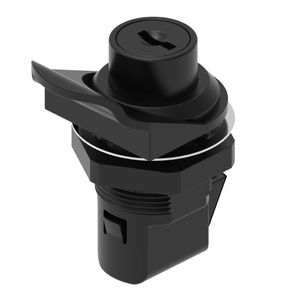
ForndLock Industrial Pop Out Knob Latches
How Do Custom Latches Solve Engineering Problems?
Custom latches address unique dimensional constraints, extreme environmental conditions, and specific operational workflows that standard catalog parts cannot accommodate.
Despite the vast array of standard access hardware available, modern industrial engineering frequently pushes the boundaries of conventional design. OEM clients routinely develop highly specialized equipment that features unusual door geometries, unprecedented weight loads, or spatial restrictions that render standard off-the-shelf latches useless. In these critical scenarios, relying on a compromised standard part can jeopardize the entire project. This is where ForndLock’s advanced OEM and ODM manufacturing capabilities, deep engineering support, and robust batch delivery systems become an invaluable asset to procurement teams and mechanical designers.
A clear demonstration of this capability occurred recently with a prominent wind energy equipment manufacturer based in Northern Europe. This client was designing a new generation of offshore wind turbine control cabinets, which housed the critical telemetry and power routing systems for the turbine. The operational environment was brutally unforgiving. Standard 304 stainless steel latches previously specified for the cabinets were failing rapidly due to severe salt spray corrosion from the North Sea, combined with constant, high-amplitude wind vibration. The vibration was causing the standard compression latches to slowly back off their locked positions, which released the pressure on the IP67 polyurethane seals. Consequently, highly corrosive saltwater was leaking into the high-voltage control panels, leading to catastrophic short circuits and massive maintenance costs involving helicopter dispatches.
The client approached ForndLock with a strict set of dimensional constraints and an urgent need for a fail-proof solution. Our engineering team immediately initiated a custom hardware development protocol. We designed a heavy-duty compression latch cast entirely from marine-grade 316 stainless steel to combat the aggressive saline environment. To address the vibration issue, our engineers integrated a proprietary internal anti-vibration detent system that mechanically locked the pawl shaft in the fully compressed position, requiring a deliberate, two-stage manual action to release. Furthermore, we applied a specialized passivation surface treatment to enhance the material's natural corrosion resistance.
To ensure the design met the client's aggressive timeline, ForndLock provided rapid 3D printed metal prototypes within days, allowing the client's engineering team to verify the dimensional fit and ergonomic feel on their actual cabinet frames. Once approved, we moved into rigorous internal validation, subjecting the custom latch to over 1,000 hours of continuous salt spray testing and extensive mechanical fatigue testing simulating decades of daily use under heavy vibration.
The result was transformative. The custom ForndLock solution completely eliminated the seal failure issue. It passed the client's full OEM environmental validation process on the first attempt and is now deployed across their entire fleet of offshore turbines. Since implementing our custom compression latch, the client has reported a zero-failure rate regarding moisture ingress in those control cabinets, drastically reducing their emergency maintenance expenditures and solidifying the reliability of their energy grids. This case illustrates exactly how tailored engineering support and specialized manufacturing solve complex industrial challenges.
How Do You Start Your Latch Project?
You begin by defining your technical specifications, requesting precise engineering drawings, and conducting rigorous sample testing with a trusted manufacturer.
Navigating how to choose the right latch type for cabinet doors is a highly technical process that fundamentally impacts the entire lifecycle, safety, and reliability of industrial equipment. From calculating necessary gasket compression and mitigating harmonic vibration to selecting the optimal metallurgical composition for harsh environments, hardware selection is a critical engineering decision that should never be left to chance.
ForndLock remains deeply committed to providing robust engineering support, precision manufacturing, and the highest quality access hardware to industrial clients worldwide. Whether your project requires standard, high-durability cam latches for indoor server racks or fully customized, vibration-proof compression mechanisms for offshore machinery, our team possesses the technical expertise to ensure your enclosures remain secure and fully sealed.
We encourage procurement professionals, mechanical design engineers, and OEM clients to take the next crucial step in their hardware selection process. Do not compromise the integrity of your equipment with inadequate fastening solutions. Invite our engineering team to review your project requirements, analyze your technical CAD drawings, or request physical hardware samples for your own rigorous internal testing. To initiate your project and secure the ideal access hardware solution, send your requirements and technical specifications via email to our engineering team at: [email protected].