
How Does a Draw Latch Work on Toolboxes and Cabinets in Industrial Applications
Industrial engineers and procurement professionals constantly deal with the challenge of securing heavy enclosures, equipment panels, and storage units against tough environmental conditions. Choosing the right access hardware is not simply about keeping a door shut. It is about maintaining structural integrity, ensuring a proper seal against water and dust, and preventing accidental opening under severe mechanical vibration. This detailed technical guide is written for original equipment manufacturers, product designers, and sourcing teams who need to make well-informed decisions about enclosure hardware.
We will explain exactly how does a draw latch work on toolboxes and cabinets, look at the mechanical advantages of these specific components, and offer clear criteria for specifying the right hardware for demanding engineering projects. Whether your applications involve extreme temperature swings, heavy shock loads, or corrosive atmospheres, understanding the basic mechanics of these fastening systems will help you optimize your industrial enclosure designs, reduce warranty claims, and simplify your hardware supply chain.
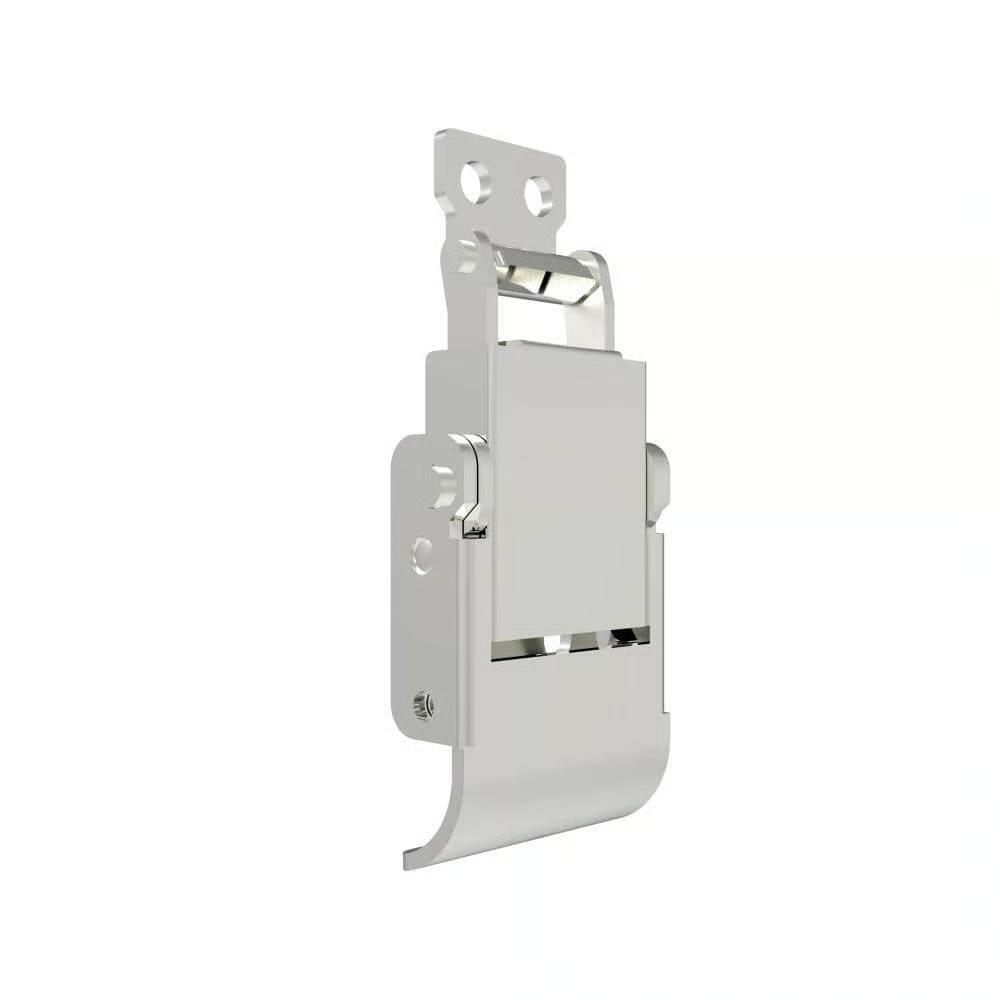
What is a Draw Latch
At its core, it is a mechanical fastener designed to pull two separate surfaces together and hold them firmly under tension. Unlike a deadbolt or a slam latch that depends on a sliding pin entering a hole, this mechanism relies on a tension-based pulling action. The system generally consists of two main parts: the latch body, which contains the lever and the linkage, and the keeper or strike plate, which provides the anchor point. By engaging the linkage with the keeper and pressing the lever down, the mechanism creates a strong pulling force that closes the gap between a door and its frame.
ForndLock Over Center Draw Latches
As an experienced industrial locks, industrial latches, industrial hinges, industrial handles and access hardware manufacturer, we at ForndLock understand that the seemingly simple design of these components hides a sophisticated use of physical geometry. The true strength of this hardware lies in its over-center locking principle. When the lever is pushed down into its final resting position, the pivot point of the linkage crosses the center line of the applied force. This geometric arrangement means that any external pulling force placed on the cabinet door or toolbox lid actually works to hold the latch more tightly closed, rather than forcing it open. This mechanical advantage allows an operator to apply a relatively small amount of manual force to the lever, which is then multiplied into a large clamping pressure. This high clamping pressure is absolutely essential for industrial applications where thick, resilient rubber gaskets must be compressed to meet strict environmental sealing standards.
Mechanics on Toolboxes and Cabinets
To fully understand the engineering value of these components, we must look closely at how does a draw latch work on toolboxes and cabinets in real-world industrial situations. The operation begins when the operator hooks the blade, wire bail, or flexible rubber loop over the keeper attached to the opposing surface. As the operator pushes the lever handle downward toward the mounting surface, the internal pivot points shift. The distance between the mounting base and the keeper is mechanically shortened, drawing the two surfaces together. Once the lever passes the theoretical center line of tension, it snaps securely into place. This snap is not just a tactile feedback feature. It is the physical confirmation that the mechanism has achieved an over-center lock, making it resistant to standard pull-apart forces.
When looking at how does a draw latch work on toolboxes and cabinets specifically, different applications call for different performance characteristics. On mobile heavy-duty toolboxes used in construction or mining vehicles, the main challenge is dynamic load and shock. As a truck moves over unpaved roads, the lid of a heavy steel toolbox experiences violent upward forces that attempt to force it open. The over-center tension mechanism absorbs these shockwaves. In addition, many designs used on toolboxes include a flexible elastomeric body or a spring-loaded linkage. This flexibility allows the latch to stretch slightly under extreme impact, absorbing the kinetic energy without permanently bending the metal components or breaking the keeper.
On the other hand, when analyzing how does a draw latch work on toolboxes and cabinets in stationary industrial settings, the focus shifts to continuous vibration and gasket compression. A large electrical control cabinet mounted next to an industrial generator will vibrate continuously at high frequencies. A standard cam lock might slowly vibrate loose over time, weakening the seal. The continuous, active tension provided by the draw mechanism keeps the door tightly pulled against the frame, preventing annoying rattles and, more importantly, maintaining the integrity of the weather seal. The precise geometric relationship between the latch base and the keeper must be calculated during the CAD design phase to ensure the stroke length perfectly matches the required gasket compression distance.
Essential Materials for Industrial Environments
The mechanical brilliance of an over-center design depends entirely on the structural integrity of the materials used to build it. In the industrial sector, hardware is exposed to chemical washdowns, salt spray from marine environments, extreme ultraviolet radiation, and large temperature fluctuations. For this reason, material selection is a critical factor for engineers and procurement personnel to evaluate. Stainless steel, specifically grades 304 and 316, remains the top choice for heavy-duty applications. Grade 316 stainless steel contains molybdenum, which significantly improves its resistance to pitting and chloride-induced corrosion, making it the required choice for offshore marine cabinets and chemical processing toolboxes.
For applications where cost is the main concern but high strength is still needed, carbon steel with advanced surface treatments is frequently specified. Modern zinc plating combined with heavy-duty powder coating or electrophoretic deposition provides solid corrosion resistance for standard outdoor environments. However, engineers must be careful about galvanic corrosion when mounting dissimilar metals. Installing a zinc-plated steel latch onto an aluminum toolbox without proper isolation can lead to rapid degradation of the mounting points.
Elastomeric and rubber materials also play a large role in modern industrial hardware. Heavy-duty rubber draw latches use a thick, UV-resistant synthetic rubber body instead of a rigid metal linkage. This material choice is highly intentional. The rubber naturally dampens vibration, eliminates metal-on-metal rattling, and handles significant dimensional variations caused by thermal expansion or manufacturing tolerances. When evaluating materials, procurement teams must look beyond the initial appearance and demand rigorous salt spray cycle testing data and tensile strength reports to confirm the hardware will survive the intended service life of the machinery it secures.
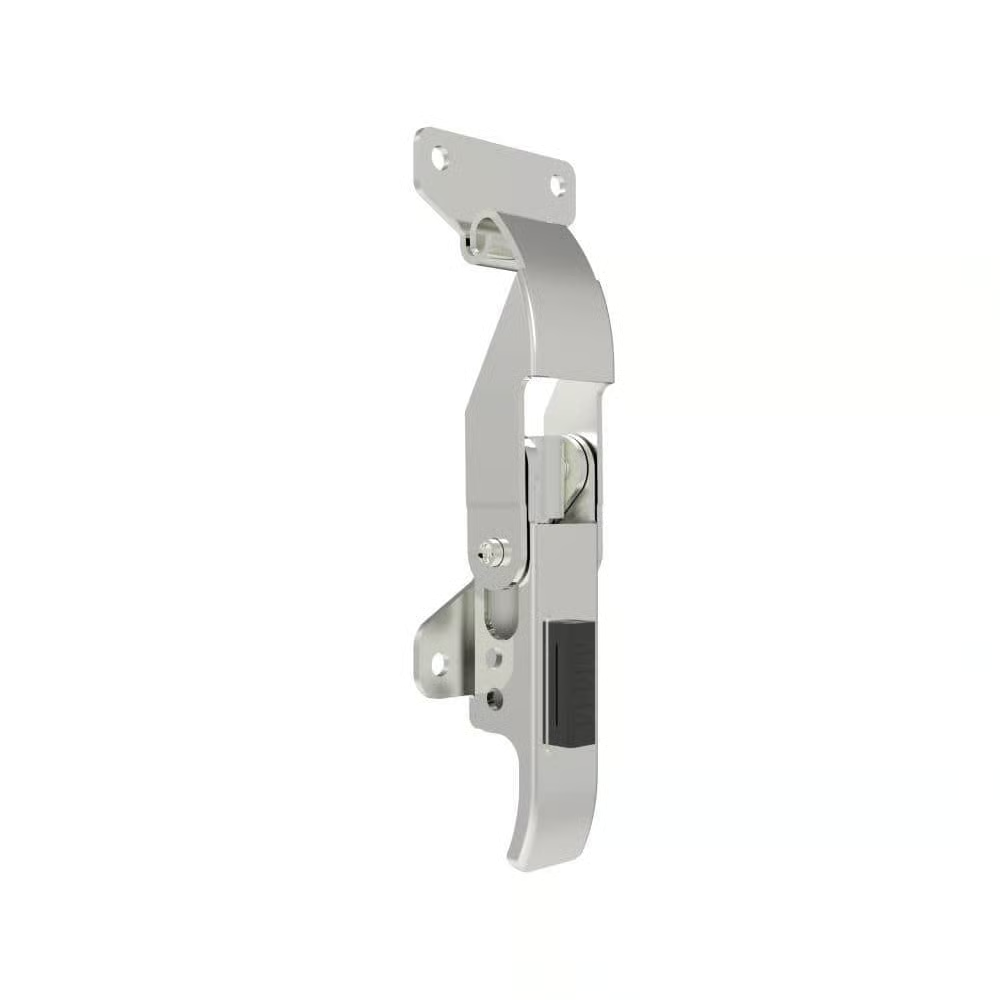
Draw Latch Vs Toggle Latch
In the world of industrial access hardware, terminology is often used loosely, which leads to confusion during the specification process. Engineers frequently ask us to evaluate draw latch vs toggle latch which is better for heavy duty applications. While both use over-center mechanics to secure panels, their geometric profiles, linkage styles, and ideal use cases differ significantly. Understanding these differences is essential for optimizing enclosure design and ensuring long-term reliability.

A toggle latch typically features a rigid, multi-pivot linkage system that operates in a very linear way. These latches often stick out further from the mounting surface and are designed to deliver maximum ultimate tensile strength. Toggle latches are excellent for applications where massive rigid clamping force is needed, such as joining two halves of a heavy industrial mold or securing pressure vessel lids. However, this extreme rigidity can be a drawback in environments exposed to heavy shock or chassis flex. If the mounting surfaces shift dynamically, a completely rigid toggle mechanism can experience metal fatigue or cause the mounting rivets to shear off entirely.
This brings us to the heart of the debate regarding draw latch vs toggle latch which is better for heavy duty applications. Draw latches generally sit lower and flatter against the panel, reducing the risk of being snagged by passing equipment or workers. More importantly, they often include a degree of tolerance or flexibility, either through spring-loaded claws, wire bails, or elastomeric bodies. This makes them far superior for heavy-duty mobile applications like vehicle toolboxes, agricultural machinery panels, and vibrating compressor enclosures. The built-in compliance allows the mechanism to maintain tension even if the cabinet door warps slightly under load. Therefore, when advising clients on draw latch vs toggle latch which is better for heavy duty applications, we always analyze the dynamic vibration profile and the potential for chassis flex in the end-user environment. If the application demands shock absorption and a low-profile snag-free design, the draw mechanism is consistently the correct engineering choice.
Sealing and Vibration Resistance Factors
One of the primary responsibilities of industrial access hardware is protecting sensitive internal components from environmental contamination. Industrial cabinets housing programmable logic controllers, electrical relays, or sensitive hydraulic valves must frequently meet strict Ingress Protection ratings, such as IP65, IP66, or IP67. Achieving these ratings requires more than just a good rubber gasket. It requires hardware capable of delivering precise, consistent compression along the entire perimeter of the enclosure door.
The tension generated by the mechanism is directly responsible for compressing the gasket to its optimal sealing thickness. If the tension is too low, water and dust will bypass the seal during high-pressure washdowns or windstorms. If the tension is too high, the gasket may permanently deform or the cabinet door itself may bow outward between the latching points, creating unintended gaps. Engineers must calculate the exact stroke length of the latch and match it to the compression curve of the chosen gasket material. This ensures that when the lever snaps over-center, the gasket is compressed by the exact amount required by the manufacturer specifications.
Vibration resistance goes hand-in-hand with sealing integrity. In environments with heavy harmonic vibrations, standard latches can slowly back out of their locked position. To address this, high-quality industrial hardware often includes secondary locking features. These can include integrated safety catches that must be manually pressed before the main lever can be lifted, or simple padlock eyes that allow for both security lockouts and physical prevention of lever movement. For extreme vibration environments, such as railway undercarriage boxes or heavy crushing equipment, these secondary safety features are not optional. They are critical requirements to prevent the internal components from being dangerously exposed.
Real Engineering Case Study Analysis
To show the critical importance of proper hardware selection, we can look at a recent project involving a major manufacturer of heavy mobile equipment for the mining industry in Australia. The client was experiencing a high failure rate on the exterior storage cabinets and toolboxes mounted on their heavy haul trucks. The vehicles operate continuously on deeply corrugated, unpaved mining roads, generating extreme low-frequency vibrations and severe shock loads. In addition, the environment is filled with highly abrasive iron ore dust and exposed to intense heat.
The original hardware specified by the client was a standard commercial-grade rigid toggle mechanism. Due to the relentless chassis flex of the trucks and the violent shock loads, the rigid metal linkages were fatiguing and snapping. When the hardware did not break entirely, the vibration was causing the levers to bounce past their over-center point, allowing the heavy toolbox lids to fly open during transit. This resulted in lost tools, severe dust contamination of sensitive diagnostic equipment, and serious safety hazards for vehicles traveling behind.
The client engineering team contacted ForndLock for a full redesign. After analyzing the failure modes and the dynamic loads, we engineered a custom heavy-duty stainless steel solution. We replaced the rigid linkage with a heavy-gauge spring-compensated draw mechanism. The integrated heavy-duty springs absorbed the violent shock loads, allowing the toolbox lid to flex slightly without transferring the destructive kinetic energy into the latch body. In addition, we incorporated a positive-action secondary safety button that physically locked the lever in the down position, making it impossible for vibration to open the mechanism. The result was an immediate elimination of hardware failures in the field. The client improved their overall equipment reliability, significantly reduced warranty replacement costs, and ensured that their mobile cabinets maintained a strict dust-proof seal even in the most demanding mining environments.
OEM Customization and Sourcing Support
For industrial procurement managers and OEM design engineers, sourcing the right hardware involves much more than browsing a catalog. It requires a strategic partnership with a manufacturer capable of providing strong engineering support and reliable supply chain logistics. Standard off-the-shelf components may work for basic applications, but high-performance industrial equipment often requires customized solutions tailored to specific panel thicknesses, gasket compression requirements, and mounting hole patterns.
Working directly with an experienced manufacturer allows engineering teams to access important technical data early in the design phase. We provide detailed 3D CAD models, allowing designers to perform interference checks and simulate the ergonomic operation of the hardware before physical prototypes are ever produced. When modifications are needed, such as changing the length of a wire bail, adjusting the mounting plate geometry, or applying a specific anti-corrosion coating, direct manufacturer engagement ensures these customizations are carried out precisely and efficiently.
Furthermore, procurement teams must require thorough quality control documentation. This includes material test reports, salt spray certification, and lifecycle testing data. Moving from the prototyping phase to mass production requires a manufacturer capable of scaling up quickly while maintaining strict dimensional tolerances across tens of thousands of units. Reliable bulk delivery, consistent quality assurance, and responsive technical support are the foundations that ensure your production lines never stop due to a hardware shortage or a quality defect.
Conclusion and Project Next Steps
Securing industrial toolboxes and heavy-duty cabinets requires a solid understanding of mechanical forces, environmental challenges, and material science. By understanding exactly how these tension-based mechanisms use over-center geometry to multiply human effort into large clamping force, engineers can design enclosures that withstand extreme vibration, maintain reliable environmental seals, and survive years of heavy use in harsh environments. Selecting the right hardware prevents costly equipment failures, protects sensitive internal components, and raises the overall perceived quality of the final industrial product.
Inside the ForndLock Factory
At ForndLock, we are committed to helping engineering teams and procurement professionals solve their most complex access hardware challenges. Whether you need to evaluate standard components for a new cabinet design, require custom engineering for a unique heavy-duty application, or need reliable bulk manufacturing for your OEM production lines, our team is ready to help. We invite you to share your specific project requirements, technical drawings, or requests for physical samples. To start optimizing your enclosure hardware and to discuss your custom manufacturing needs, please send your project details to us via email at: [email protected].