
Concealed Hinge vs Butt Hinge: How to Choose the Right Industrial Door Hinge?
A sagging cabinet door rarely fails on day one — it fails months later, after the hinge has quietly carried more load than its geometry was designed for. We see this pattern often when clients ask us to re-specify hardware after an early failure: the door looked fine at installation, then slowly dropped out of alignment as the pivot points wore under repeated cycling. The decision between a concealed hinge and a butt hinge for industrial cabinet doors weight capacity isn't a matter of appearance preference. It's a structural calculation involving panel weight, mounting geometry, and how load travels through the hinge body.
The same logic scales upward. Once you move from a industrial cabinet door to something heavier — say, a solid wood interior door in an industrial control room or an equipment enclosure — the stakes of getting this wrong grow considerably. Comparing concealed hinge vs butt hinge for heavy solid wood interior doors follows the same mechanical principles, just with tighter margins for error. This article walks through where each hinge type carries weight well, where it doesn't, and how to match hinge selection to actual door specifications rather than habit.
What Is a Concealed Hinge and How Does It Bear Load?
A concealed hinge hides its mounting hardware inside the door and cabinet frame, using a multi-pivot arm that spreads rotational force across several contact points rather than a single pin. The typical design uses a cup that recesses into the door panel, paired with an articulating arm mounted to the cabinet frame. When the door swings, the arm's linkage — often built around five to seven pivot points — carries the rotational load through a chain of small joints instead of one central axis.
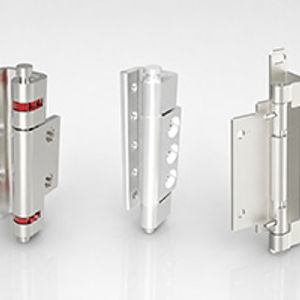
This distributed structure is why concealed hinges disappear from view when the door closes, but it also changes how stress moves through the hardware. Instead of one pin absorbing the full torque of the swinging panel, that torque gets divided across multiple smaller pivots. Each pivot is individually less loaded, but the overall assembly has more points where wear, clearance, or manufacturing tolerance can accumulate over time.
We apply concealed hinges regularly across industrial cabinets, electrical enclosures, automation equipment covers, and machine covers where flush aesthetics and internal clearance matter as much as function. One advantage that gets overlooked in load discussions is adjustability — the ability to fine-tune height, depth, and lateral position after installation. On one automation enclosure project, a misaligned frame opening left the door binding against the cabinet lip after mounting. Because the concealed hinge allowed three-axis adjustment, we corrected the alignment without re-drilling or replacing hardware — a fix a fixed-pin hinge would not have permitted without full reinstallation.
What Is a Butt Hinge and Why Is It Structurally Simple?
A butt hinge joins two flat leaves with a single fixed pin running through interlocking knuckles, creating a straightforward single-axis rotation that is mounted directly on the surface. One leaf attaches to the door, the other to the frame, and the knuckle assembly between them carries the entire rotational load through that one pin.
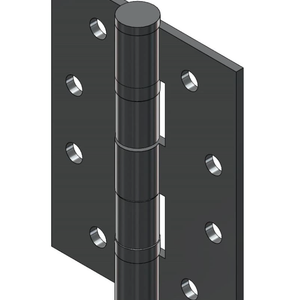
This simplicity is precisely what gives the butt hinge its structural directness. There's no intermediate linkage translating force between multiple joints — the load path runs straight from the door leaf, through the pin, into the frame leaf. Fewer moving parts mean fewer tolerance stack-ups, which is part of why butt hinges have remained a standard choice for over a century of door hardware design.
The practical advantages follow from that simplicity: straightforward manufacturing, easy field inspection, and maintenance that typically just means replacing a worn pin or hinge unit rather than diagnosing a multi-point linkage. We see butt hinges specified frequently on exposed industrial doors and access panels where surface-mounted hardware is acceptable and where technicians need to be able to assess wear at a glance.
ForndLock Hinge Product Range: Heavy-Duty Butt Hinges for Perfect Cabinet Door Alignment!
Concealed Hinge vs Butt Hinge — What Are the Key Differences?
The core difference between a concealed hinge and a butt hinge lies in where the load path sits — a butt hinge carries weight through one fixed pin, while a concealed hinge distributes it across a multi-point linkage.
Feature | Concealed Hinge | Butt Hinge |
Installation method | Recessed into door/frame, requires precise boring | Surface-mounted, requires basic mortising |
Appearance | Fully hidden when closed | Visible knuckle and pin |
Space requirement | Needs internal cavity clearance | Minimal internal clearance needed |
Load capacity | Moderate, depends on arm/pivot rating | Higher on single-axis loads, especially with ball-bearing versions |
Maintenance | Limited field access, adjustment-based | Easy visual inspection and part replacement |
Application | Cabinet doors, enclosures, automation covers | Heavy access panels, large industrial doors |
Customization | Adjustable geometry, finish options | Size, thickness, and bearing type variations |
The load capacity gap in that table isn't arbitrary. A single-axis pin under proper sizing resists bending and shear more predictably than a linkage with several smaller joints, each carrying a fraction of the load but each also introducing a potential wear point. That's not a flaw in concealed hinge engineering — it's a trade-off that makes sense when the priority is concealment and adjustability rather than maximum static capacity.
How Do Concealed and Butt Hinges Compare in Load Capacity?
Load capacity in cabinet and door hinges depends less on hinge type alone and more on how door weight, panel size, and mounting structure interact with the hinge's pivot design.
What Factors Determine Weight Capacity?
Four variables typically decide whether a given hinge configuration will hold up over time:
· Door weight, which depends heavily on panel material — an MDF cabinet door behaves very differently from a solid wood panel or a steel-clad enclosure cover of the same dimensions.
· Panel size, since a larger door surface increases the leverage, and therefore the torque, applied to the pivot point even if the total weight is similar to a smaller panel.
· Mounting structure, including screw pattern, frame material, and how many hinges are distributing the load across the door's height.
· Opening frequency, because cycle count accelerates wear-related capacity loss — a hinge rated for a given static weight can still underperform if it's cycled thousands of times per year without margin.
As a general reference point, standard concealed cabinet hinges are commonly rated per pair for door weights in the range suited to typical industrial cabinetry, while heavy-duty butt hinges — particularly ball-bearing variants — are rated for meaningfully higher static loads, which is why they show up on larger access panels and industrial doors rather than lightweight cabinetry.
Why Does Sagging Risk Differ Between the Two?
If a concealed hinge is undersized relative to actual door weight, its multi-axis geometry can allow gradual deflection at each pivot point, and those small deflections compound into visible sagging over months of use. A correctly sized butt hinge, by contrast, tends to resist sagging more consistently because its single fixed pin has a more direct, predictable load path with fewer accumulation points for wear.
This is exactly where the secondary comparison becomes relevant: concealed hinge vs butt hinge for heavy solid wood interior doors follows the same sagging logic, just amplified. A solid wood interior door frequently weighs several times more than a standard industrial cabinet door of similar size, which means the margin for hinge undersizing shrinks considerably. When we validate hinge selection for automation enclosure covers carrying dense composite or metal-faced panels, we cross-check the specified door weight against the hinge's rated capacity before finalizing a configuration — not after a customer reports sag.
How Does Durability Hold Up Under Repeated Use?
Wear shows up in different places depending on hinge type. Concealed hinges tend to show wear first at the pivot arm's linkage points, where repeated small movements gradually loosen tolerance. Butt hinges wear primarily at the pin and knuckle interface, where friction between the pin and knuckle bore accumulates over cycles.
In applications involving vibration — transportation equipment, mobile machinery, or installations near rotating equipment — bearing type matters as much as hinge category. A plain-bearing butt hinge will wear faster under vibration than a ball-bearing version, which reduces friction and extends service life meaningfully in high-cycle environments.
Which Material Should You Choose for Load-Bearing Hinges?
Material choice affects load capacity as much as hinge geometry does, with stainless steel 316 and reinforced zinc alloy options each suited to different weight and corrosion demands.
Stainless steel 304 remains a reasonable default for general industrial cabinets facing moderate corrosion exposure — indoor environments without heavy chemical contact or washdown cycles. Stainless steel 316 adds molybdenum to the alloy, which meaningfully improves resistance to chloride-based corrosion, making it the better choice for washdown areas, marine-adjacent installations, or chemical-exposure environments, particularly when those doors also carry heavier panel loads that would accelerate corrosion-related weakening over time.
Zinc alloy sits at the more cost-sensitive end of the spectrum. It performs adequately for lighter-duty applications where full stainless steel isn't required, but it isn't the right choice when both heavy load and corrosion resistance are simultaneous requirements. In practical terms, 316 grade stainless typically outperforms 304 in salt-spray and chemical-exposure testing by a wide margin, while 304 still offers solid tensile performance for dry indoor use. When we specify industrial concealed hinges and stainless steel hinge options for customers, we match grade to environment first, then confirm the geometry meets the panel's weight profile.
When Should You Choose a Concealed Hinge for Cabinet Doors?
A concealed hinge fits best when appearance, limited installation space, and moderate door weight matter more than maximum static load capacity.
Does Appearance Justify the Trade-Off?
In medical equipment enclosures, automation panels, and premium enclosure systems, a flush exterior isn't just cosmetic — it often supports cleanability requirements or a specific design language the equipment manufacturer needs to maintain across a product line.
Is Space a Deciding Factor?
Compact cabinets and narrow door structures frequently can't accommodate the surface-mounted knuckle and pin of a butt hinge without interfering with adjacent components. A recessed concealed hinge solves that clearance problem directly.
Why Does Protected Hardware Matter?
With no exposed pin or knuckle, concealed hinges reduce external points of tampering risk and keep the door's design integrity intact — a relevant consideration for cabinet door hinges used in secure or public-facing equipment enclosures.
When Should You Choose a Butt Hinge for Heavy Industrial Doors?
A butt hinge is the stronger choice when door weight, panel size, or access frequency push beyond what a concealed hinge's pivot arm is rated to carry.
Heavy-duty industrial doors and large access panels — the kind found on transportation equipment or machinery covers — routinely exceed the practical weight range where concealed hinge geometry performs reliably long-term. Butt hinges also simplify fabrication in cost-sensitive applications, since surface mounting avoids the precision boring that concealed hinges require. In environments where field technicians need fast turnaround on repairs, a butt hinge's exposed pin and straightforward knuckle assembly make replacement a matter of minutes rather than a specialized adjustment procedure.
This is also where the secondary keyword applies directly: heavy solid wood interior doors often default to butt hinges, particularly ball-bearing variants, once the panel weight exceeds what a standard concealed hinge is rated to hold. It's less a stylistic choice at that point and more a load-rating decision.
Concealed Hinge or Butt Hinge — Which One Should You Specify?
Neither hinge type is universally better — the right choice depends on matching door weight, structure, and installation constraints to the hinge's actual load rating.
The application environment, the door's construction, the expected load, and the available installation space all factor into the answer jointly. A quick way to frame the decision:
Application Requirement | Recommended Hinge |
Hidden appearance | Concealed hinge |
Compact design | Concealed hinge |
Heavy industrial doors | Butt hinge |
Easy maintenance | Butt hinge |
High-cycle vibration environments | Butt hinge (ball-bearing) |
Adjustable alignment needs | Concealed hinge |
Treat this table as a starting filter, not a final answer. A heavy door in a compact enclosure, for instance, might require reinforced concealed hinges rated above standard cabinet-grade capacity, or a hybrid approach using multiple hinge points to distribute load beyond what either hinge type could handle alone.
How Can ForndLock Help You Specify the Right Industrial Hinge?
We help engineering teams match hinge type, material, and load rating to actual door weight and duty cycle before a single unit goes into production.
At ForndLock, we provide customized industrial hinge solutions covering concealed hinges, industrial hinges, lift-off hinges, and torque hinges, built around the specific panel weights and duty cycles our customers describe rather than defaulting to generic catalog sizing. Our support scope includes custom dimensions, material selection across stainless steel hinges and heavy duty hinges, surface treatment options for corrosion or wear resistance, and engineering support during the specification process itself.
We work as a concealed hinge manufacturer across industrial cabinets, electrical enclosures, automation equipment, and transportation equipment, which means we regularly handle non-standard panel weights that don't map cleanly onto off-the-shelf hinge ratings. If your team is evaluating custom industrial hinges for a door or panel that doesn't fit a standard weight bracket, working directly with our engineering process during specification tends to catch load-mismatch problems long before they show up as field failures.
What Should You Know Before Finalizing Your Hinge Selection?
How much cabinet door weight can each hinge type actually hold?
It depends on the specific hinge model's rated capacity, but as a general pattern, standard concealed hinges suit lighter to moderate cabinet doors, while ball-bearing butt hinges carry noticeably higher static loads suited to heavier panels.
What is the difference between a concealed hinge and a butt hinge?
A concealed hinge is recessed and hidden, distributing load across a multi-pivot linkage, while a butt hinge is surface-mounted and carries load through a single fixed pin.
Are concealed hinges suitable for industrial cabinets?
Yes, particularly where flush appearance, internal clearance limits, or alignment adjustability matter, as long as the hinge's rated capacity matches the panel's actual weight.
Which hinge is better for heavy-duty equipment doors?
Butt hinges, especially ball-bearing versions, generally handle heavier equipment doors and higher-cycle applications more reliably than standard concealed hinges.
Can ForndLock provide custom industrial hinges?
Yes — we specify hinge type, material, and dimensions around actual door weight and duty cycle rather than standard catalog assumptions.
What materials are available for industrial hinges?
Common options include stainless steel 304 for general indoor use, stainless steel 316 for corrosion-heavy environments, and zinc alloy for lighter-duty, cost-sensitive applications.
Where Does This Leave Your Hinge Decision?
Hinge selection is a load-bearing engineering decision, not a cosmetic afterthought. Get it wrong, and the consequence rarely appears at installation — it shows up years later as a sagging door, a misaligned enclosure, or a hinge that's quietly failing under a load it was never rated to carry. As equipment designs trend toward tighter tolerances and heavier composite panels, specifying the right hinge early matters more than it used to, not less.
At ForndLock, we provide customized industrial hinge solutions designed for different equipment and enclosure applications. If you need technical support, custom hinge designs, or reliable manufacturing solutions, please contact us at:
Email: [email protected]