
Aerospace Hinges: Types, Materials and How to Choose a Manufacturer?
Aerospace hinges are among the most demanding mechanical components we build at ForndLock, because a hinge that fails to open a cabin panel is a minor inconvenience, but a hinge that fails on a cowling, access door, or cargo panel can compromise flight safety. Every hinge we design has to reconcile weight, load, fatigue life, and environmental resistance within tight dimensional tolerances, and the right choice of type and material changes depending on where the hinge sits on the aircraft.
This guide walks through what aerospace hinges are, how they differ from industrial hardware, the main hinge types and materials used across airframes and interiors, the design requirements engineers need to account for, and how we manufacture and quality-check every part before it leaves our facility. At ForndLock, we design and manufacture aerospace hinges for equipment manufacturers, mechanical engineers, and procurement teams who need hardware built to a drawing rather than pulled from a generic catalog. Our engineering team reviews custom hinge drawings on a regular basis, and that review process shapes much of what we cover below.
What Are Aerospace Hinges?
Aerospace hinges are precision mechanical components that connect movable structures—such as doors, panels, cowlings, and access covers—to an aircraft's fixed structure while withstanding flight loads, vibration, and extreme environmental conditions. In basic construction, a hinge consists of two or more leaves joined by a pin, with a bushing or bearing surface controlling rotation and reducing wear between the leaf and the pin.
Not every aerospace hinge carries the same responsibility. Structural hinges support primary loads on components like cargo doors or landing gear doors, where failure would directly affect airworthiness. Non-structural hinges, by contrast, are used on interior cabinetry, lavatory panels, or overhead bin doors, where the load is limited to the weight of the panel itself and occasional human contact. This distinction drives almost every downstream decision about material, thickness, and pin diameter.
Across the aircraft hinges we have supplied, we have seen the same pattern repeat: engineers rarely need one universal hinge. They need a hinge matched to a specific access panel, a specific interior configuration, or a specific cowling geometry, and aircraft interior hinges in particular tend to prioritize a clean appearance and low weight over raw load capacity.
What Makes Aerospace Hinges Different?
Aerospace hinges differ from industrial or architectural hinges because they must meet strict weight, fatigue life, vibration resistance, and dimensional tolerance requirements that standard hinges are not engineered to handle. A cabinet hinge is designed around thousands of open-close cycles under mild loads at room temperature. An aerospace hinge is designed around similar or higher cycle counts, but under sustained vibration, temperature swings from sub-zero cruise altitudes to hot tarmac exposure, and occasional contact with de-icing fluid or hydraulic fluid.
Vibration resistance deserves particular attention. Under high-frequency vibration from engines or airframe flex, a hinge that relies purely on static friction between leaves can gradually lose clamping force as static friction transitions to kinetic friction. This is sometimes described as a hinge "walking" out of its set position. Aerospace hinge design manages this through tighter pin-to-bushing clearances, controlled leaf geometry, and material choices that maintain consistent torque under cyclic loading, rather than depending on friction alone to hold a position.
Dimensional tolerance is the other major separator. An aerospace hinge often needs to fit within a defined envelope on a panel that also carries seals, latches, or wiring, so there is little room to adjust the hinge footprint after the fact. Our engineering team reviews these factors during every drawing evaluation, because a hinge that looks correct on paper can still bind, rattle, or wear prematurely if the pin fit or leaf flatness is off by a small margin.
What Are the Main Types of Aerospace Hinges?
The main types of aerospace hinges include continuous piano hinges, lift-off hinges, concealed hinges, friction torque hinges, and heavy duty hinges, each suited to different load, access, and space requirements. Choosing between them starts with the question of how the panel needs to move, how often it will be accessed, and how much load it needs to carry.
Hinge Type | Typical Application | Load Handling | Key Advantage |
Continuous Piano Hinge | Long panels, access doors | Even load distribution | Full-length support |
Lift-off Hinge | Removable panels/covers | Light-medium | Tool-free removal |
Concealed Hinge | Interior cabin panels | Light | Clean aesthetic, no visible hardware |
Friction Torque Hinge | Tray tables, adjustable panels | Controlled resistance | Hold-open at any angle |
Heavy Duty Hinge | Cargo doors, structural panels | High structural load | High fatigue strength |
What Are Continuous Piano Hinges Used For?

Continuous piano hinges run the full length of a panel to distribute load evenly, making them suitable for long access doors and structural panels. Because the pin spans the entire hinge length, load is shared across the whole joint rather than concentrated at a few mounting points, which reduces localized stress and helps the panel stay aligned over repeated cycles.
When Should You Use a Lift-off Hinge?

Lift-off hinges are used when a panel or cover needs to be removed quickly without disassembling the pin, which simplifies maintenance access. This makes them a practical choice for covers that maintenance crews open frequently, since technicians can lift the panel free without pulling a separate pin or fastener.
What Is a Concealed Hinge Used For?
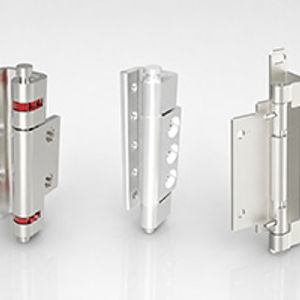
Concealed hinges hide the hardware from view, which is why they are common in aircraft interior hinges for cabin panels and cabinetry. Passengers and crew see a clean panel line rather than exposed metal leaves, which matters for cabin finish quality even though the load requirements are typically modest.
How Do Friction Torque Hinges Work?
Friction torque hinges use controlled resistance to hold a panel at any set angle without additional latches, which is why they are often called torque hinges.

The resistance is built into the hinge itself, usually through a spring-loaded or friction-band mechanism, allowing a tray table or adjustable panel to stay in position without a separate locking device.
ForndLock Friction & Torque Hinges
When Are Heavy Duty Hinges Required?

Heavy duty hinges are required when a hinge must carry high structural loads, such as cargo doors or primary access panels subject to repeated cyclic stress. These hinges use thicker leaves, larger pin diameters, and often higher-strength materials to keep stress concentrations within safe limits across a long service life.
ForndLock Heavy-Duty Butt Hinges
Which Materials Are Used for Aerospace Hinges?
Aerospace hinges are typically made from aluminum, stainless steel, titanium, or composite materials, with the choice depending on required strength-to-weight ratio, corrosion resistance, and operating environment. None of these materials is universally "best." Each represents a different balance between weight, strength, corrosion resistance, and cost, and the correct choice depends on where the hinge sits and what it needs to survive.
Material | Weight | Strength | Corrosion Resistance | Best Suited For |
Aluminum | Low | Medium | Good (with anodizing) | Weight-sensitive interior/structural panels |
Stainless Steel | Medium-High | High | Excellent | High-load, corrosion-exposed applications |
Titanium | Low-Medium | Very High | Excellent | High-stress, weight-critical structural hinges |
Composite | Very Low | Medium | Excellent | Non-structural, EMI-sensitive assemblies |
The trade-off is rarely as simple as picking the lightest or strongest option on the chart. A titanium hinge might outperform aluminum on every mechanical axis, but if the application only sees light interior loads, the added cost is difficult to justify. Conversely, using aluminum on a high-cycle cargo door hinge without accounting for its lower fatigue margin compared to steel or titanium can shorten service life. Material selection has to start from the load and environment, not from a general preference for "lightweight" or "strong."
When Is Aluminum the Right Choice?
Aluminum is the right choice when weight reduction is the primary design driver and loads remain moderate, such as in interior panels and lightweight access doors. With anodized finishing, aluminum also holds up well against normal cabin and cargo bay exposure, which makes it a common choice for lightweight hinges throughout non-critical structure.
Why Use Stainless Steel for Aerospace Hinges?
Stainless steel is used when a hinge must withstand higher structural loads and repeated exposure to moisture or de-icing fluids without corroding. It offers a strength margin that aluminum cannot match at a similar thickness, which is why it appears frequently on structural access panels and exterior-facing hardware.
When Should Titanium Be Selected?
Titanium is selected when engineers need the highest strength-to-weight ratio combined with strong fatigue resistance for critical structural hinges. The added material cost is generally accepted on hinges where weight savings translate directly into performance gains, or where the hinge must survive a very high number of load cycles without measurable wear.
What Role Do Composite Materials Play?
Composite materials play a role in non-structural or electromagnetically sensitive hinge applications where minimal weight and non-conductive properties are priorities. They are not typically specified for primary load-bearing hinges, but they can be appropriate where weight savings outweigh the need for maximum mechanical strength.
Material selection is one of the first questions our engineering team addresses during drawing review, because the material a designer specifies on paper has to match both the load path and the finishing process the hinge will go through afterward.
What Design Requirements Do Aerospace Hinges Need?
Aerospace hinges must meet design requirements covering weight optimization, load capacity, stress distribution, fatigue resistance, and environmental durability to ensure safe, long-term operation. These five factors do not operate independently; a change made to satisfy one often affects the others, which is why hinge design is treated as an engineering exercise rather than a hardware selection exercise.
Why Does Weight Optimization Matter?
Weight optimization matters because every gram added to an aircraft structure affects fuel efficiency and payload capacity over the service life of the aircraft. This is why hinge geometry is frequently thinned wherever load allows, and why material substitution toward aluminum or titanium is considered even on parts that seem structurally minor.
How Are Load Requirements Determined?
Load requirements are determined by analyzing the static and dynamic forces a hinge will experience during normal operation, opening cycles, and emergency conditions. This includes the panel's own weight, wind loading during ground operation, and any load introduced by crew or passengers interacting with the panel.
How Is Stress Managed in Hinge Design?
Stress is managed through geometry optimization, fillet design, and material selection that reduce stress concentration points around the pin and mounting holes. Sharp internal corners and undersized fillet radii are common sources of premature cracking, so hinge geometry is refined specifically to smooth out these transition points.
Why Is Fatigue Resistance Important?
Fatigue resistance is important because hinges undergo thousands of open-close cycles over an aircraft's service life, and premature fatigue failure can compromise safety. Unlike a single overload event, fatigue failure develops gradually through repeated stress cycling, which makes material choice and surface finish quality just as important as raw strength.
How Do Hinges Resist Environmental Damage?
Hinges resist environmental damage through corrosion-resistant materials, protective coatings, and sealed designs that limit exposure to moisture, temperature swings, and chemical contact. Anodizing, passivation, and plating are all used depending on the base material, and the choice of coating is matched to the specific fluids and climates the hinge is expected to encounter in service.
How Are Aerospace Hinges Manufactured?
Aerospace hinges are manufactured through a structured process that includes engineering review, precision machining, assembly, and quality control before parts are released to the customer. At ForndLock, we follow this sequence on every custom order, because skipping a step at the front end tends to create rework further down the line.
ForndLock Unveiled: Inside Our State-of-the-Art Factory
What Happens During Engineering Review?
During engineering review, our team evaluates the customer's drawing, load requirements, and material specifications to confirm manufacturability before production begins. This is where we flag tolerances that may be difficult to hold, geometry that could create stress risers, or material callouts that may not suit the stated application, so adjustments happen before tooling and machining start.
How Is Precision Manufacturing Performed?
Precision manufacturing is performed using CNC machining and controlled tolerancing to achieve the fit and finish required for smooth, reliable hinge operation. Consistent tolerancing across leaves, pin bores, and bushing seats is what keeps rotation smooth and prevents binding once the hinge is installed on the finished panel.
How Are Aerospace Hinges Assembled?
Aerospace hinges are assembled by fitting leaves, pins, and bushings within controlled clearances to ensure consistent torque and rotation without excessive play. Too tight a fit creates unnecessary operating resistance and accelerated wear; too loose a fit introduces play that can develop into rattling or premature pin wear over time.
What Does Quality Control Involve?
Quality control involves dimensional inspection, material verification, and functional testing to confirm each hinge meets the specifications defined in the customer's drawing. Our process is built around drawing review at the start, prototype validation before full production, and ongoing engineering communication throughout, so the customer knows exactly how their part is progressing rather than receiving a finished batch with no visibility into the process.
Neutral Salt Spray Test for ForndLock Rotary Locks & Swing Hinges | Industrial Durability
ForndLock: 100,000 Cycle Fatigue Tested Industrial Lock
How Do You Choose an Aerospace Hinge Manufacturer?
Choosing an aerospace hinge manufacturer comes down to evaluating engineering capability, material expertise, manufacturing precision, and the ability to support custom drawing-based production rather than catalog-only hardware. Procurement teams sourcing hinges for equipment programs are often comparing suppliers on price alone, but price without engineering support tends to create hidden costs later in the form of fit issues, rework, or field failures.
Evaluation Factor | Why It Matters |
Engineering review capability | Confirms feasibility before production, reduces costly design errors |
Material sourcing & traceability | Ensures consistent mechanical properties across production batches |
Precision manufacturing tolerance | Directly affects hinge fit, torque, and service life |
Prototype validation support | Allows verification before committing to full production runs |
Custom development flexibility | Supports application-specific geometry, torque, and load requirements |
An aerospace hinge supplier that only stocks standard catalog hardware is a reasonable fit for simple interior applications, but industrial procurement teams sourcing hinges for structural panels, cowlings, or application-specific interiors generally need a manufacturer willing to work from a drawing and build custom aerospace hinges around the actual load path, rather than adapting the application to fit an existing part number.
Where Are Aerospace Hinges Used?
Aerospace hinges are used across aircraft doors, access panels, cowlings, cabin interiors, cargo compartments, and equipment enclosures wherever controlled movement and structural connection are required. Each of these environments calls for a different combination of the hinge types and materials described earlier in this guide.
Structural panels and cargo doors typically call for heavy duty hinges built from stainless steel or titanium, given the load cycling and structural importance involved. Cowlings and engine access panels often use continuous piano hinges for even load distribution across a long opening. Cabin interiors lean toward concealed hinges and lightweight hinges in aluminum or composite materials, since aesthetic finish and weight reduction matter more than raw load capacity in these locations. Equipment enclosures and avionics bay covers frequently use lift-off or friction torque hinges, depending on how often the panel needs to be accessed and whether it needs to hold an open position without a separate latch.
Matching hinge type and material to the specific application, rather than defaulting to a single "aerospace-grade" part across an entire program, is what keeps weight, cost, and service life in balance.
Why Choose Custom Aerospace Hinges from ForndLock?
We offer custom aerospace hinges built around your drawing, load requirements, and material specifications, supported by engineering review and prototype validation before full production. We design hinges to the geometry, torque curve, and mounting configuration specified in your drawing, rather than asking your team to adapt a design around an existing catalog part.
Our engineering team reviews load conditions, cycle expectations, and environmental exposure alongside your material preferences to confirm the hinge will hold up in service before we commit to tooling. We manufacture using CNC precision machining, and we validate fit and function through prototype parts before scaling into full production, so design issues surface early rather than after a production run is already underway. Our quality control checks dimensional accuracy and material properties against your drawing at each stage, and our team stays in direct communication with your engineers throughout the process, from initial drawing review through production release.
For programs that require non-standard geometry, specific torque profiles, or material substitutions not found in a standard catalog, this is where custom development makes the most difference, since a hinge engineered around the actual application tends to outperform a generic part adapted after the fact.
What Is the Right Way to Select an Aerospace Hinge?
The right way to select an aerospace hinge is to start from the application's load, environment, and space constraints, then match hinge type and material accordingly before finalizing with a manufacturer capable of custom engineering support. Working through this guide in order reflects how the selection process actually unfolds in practice: define what the hinge needs to do, choose a hinge type suited to that motion and load, select a material that balances weight against strength and corrosion resistance, confirm the design against fatigue and stress requirements, and finally, choose a manufacturer who can validate the design through drawing review and prototyping rather than shipping a part off a shelf.
There is no single hinge that fits every application on an aircraft, and treating hinge selection as a one-size-fits-all decision is usually where avoidable problems begin. Working through load, environment, and access requirements first, then matching type and material to those constraints, produces a more reliable outcome than starting from a preferred material or hinge style.
How Can You Request an Aerospace Hinge Quote?
You can request a quote by sending your drawings, specifications, and application details to our engineering team for review. Send us your drawing along with your load requirements, preferred material, application details, and quantity, and our team will review the design for manufacturability before providing feedback or a quote.
If you are developing a new program or replacing an existing hinge that is no longer meeting your requirements, we can support the project from prototype evaluation through full production, with engineering communication at every stage.
To start a review, email your drawings and specifications to [email protected], including:
· Drawings (2D/3D, with critical dimensions and tolerances noted)
· Material requirements or preferences
· Application details (location on the aircraft or equipment, load and cycle expectations)
· Environmental exposure conditions, if applicable
· Quantity required, including prototype and production volumes
Our engineering team will review your submission and follow up with feedback on manufacturability, material selection, and next steps for prototype validation and production support.